Review
. 2018 Apr:49:72-85.
doi: 10.1016/j.yfrne.2018.01.001. Epub 2018 Jan 12.

An energetic view of stress: Focus on mitochondria

Affiliations
Review

An energetic view of stress: Focus on mitochondria

Martin Picard et al. Front Neuroendocrinol. 2018 Apr.

Abstract

Energy is required to sustain life and enable stress adaptation. At the cellular level, energy is largely derived from mitochondria - unique multifunctional organelles with their own genome. Four main elements connect mitochondria to stress: (1) Energy is required at the molecular, (epi)genetic, cellular, organellar, and systemic levels to sustain components of stress responses; (2) Glucocorticoids and other steroid hormones are produced and metabolized by mitochondria; (3) Reciprocally, mitochondria respond to neuroendocrine and metabolic stress mediators; and (4) Experimentally manipulating mitochondrial functions alters physiological and behavioral responses to psychological stress. Thus, mitochondria are endocrine organelles that provide both the energy and signals that enable and direct stress adaptation. Neural circuits regulating social behavior - as well as psychopathological processes - are also influenced by mitochondrial energetics. An integrative view of stress as an energy-driven process opens new opportunities to study mechanisms of adaptation and regulation across the lifespan.

Keywords: ATP; Brain; CORT; Chronic stress; HPA axis; Mitochondrial signaling; Mitochondrion; Mitokine; Stress pathophysiology; mtDNA.


Figures

Fig. 1
Fig. 1
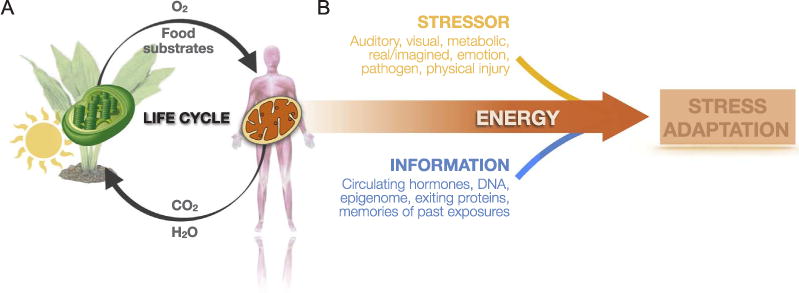
Mitochondria sustain life and enable stress adaptation. (A) Within mammalian cells, mitochondria perform exactly the opposite reaction as the plant chroloroplasts. Powered by solar energy, plants produce oxygen and food substrates (carbohydrates, lipids), which are used within mitochondria to power oxidative phosphorylation and ATP synthesis. In this process, mitochondria release carbon dioxide (CO2) and water (H2O), the substrates required by plants, thus sustaining the cycle of life. (B) Stressors interact with information contained within the organism, such as genetically encoded biological constitution, memories of past events, and the current psycho/physiological state reflected by molecular, neuroendocrine, immune, and metabolic factors. Together, this generates unique adaptive stress responses and behaviors. Without energy, stressors would have no effect on the organism. But in the presence of heat and chemical energy, stressors and information interact in meaningful ways to enable stress adaptation.
Fig. 2
Fig. 2
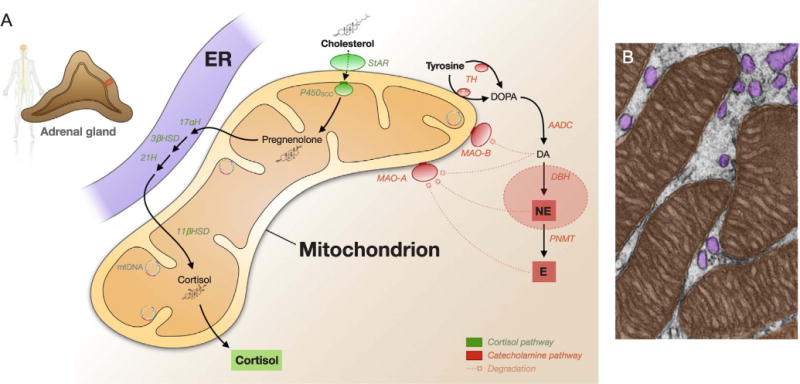
Cortisol and catecholamine metabolism. (A) Steroidogenesis takes place in mitochondria. The first step involves the rate-limiting import of cholesterol into mitochondria by the steroidogenic acute regulatory (StAR) protein, followed by the side chain cleavage to pregnenolone by P450SCC, three enzymatic reactions in the endoplasmic reticulum, and the final 11-β-hydroxylase reaction catalyzing cortisol synthesis in the mitochondrial matrix. Mitochondria are particularly enriched in the adrenal cortex where glucocorticoids are synthesized in response to ACTH. Also shown is the catecholamine pathway which mostly occurs in other cell types, including tyrosine hydroxylase, which may become associate with mitochondrial membranes under some conditions (see text for discussion), and the mitochondria-anchored monoamine oxidases A and B, which degrade catecholamines in specific tissues. Degradation products are not shown. (B) Electron micrograph of the zona fasciculata of the hamster adrenal cortex with pseudocolored mitochondria (orange) and endoplasmic reticulum (purple). Picture modified from (Fawcett, 1981). ER: Endoplasmic reticulum; StAR: Steroidogenic acute regulatory protein; P450SCC: Cytochrome P450 side chain cleavage (Cyp11a1, inner mitochondrial membrane bound); 17αH: 17-alpha hydroxylase; 3βHSD: 3β-hydroxysteroid dehydrogenase; 21H: steroid 21-hydroxylase; 11βHSD: 11-β-hydroxylase; TH: Tyrosine hydroxylase; AADC: Aromatic L-amino acid decarboxylase; DBH: Dopamine β-hydroxylase; PNMT: Phenylethanolamine N-methytransferase; MAO-A/B: Monoamine oxidase A/B.
Fig. 3
Fig. 3
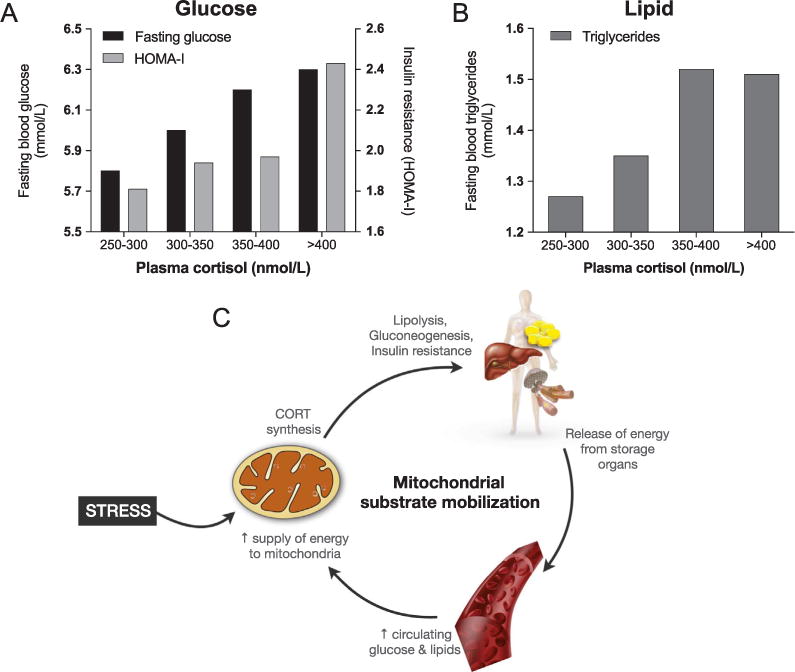
Interplay of primary stress mediators, glucose and lipids, and mitochondria. (A) Fasting blood glucose levels and the homeostatic model assessment of insulin resistance (HOMA-IR) index reflecting insulin resistance, and (B) blood triglycerides as a function of resting plasma cortisol concentration categories. These data reflect dose-response association between glucocorticoids and metabolic stress, in line with the glucose-mobilizing properties of cortisol (CORT). Data are from 286 individuals, adapted from (Phillips et al., 1998). (C) Mitocentric model of mitochondrial substrate mobilization to serve their bioenergetic needs in target tissues. Mitochondria in the adrenal cortex are the source of CORT, whereas mitochondria in other tissues are the recipient of resulting increases in circulating energy substrates used for oxidative phosphorylation, ATP synthesis, and metabolic signaling.
Fig. 4
Fig. 4
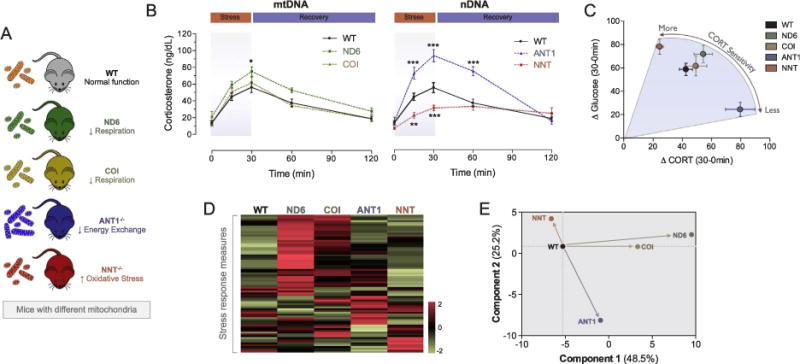
Mitochondrial defects cause unique stress response patterns in mice. (A) Mice with normal mitochondria (wild type, WT) were compared with mice with mitochondrial defects, including four different genes involved in energy production (ND6: respiratory chain Complex I, ND6 subunit; COI: respiratory chain Complex IV, MT-COI subunit), ANT1−/−: energy transfer (adenine nucleotide translator 1, ANT1), and NNT−/−: mitochondrial oxidative stress (nicotinamine nucleotide transhydrogenase, NNT). All mice were exposed to 30 min of restraint stress with sequential tail blood collections. (B) Hypothalamic-pituitary-adrenal (HPA) axis response kinetic indicated by corticosterone (CORT) increase during stress and recovery. (C) This acute stressor also caused hyperglycemia, as expected from the glucose mobilizing properties of CORT. This graph shows the juxtaposition of the stress-induced CORT levels over the first 30 min and the associated increase in circulating blood glucose. Note that the mitochondrial defect causing excess CORT release simultaneously causes the lowest glucose increase, whereas the NNT defect that blunts CORT release causes the highest glucose response. These results indicate an uncoupling of neuroendocrine and metabolic allostasis by mitochondria. (D) Each mitochondrial defect produced a unique stress response signature, here illustrated as a heatmap showing results of an unsupervised hierarchical clustering analysis of gene expression, neuroendocrine, inflammatory, and metabolic measurements (n = 77 parameters). (E) Principal component analysis illustrating qualitatively and quantitatively distinct whole-body stress response patterns for each mitochondrial defect. Figures adapted from (Picard et al., 2015).

References

    1. Adam TC, Epel ES. Stress, eating and the reward system. Physiol Behav. 2007;91:449–458. - PubMed
    1. Ahn Y, Narous M, Tobias R, Rho JM, Mychasiuk R. The ketogenic diet modifies social and metabolic alterations identified in the prenatal valproic acid model of autism spectrum disorder. Dev Neurosci. 2014;36:371–380. - PubMed
    1. Akana SF, Jacobson L, Cascio CS, Shinsako J, Dallman MF. Constant corticosterone replacement normalizes basal adrenocorticotropin (ACTH) but permits sustained ACTH hypersecretion after stress in adrenalectomized rats. Endocrinology. 1988;122:1337–1342. - PubMed
    1. Al-Mehdi AB, Pastukh VM, Swiger BM, Reed DJ, Patel MR, Bardwell GC, Pastukh VV, Alexeyev MF, Gillespie MN. Perinuclear mitochondrial clustering creates an oxidant-rich nuclear domain required for hypoxia-induced transcription. Sci Signal. 2012;5:ra47. - PMC - PubMed
    1. Auron M, Raissouni N. Adrenal insufficiency. Pediatr Rev. 2015;36:92–102. quiz 103, 129. - PubMed

Publication types