. 2018 Jan 16;9(1):e01472-17.
doi: 10.1128/mBio.01472-17.

Immune Protection against Lethal Fungal-Bacterial Intra-Abdominal Infections

Affiliations

Immune Protection against Lethal Fungal-Bacterial Intra-Abdominal Infections

Elizabeth A Lilly et al. mBio. .

Abstract

Polymicrobial intra-abdominal infections (IAIs) are clinically prevalent and cause significant morbidity and mortality, especially those involving fungi. Our laboratory developed a mouse model of IAI and demonstrated that intraperitoneal inoculation with Candida albicans or other virulent non-albicans Candida (NAC) species plus Staphylococcus aureus resulted in 70 to 80% mortality in 48 to 72 h due to robust local and systemic inflammation (sepsis). Surprisingly, inoculation with Candida dubliniensis or Candida glabrata with S. aureus resulted in minimal mortality, and rechallenge of these mice with lethal C. albicans/S. aureus (i.e., coninfection) resulted in >90% protection. The purpose of this study was to define requirements for C. dubliniensis/S. aureus-mediated protection and interrogate the mechanism of the protective response. Protection was conferred by C. dubliniensis alone or by killed C. dubliniensis plus live S. aureusS. aureus alone was not protective, and killed S. aureus compromised C. dubliniensis-induced protection. C. dubliniensis/S. aureus also protected against lethal challenge by NAC plus S. aureus and could protect for a long-term duration (60 days between primary challenge and C. albicans/S. aureus rechallenge). Unexpectedly, mice deficient in T and B cells (Rag-1 knockouts [KO]) survived both the initial C. dubliniensis/S. aureus challenge and the C. albicans/S. aureus rechallenge, indicating that adaptive immunity did not play a role. Similarly, mice depleted of macrophages prior to rechallenge were also protected. In contrast, protection was associated with high numbers of Gr-1hi polymorphonuclear leukocytes (PMNLs) in peritoneal lavage fluid within 4 h of rechallenge, and in vivo depletion of Gr-1+ cells prior to rechallenge abrogated protection. These results suggest that Candida species can induce protection against a lethal C. albicans/S. aureus IAI that is mediated by PMNLs and postulated to be a unique form of trained innate immunity.IMPORTANCE Polymicrobial intra-abdominal infections are clinically devastating infections with high mortality rates, particularly those involving fungal pathogens, including Candida species. Even in patients receiving aggressive antimicrobial therapy, mortality rates remain unacceptably high. There are no available vaccines against IAI, which is complicated by the polymicrobial nature of the infection. IAI leads to lethal systemic inflammation (sepsis), which is difficult to target pharmacologically, as components of the inflammatory response are also needed to control the infection. Our studies demonstrate that prior inoculation with low-virulence Candida species provides strong protection against subsequent lethal infection with C. albicans and S. aureus Surprisingly, protection is long-lived but not mediated by adaptive (specific) immunity. Instead, protection is dependent on cells of the innate immune system (nonspecific immunity) and provides protection against other virulent Candida species. This discovery implies that a form of trained innate immunity may be clinically effective against polymicrobial IAI.

Keywords: Candida albicans; Staphylococcus aureus; immune protection; innate immunity; intra-abdominal infection.


Figures

FIG 1
FIG 1
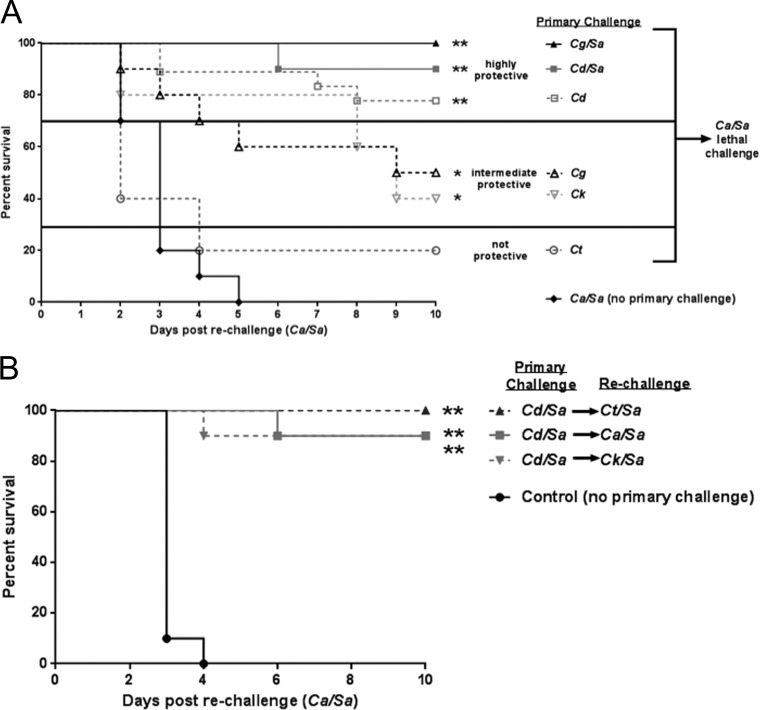
Role of NAC species in protection against lethal polymicrobial IAI. Mice (n = 10/group) were injected i.p. with 3.5 × 10⁷ CFU of C. dubliniensis (Cd) C. glabrata (Cg), C. tropicalis (Ct), or C. krusei (Ck) alone (standard inocula) or in combination with 8 × 10⁷ CFU of S. aureus (Sa) (standard inocula) as a primary challenge, and then rechallenged with C. albicans/S. aureus after 14 days (A) or injected i.p. with C. dubliniensis/S. aureus as the primary challenge and rechallenged with C. albicans (Ca), C. tropicalis, or C. krusei in combination with S. aureus after 14 days (standard inocula) (B). Animals receiving no primary challenge served as the positive (lethal) control. Mice were monitored for 10 days post-rechallenge. Data are representative of 2 separate experiments. *, P < 0.05; **, P < 0.0001 (significantly different from control by log rank Mantel-Cox test).
FIG 2
FIG 2
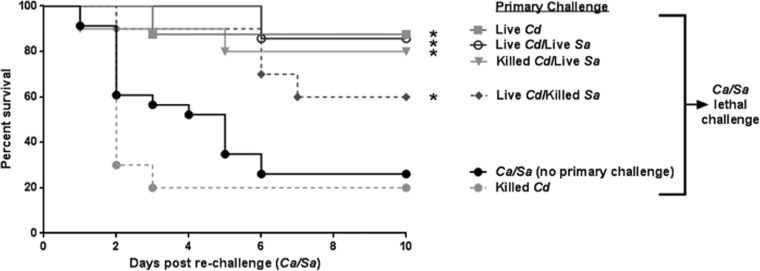
Limits of C. dubliniensis-mediated protection against lethal polymicrobial IAI. Mice (n = 10/group) were injected i.p. with different permutations of viable and nonviable C. dubliniensis and S. aureus as the primary challenge followed by rechallenge with C. albicans/S. aureus (standard inocula). Animals receiving no primary challenge served as the positive (lethal) control. Mice were monitored for 10 days post-rechallenge. Data are representative of 3 separate experiments. *, significantly different from control (P < 0.05) by log rank Mantel-Cox test.
FIG 3
FIG 3
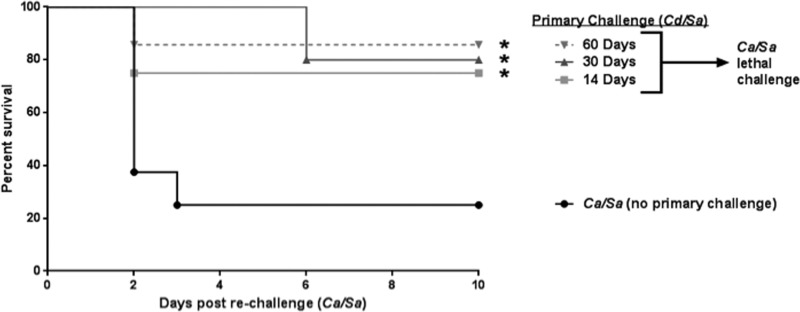
C. dubliniensis induces long term protection against polymicrobial IAI. Mice (n = 10/group) were injected i.p. with C. dubliniensis and S. aureus as the primary challenge 14, 30, and 60 days prior to rechallenge with C. albicans / S. aureus (standard inocula). Animals receiving no primary challenge served as the positive (lethal) control. Mice were monitored for 10 days post-rechallenge. *, significantly different from control (P < 0.05) by log rank Mantel-Cox test.
FIG 4
FIG 4
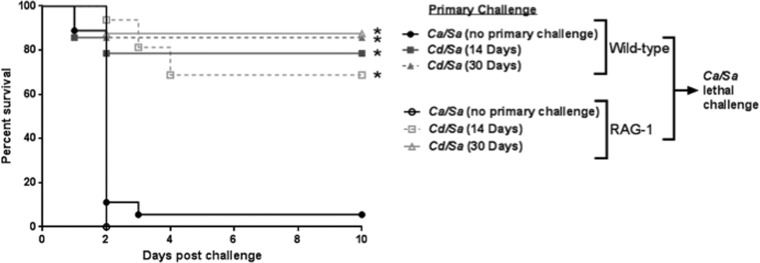
Role of T and B cells in C. dubliniensis-induced protection. RAG mice (deficient in T and B cells) (n = 10) and the background congenic strain, C57BL/6J mice (n = 10) were given the primary challenge of C. dubliniensis and S. aureus 30 days or 14 days prior to rechallenge with C. albicans/S. aureus (standard inocula). Animals receiving no primary challenge served as the positive (lethal) controls. Mice were monitored for 10 days post-rechallenge. *, significantly different from control (P < 0.05) by log rank Mantel-Cox test.
FIG 5
FIG 5
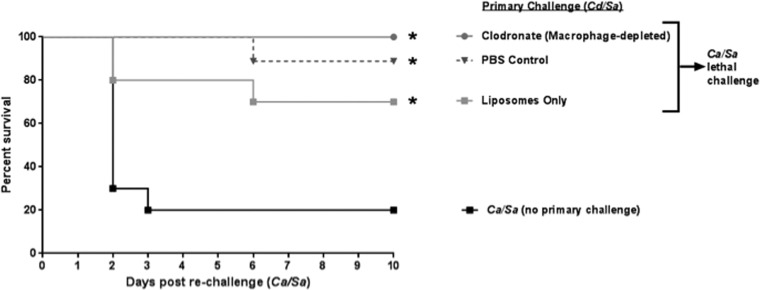
Role of macrophages in C. dubliniensis-induced protection. Mice (n = 10/group) previously given the primary challenge of C. dubliniensis/S. aureus (14 days prior) were injected i.p. with liposome-encapsulated clodronate (which results in ~90% depletion of resident peritoneal macrophages), liposomes only, or PBS 1 day prior to rechallenge with C. albicans/S. aureus. Animals receiving no primary challenge also served as the positive (lethal) controls. Mice were monitored for 10 days post-rechallenge. *, significantly different from control (P < 0.02) by log rank Mantel-Cox test.
FIG 6
FIG 6
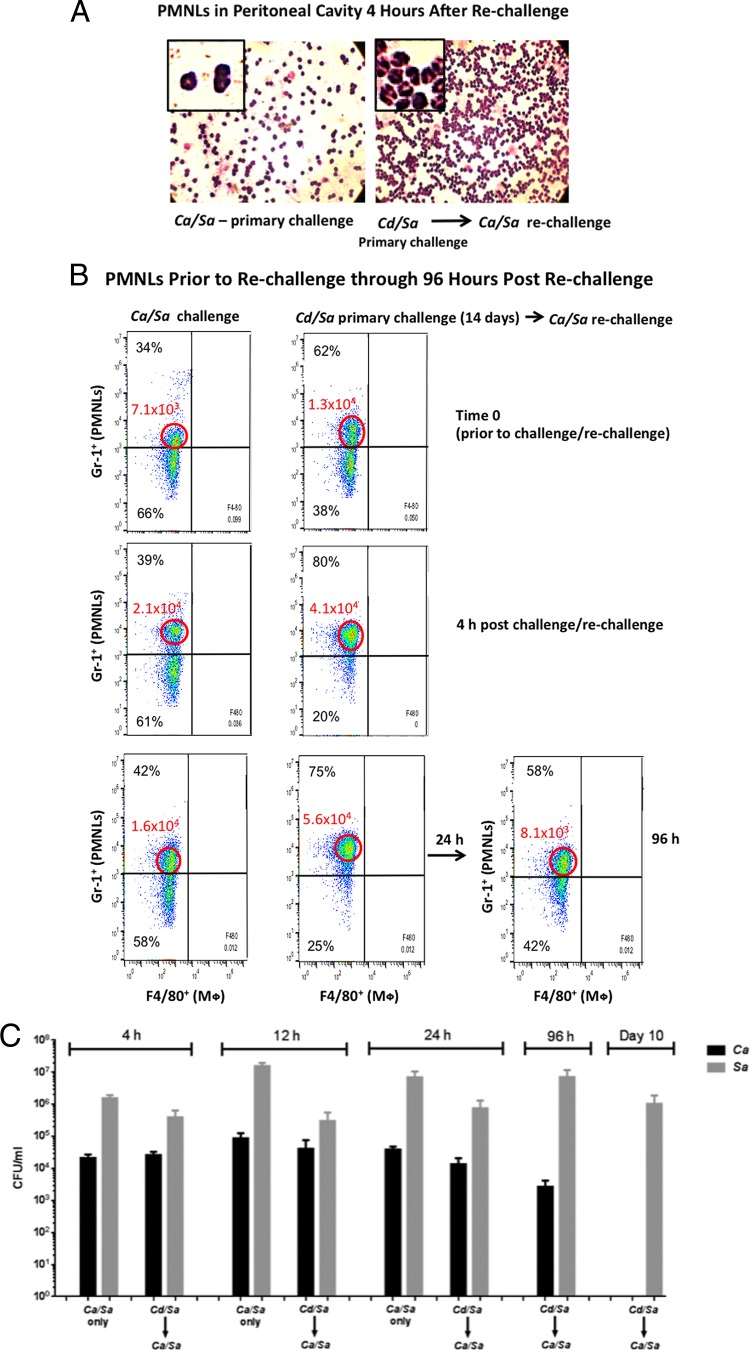
Presence of PMNLs in C. albicans/S. aureus rechallenged, protected animals. Mice (n = 10/group) were given the primary challenge of C. dubliniensis/S. aureus and rechallenged with C. albicans/S. aureus 14 days later. Control mice (n = 10) received no primary challenge. (A) H&E-stained smears of PMNLs from peritoneal lavage fluid collected 4 h after rechallenge. The illustration is representative of several individual mice evaluated. (B) Flow cytometry analysis results of PMNLs from peritoneal lavage fluid prior to rechallenge through 96 h post-rechallenge with C. albicans/S. aureus. Percentages indicate proportions of Gr-1hi PMNLs present in the total cell population. MFI of Gr-1hi PMNLs within the encircled areas are shown in red. The illustration is representative of results for several individual mice evaluated. (C) Microbial burden (C. albicans and S. aureus) in peritoneal lavage fluid of mice 4 h post-rechallenge through 10 days post-rechallenge with C. albicans/S. aureus in those that remained alive. Data are cumulative for all animals from each group. Mφ, macrophage(s).
FIG 7
FIG 7
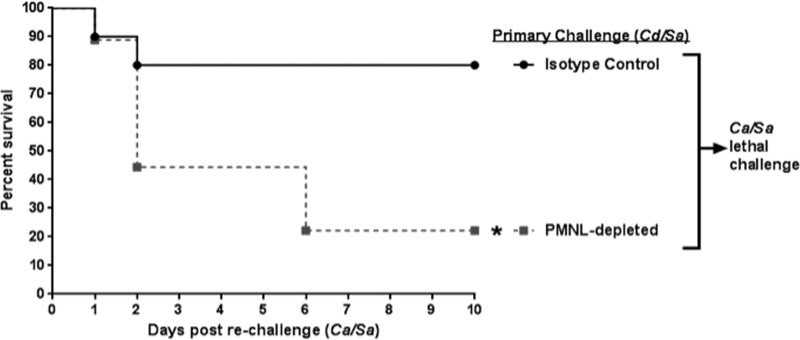
PMNL depletion abrogates protection. Mice (n = 10/group) given the primary challenge of C. dubliniensis/S. aureus were injected i.p. with 200 µg anti-Gr-1 (Ly6G/C) antibodies to deplete PMNLs or isotype control antibodies 48 h prior to and 2 h after rechallenge with C. albicans/S. aureus. Antibodies were given every 2 days to the remaining live animals for the duration of the study. Mice were monitored for 10 days post-rechallenge. *, significantly different from control (P = 0.02) by log rank Mantel-Cox test.

References

    1. Santos SG, Serufo JC, Silva RA, Marra BA, Reis CM, Hamdan JS, Nicoli JR, Carvalho MA, Farias LM. 2003. Microbiologic profile of intra-abdominal infections at Belo Horizonte, Brazil. Am J Infect Control 31:135–143. doi: 10.1067/mic.2003.54. - DOI - PubMed
    1. Saini S, Gupta N, Aparna L, Lokveer MS, Griwan MS. 2004. Surgical infections: a microbiological study. Braz J Infect Dis 8:118–125. doi: 10.1590/S1413-86702004000200001. - DOI - PubMed
    1. Heemken R, Gandawidjaja L, Hau T. 1997. Peritonitis: pathophysiology and local defense mechanisms. Hepatogastroenterology 44:927–936. - PubMed
    1. Cahill RA, Wang JH, Redmond HP. 2007. Enteric bacteria and their antigens may stimulate postoperative peritoneal adhesion formation. Surgery 141:403–410. doi: 10.1016/j.surg.2006.09.010. - DOI - PubMed
    1. Karantonis FF, Nikiteas N, Perrea D, Vlachou A, Giamarellos-Bourboulis EJ, Tsigris C, Kostakis A. 2008. Evaluation of the effects of laparotomy and laparoscopy on the immune system in intra-abdominal sepsis—a review. J Invest Surg 21:330–339. doi: 10.1080/08941930802438914. - DOI - PubMed

Publication types