


Cooperation, clustering, and assortative mixing in dynamic networks
- PMID: 29339478
- PMCID: PMC5798352
- DOI: 10.1073/pnas.1715357115
Cooperation, clustering, and assortative mixing in dynamic networks
Abstract
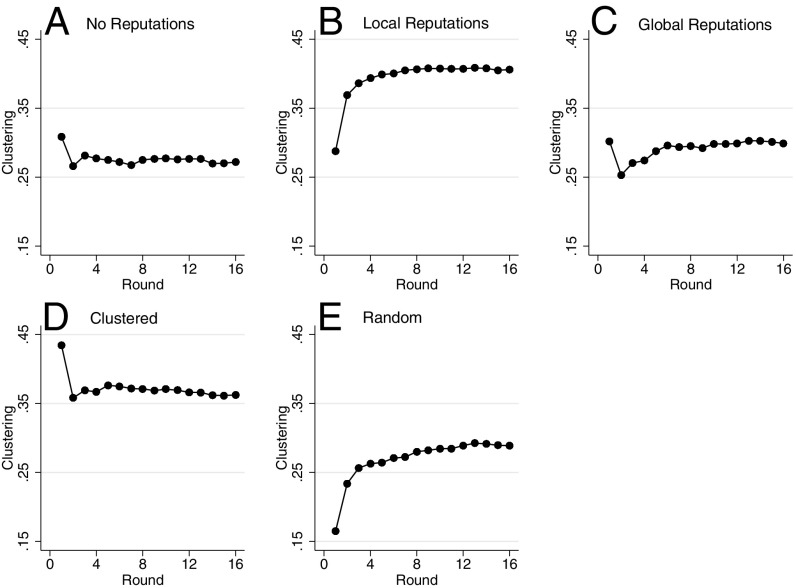
Humans' propensity to cooperate is driven by our embeddedness in social networks. A key mechanism through which networks promote cooperation is clustering. Within clusters, conditional cooperators are insulated from exploitation by noncooperators, allowing them to reap the benefits of cooperation. Dynamic networks, where ties can be shed and new ties formed, allow for the endogenous emergence of clusters of cooperators. Although past work suggests that either reputation processes or network dynamics can increase clustering and cooperation, existing work on network dynamics conflates reputations and dynamics. Here we report results from a large-scale experiment (total n = 2,675) that embedded participants in clustered or random networks that were static or dynamic, with varying levels of reputational information. Results show that initial network clustering predicts cooperation in static networks, but not in dynamic ones. Further, our experiment shows that while reputations are important for partner choice, cooperation levels are driven purely by dynamics. Supplemental conditions confirmed this lack of a reputation effect. Importantly, we find that when participants make individual choices to cooperate or defect with each partner, as opposed to a single decision that applies to all partners (as is standard in the literature on cooperation in networks), cooperation rates in static networks are as high as cooperation rates in dynamic networks. This finding highlights the importance of structured relations for sustained cooperation, and shows how giving experimental participants more realistic choices has important consequences for whether dynamic networks promote higher levels of cooperation than static networks.
Keywords: altruism; cooperation; dynamic networks; network science; reputation.
Conflict of interest statement
The authors declare no conflict of interest.
Figures
References
-
- Kollock P. Social dilemmas: The anatomy of cooperation. Annu Rev Sociol. 1998;24:183–214.
-
- Granovetter M. Economic action and social structure: The problem of embeddedness. Am J Sociol. 1985;91:481–510.
-
- Nakamaru M, Matsuda H, Iwasa Y. The evolution of cooperation in a lattice-structured population. J Theor Biol. 1997;184:65–81. - PubMed
-
- Axelrod R. The Evolution of Cooperation. Basic Books; New York: 1984.
Publication types
MeSH terms
LinkOut - more resources
Full Text Sources
Other Literature Sources
Miscellaneous
