. 2018 Jan 30;115(5):E916-E924.
doi: 10.1073/pnas.1719497115. Epub 2018 Jan 16.

Nonenzymatic release of N7-methylguanine channels repair of abasic sites into an AP endonuclease-independent pathway in Arabidopsis

Affiliations

Nonenzymatic release of N7-methylguanine channels repair of abasic sites into an AP endonuclease-independent pathway in Arabidopsis

Casimiro Barbado et al. Proc Natl Acad Sci U S A. .

Abstract

Abasic (apurinic/apyrimidinic, AP) sites in DNA arise from spontaneous base loss or by enzymatic removal during base excision repair. It is commonly accepted that both classes of AP site have analogous biochemical properties and are equivalent substrates for AP endonucleases and AP lyases, although the relative roles of these two types of enzymes are not well understood. We provide here genetic and biochemical evidence that, in Arabidopsis, AP sites generated by spontaneous loss of N7-methylguanine (N7-meG) are exclusively repaired through an AP endonuclease-independent pathway initiated by FPG, a bifunctional DNA glycosylase with AP lyase activity. Abasic site incision catalyzed by FPG generates a single-nucleotide gap with a 3'-phosphate terminus that is processed by the DNA 3'-phosphatase ZDP before repair is completed. We further show that the major AP endonuclease in Arabidopsis (ARP) incises AP sites generated by enzymatic N7-meG excision but, unexpectedly, not those resulting from spontaneous N7-meG loss. These findings, which reveal previously undetected differences between products of enzymatic and nonenzymatic base release, may shed light on the evolution and biological roles of AP endonucleases and AP lyases.

Keywords: AP endonucleases; AP lyases; N7-methylguanine; abasic sites; base excision repair.


Conflict of interest statement

The authors declare no conflict of interest.

Figures
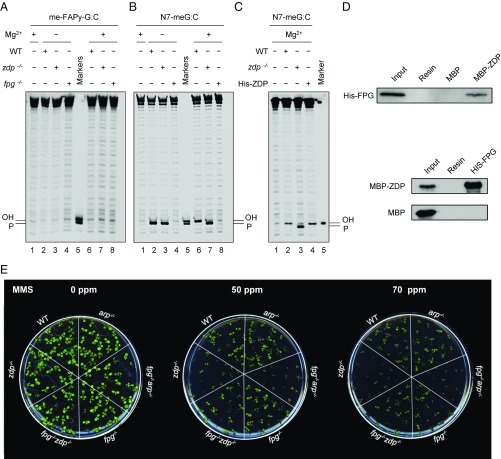
Fig. 1.
Fig. 1.
ZDP 3′-phosphatase functions downstream of FPG DNA glycosylase/lyase during repair of DNA containing N7-meG. (AC) Double-stranded oligonucleotide substrates (20 nM) containing either a single me-FAPy-G:C (A) or an N7-meG:C pair (B and C) were incubated with WT, fpg−/−, or zdp−/− Arabidopsis cell-free extracts for 16 h at 37 °C. Then, MgCl2 (2 mM) was added to reactions and incubation continued for 1 h. When indicated, His-ZDP protein (1.8 nM) was added to zdp−/− extracts. All reaction products were separated by denaturing PAGE and detected by fluorescence scanning. (D) Pull-down assays using either His-FPG (Upper) or MBP-ZDP protein (Lower) as baits. (E) MMS sensitivity assay. Arabidopsis seedlings were grown in MS nutrient agar containing increasing concentrations of MMS and photographs were taken after 14 d of growth.
Fig. 2.
Fig. 2.
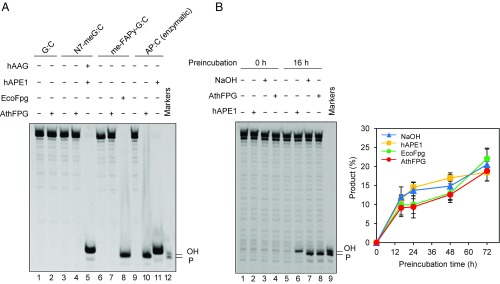
FPG incises AP sites generated by spontaneous depurination of N7-meG. (A) Double-stranded oligonucleotide substrates (20 nM) containing a single lesion opposite C (N7-meG, me-FAPy-G, or AP site generated by uracil excision) were incubated for 2 h at 37 °C with Arabidopsis FPG (10 nM), hAPE1 (1 U), hAAG (2 U), or E. coli Fpg (8 U). (B) A double-stranded oligonucleotide substrate containing a single N7-meG:C pair was preincubated in DNA incision assay buffer (Methods) at 37 °C for the indicated times and then treated with human APE1 (1 U), E. coli Fpg (8 U), or Arabidopsis FPG (10 nM) for 1 h at 37 °C, or with NaOH (15 mM) for 10 min. at 70 °C. After stabilization with NaBH4, reaction products were separated by denaturing PAGE and detected by fluorescence scanning. Values are means with SEs from three independent experiments.
Fig. 3.
Fig. 3.
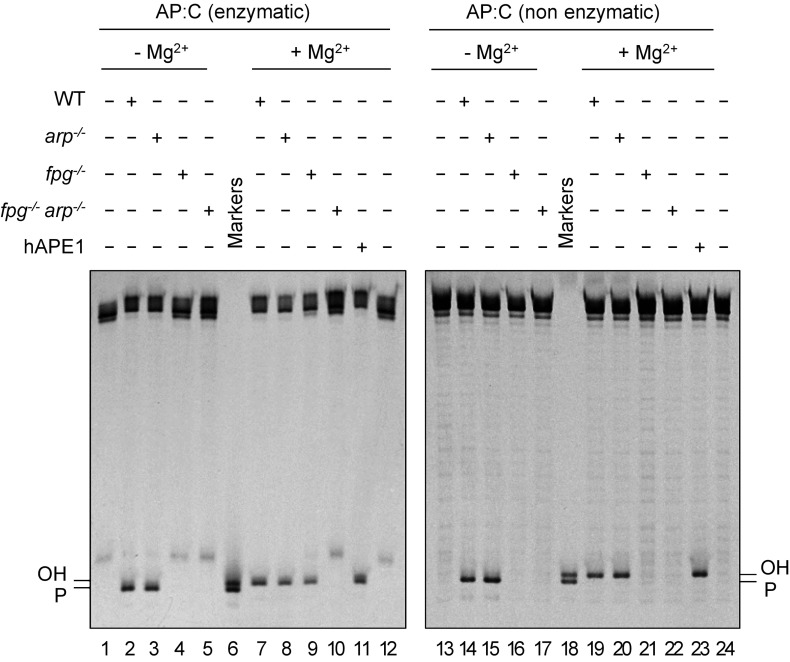
ARP plays a negligible role in repair of depurinated N7-meG. DNA substrates (20 nM) were a 9:1 mixture of homoduplex G:C and heteroduplex AP:C generated either by uracil excision (enzymatic AP:C, Left) or by spontaneous N7-meG depurination (nonenzymatic AP:C, Right). Similar concentrations of each type of AP site were verified by incision with hAPE1 (10 U) (lanes 11 and 23). Substrates were incubated with Arabidopsis cell-free extracts (8 µg) for 1 h at 37 °C. After stabilization with NaBH4, reaction products were separated by denaturing PAGE and detected by fluorescence scanning.
Fig. 4.
Fig. 4.
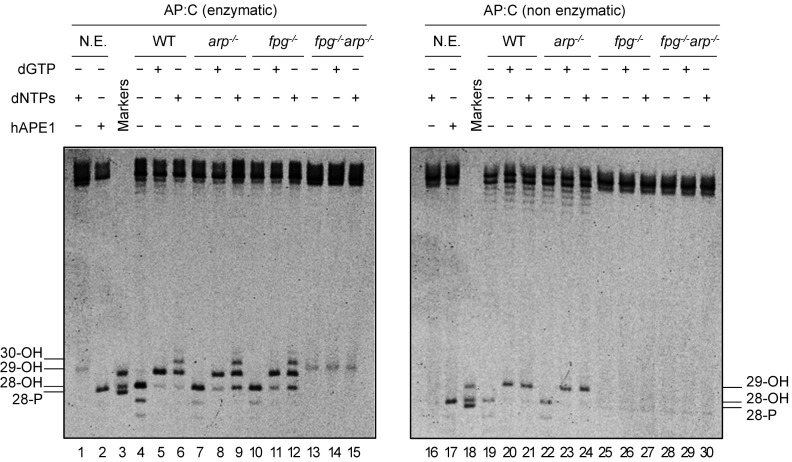
Depurinated N7-meG is repaired through FPG-dependent SP-BER. DNA substrates (20 nM) were a 9:1 mixture of homoduplex G:C and heteroduplex AP:C generated either by uracil excision (enzymatic AP:C, Left) or by spontaneous N7-meG depurination (nonenzymatic AP:C, Right). Similar concentrations of each type of AP site were verified by incision with hAPE1 (10 U) (lanes 2 and 17). Substrates were incubated with Arabidopsis cell-free extracts (8 µg) for 1 h at 37 °C with or without either dGTP or all four dNTPs. After stabilization with NaBH4, reaction products were separated by denaturing PAGE and detected by fluorescence scanning. N.E., nonextract.
Fig. 5.
Fig. 5.
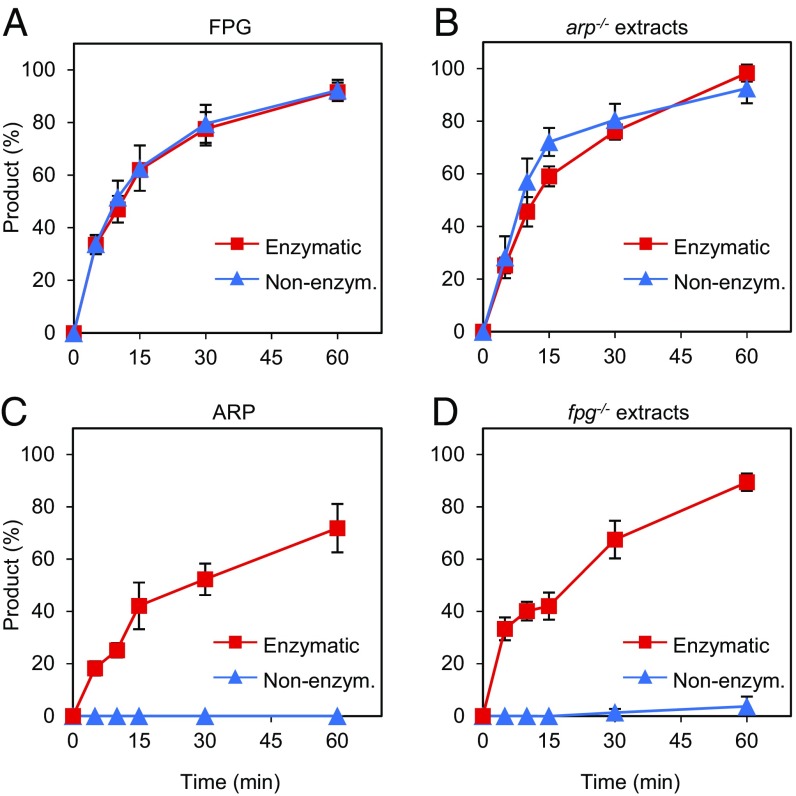
ARP discriminates between AP sites generated by enzymatic and nonenzymatic release of N7-meG. DNA substrates (20 nM) were a 9:1 mixture of homoduplex G:C and heteroduplex AP:C generated either by spontaneous N7-meG depurination (nonenzymatic, blue triangles), or N7-meG excision by hAAG (enzymatic, red squares). Substrates were incubated either with purified proteins [(A) FPG: 0.5 nM; (C) ARP: 10 nM] or Arabidopsis cell-free extracts [(B) arp−/−: 8 µg; (D) fpg−/−: 8 µg]. Reactions for detection of AP endonuclease activity (C and D) were supplemented with 2 mM MgCl2. After stabilization with NaBH4, reaction products were separated by denaturing PAGE and detected by fluorescence scanning. Values are means with SEs from three independent experiments.
Fig. 6.
Fig. 6.
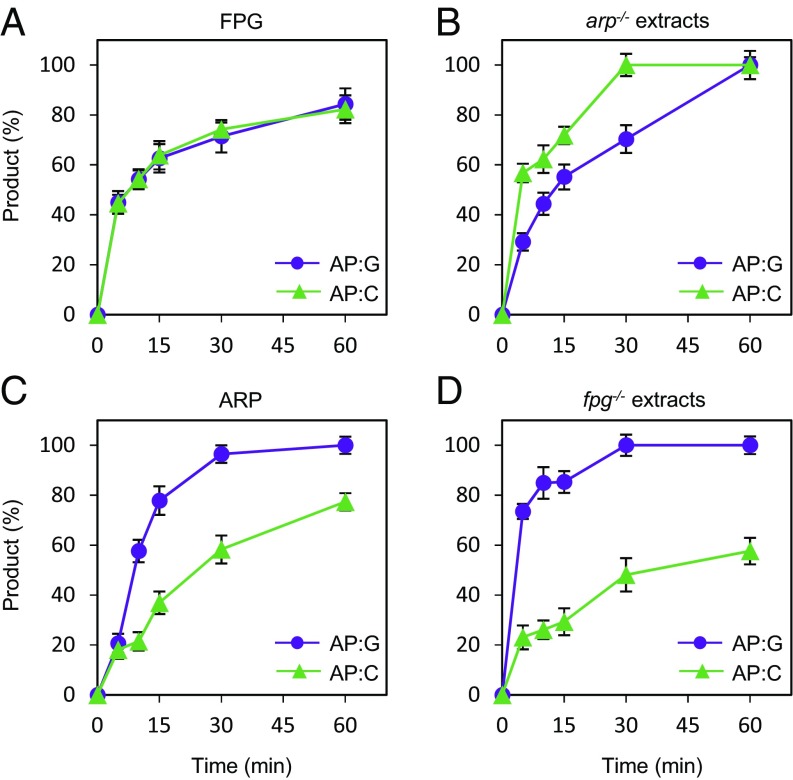
Identity of the base opposite the abasic site influences the choice between AP endonuclease- and AP lyase-mediated repair. DNA substrates (2 nM) contained either a single AP:G (purple circles) or AP:C (green triangles), both generated by uracil excision. Substrates were incubated either with purified proteins [(A) FPG: 0.5 nM; (C) ARP: 10 nM] or Arabidopsis cell-free extracts [(B) arp−/−: 8 µg; (D) fpg−/−: 8 µg]. Reactions for detection of AP endonuclease activity (C and D) were supplemented with 2 mM MgCl2. After stabilization with NaBH4, reaction products were separated by denaturing PAGE and detected by fluorescence scanning. Values are means with SEs from two independent experiments.
Fig. 7.
Fig. 7.
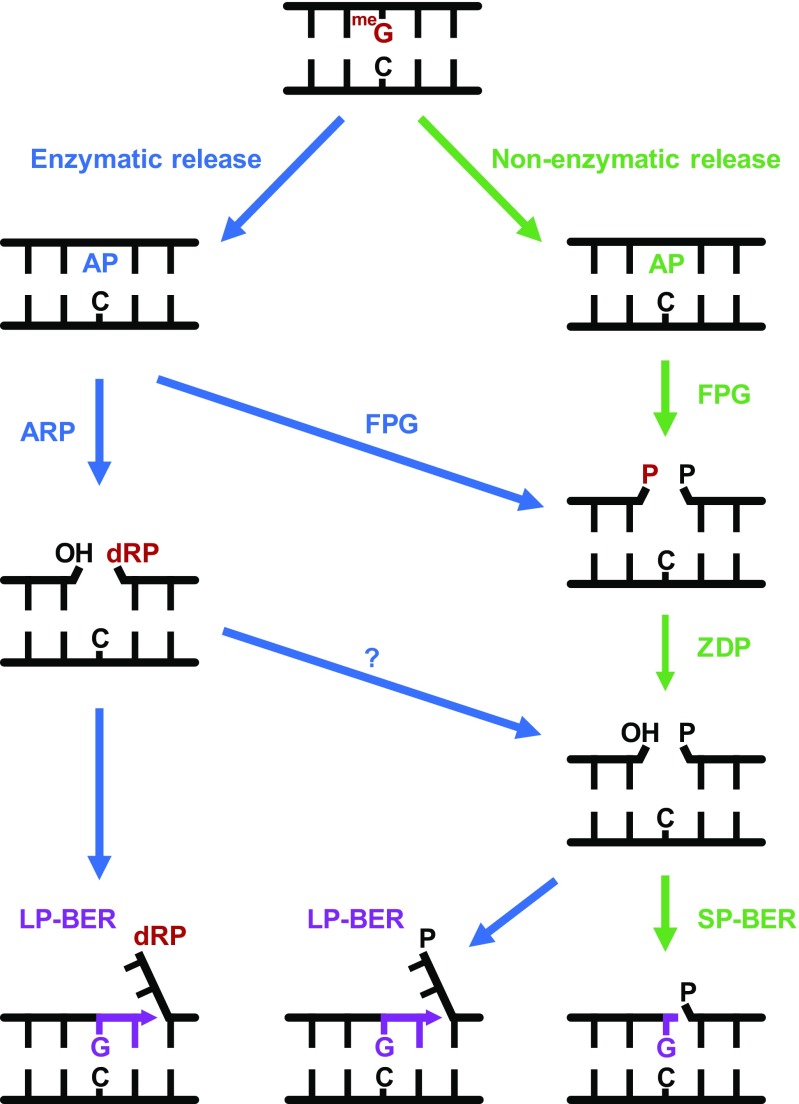
A model for repair of AP sites arising from enzymatic and nonenzymatic release of N7-meG. FPG incises AP sites generated by spontaneous release of N7-meG, generating a single-nucleotide gap with a 3′-P terminus that is processed by ZDP to generate a 3′-OH terminus. Repair is continued through SP-BER. AP sites generated by enzymatic release of N7-meG may be incised by both ARP and FPG, and repair may be continued by either SP- or LP-BER. See text for details.

References

    1. Lindahl T. Instability and decay of the primary structure of DNA. Nature. 1993;362:709–715. - PubMed
    1. Lindahl T, Nyberg B. Rate of depurination of native deoxyribonucleic acid. Biochemistry. 1972;11:3610–3618. - PubMed
    1. Lindahl T. DNA glycosylases, endonucleases for apurinic/apyrimidinic sites, and base excision-repair. Prog Nucleic Acid Res Mol Biol. 1979;22:135–192. - PubMed
    1. Krokan HE, Bjørås M. Base excision repair. Cold Spring Harb Perspect Biol. 2013;5:a012583. - PMC - PubMed
    1. Talpaert-Borlé M. Formation, detection and repair of AP sites. Mutat Res. 1987;181:45–56. - PubMed

Publication types