. 2018 Jan 16;8(1):830.
doi: 10.1038/s41598-018-19151-1.

Postural adaptations to unilateral knee joint hypomobility induced by orthosis wear during gait initiation

Affiliations

Postural adaptations to unilateral knee joint hypomobility induced by orthosis wear during gait initiation

A Delafontaine et al. Sci Rep. .

Abstract

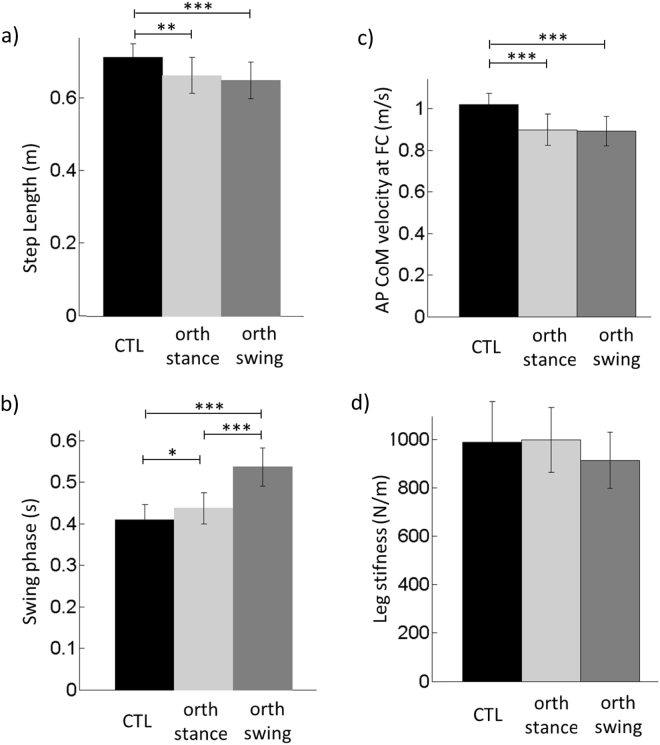
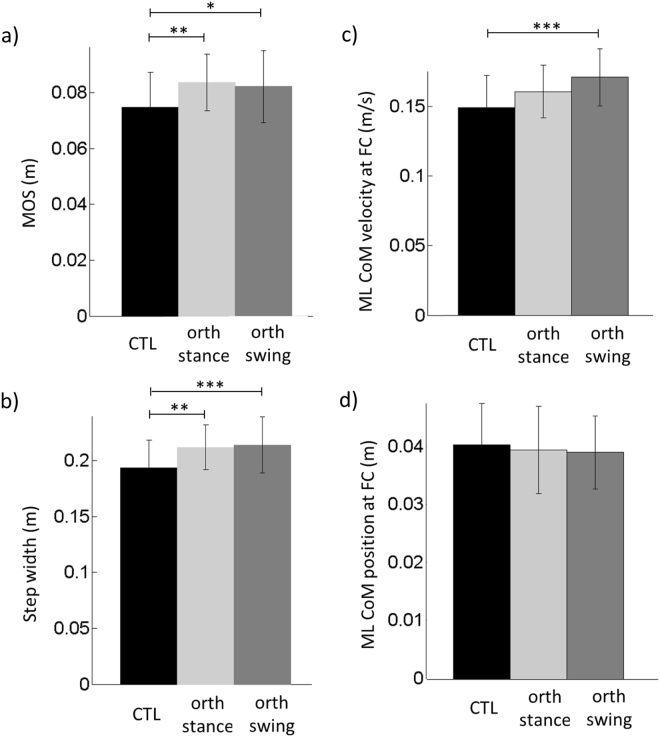
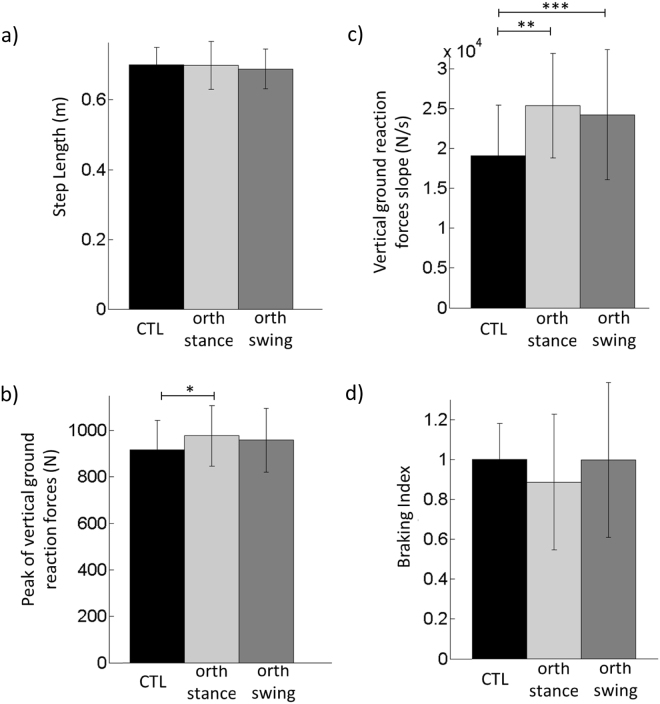
Balance control and whole-body progression during gait initiation (GI) involve knee-joint mobility. Single knee-joint hypomobility often occurs with aging, orthopedics or neurological conditions. The goal of the present study was to investigate the capacity of the CNS to adapt GI organization to single knee-joint hypomobility induced by the wear of an orthosis. Twenty-seven healthy adults performed a GI series on a force-plate in the following conditions: without orthosis ("control"), with knee orthosis over the swing leg ("orth-swing") and with the orthosis over the contralateral stance leg ("orth-stance"). In orth-swing, amplitude of mediolateral anticipatory postural adjustments (APAs) and step width were larger, execution phase duration longer, and anteroposterior APAs smaller than in control. In orth-stance, mediolateral APAs duration was longer, step width larger, and amplitude of anteroposterior APAs smaller than in control. Consequently, step length and progression velocity (which relate to the "motor performance") were reduced whereas stability was enhanced compared to control. Vertical force impact at foot-contact did not change across conditions, despite a smaller step length in orthosis conditions compared to control. These results show that the application of a local mechanical constraint induced profound changes in the global GI organization, altering motor performance but ensuring greater stability.


Conflict of interest statement

The authors declare that they have no competing interests.

Figures
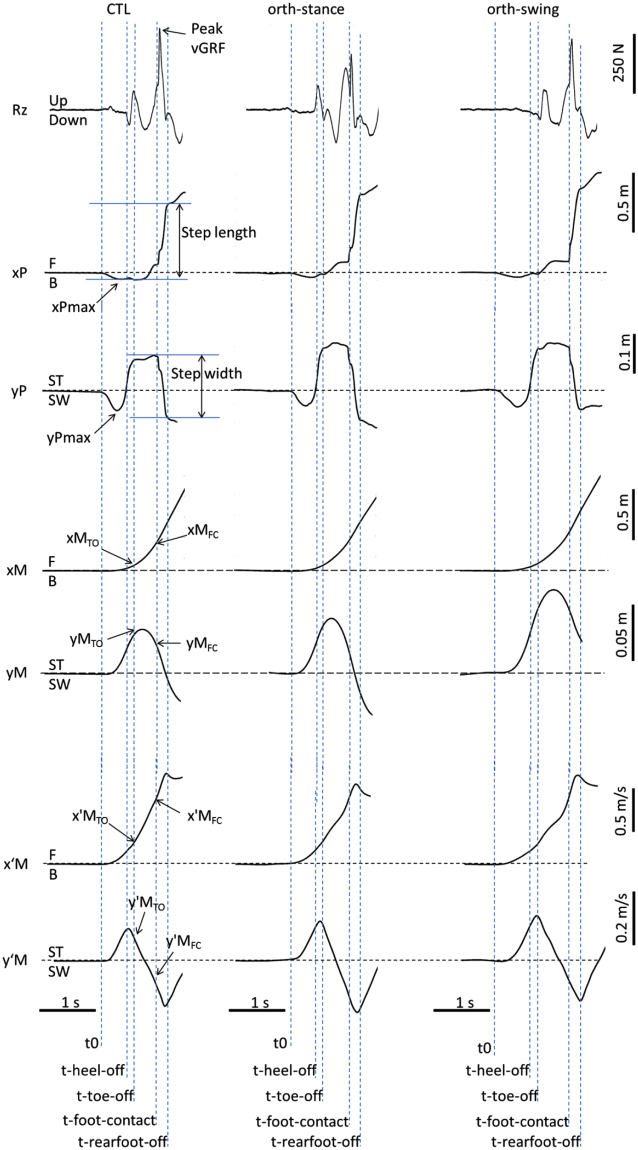
Figure 1
Figure 1
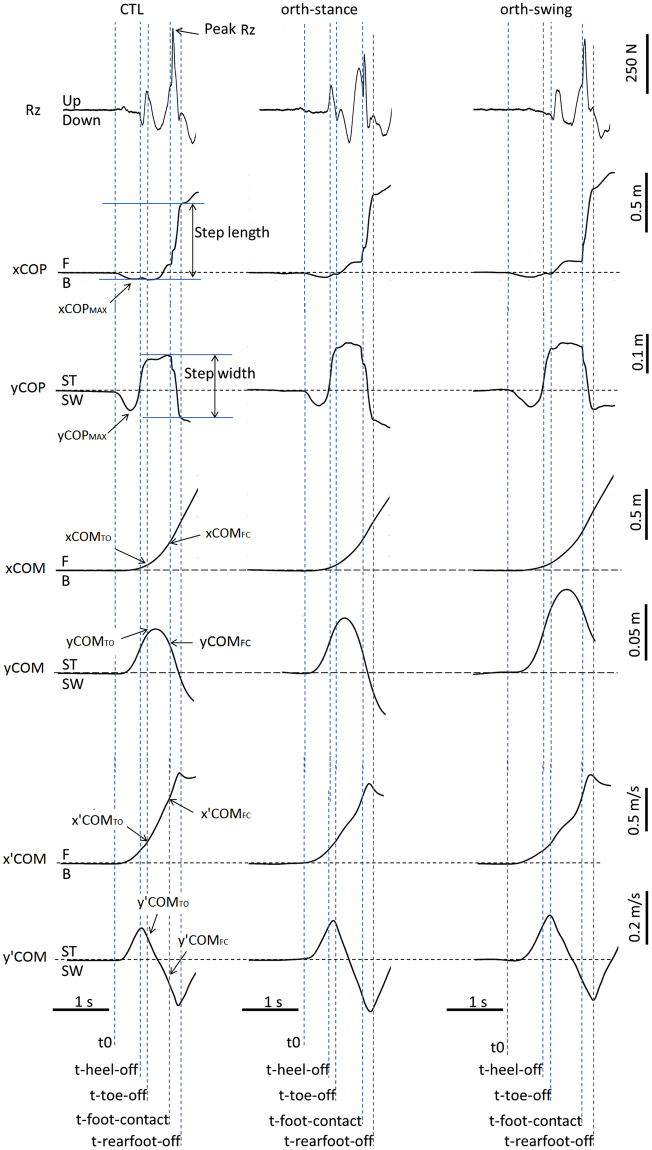
Typical biomechanical traces in the three experimental conditions of the main experiment (one representative participant). Rz is the vertical ground reaction force. xCOP, xCOM and x’COM are respectively the center of pressure (COP) displacement, the COM displacement and COM velocity along the x axis which corresponded to the anteroposterior axis. xCOPMAX, xCOMTO, xCOMFC are respectively the peak of the COP position reached during APAs, the COM position at toe off (TO) and the COM position at foot contact (FC). yCOP, yCOM and y’COM are respectively the COP displacement, the COM displacement and the COM velocity along the y axis which corresponded to the mediolateral axis. B and F are respectively the backward and forward directions. SW and ST are respectively the swing and stance limbs. t0, t-heel-off, t-toe-off, t-foot-contact and t-rear foot-off are respectively the instants of gait initiation onset, swing heel-off, swing toe-off, swing foot-contact and rear foot-off.
Figure 2
Figure 2
Comparison of selected APAs parameters between the three conditions in the main experiment. Reported are mean values (all participants together) ±1 SD. *, ** and *** indicates a significant difference between bars with respectively p < 0.05, p < 0.01 and p < 0.001.
Figure 3
Figure 3
Comparison of execution phase related parameters between the three conditions in the main experiment. Reported are mean values (all participants together) ±1 SD. *, ** and *** indicates a significant difference between bars with respectively p < 0.05, p < 0.01 and p < 0.001.
Figure 4
Figure 4
Comparison of stability related parameters between the three conditions in the main experiment. Reported are mean values (all participants together) ±1 SD. *, ** and *** indicates a significant difference between bars with respectively p < 0.05, p < 0.01 and p < 0.001. MOS is the Margin Of Stability.
Figure 5
Figure 5
Comparison of step length and vertical force impact related variables between the three conditions in the complementary experiment. Reported are mean values (all participants together) ±1 SD. *, ** and *** indicates a significant difference between bars with respectively p < 0.05, p < 0.01 and p < 0.001.
Figure 6
Figure 6
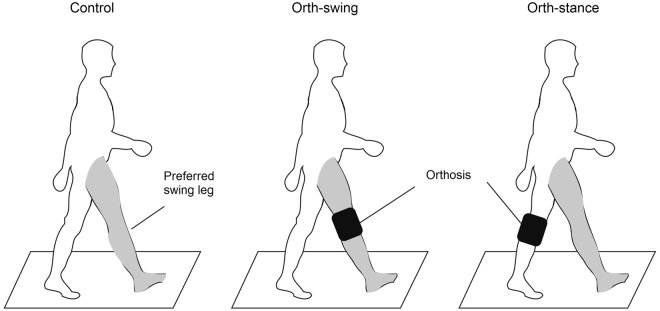
Illustration of the three experimental conditions. The orthosis was positioned over the knee of the stepping leg in the “orth-swing” condition and over the knee of the stance leg in the “orth-stance” condition.
Figure 7
Figure 7
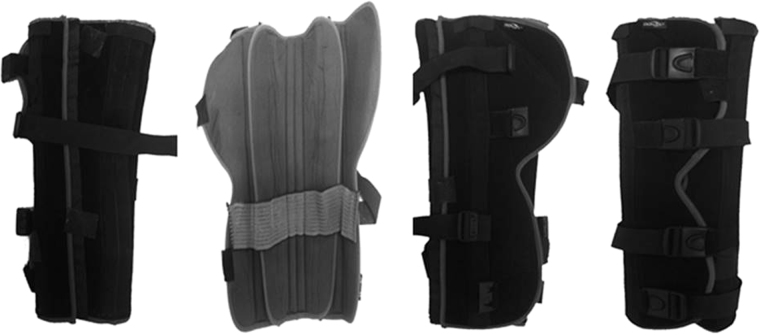
Postoperative knee orthosis (Donjoy®, referee AT43V).

References

    1. Brenière Y, Do MC, Bouisset S. Are dynamic phenomena prior to stepping essential to walking? J. Mot. Behav. 1987;19(1):62–76. doi: 10.1080/00222895.1987.10735400. - DOI - PubMed
    1. Honeine JL, Schieppati M, Gagey O, Do MC. By counteracting gravity, triceps surae sets both kinematics and kinetics of gait. Physiol. Rep. 2014;2(2):e00229. doi: 10.1002/phy2.229. - DOI - PMC - PubMed
    1. Mann RA, Hagy JL, White V, Liddell D. The initiation of gait. J. Bone Joint Surg. 1979;61:A:232–239. doi: 10.2106/00004623-197961020-00011. - DOI - PubMed
    1. Nissan M, Whittle MW. Initiation of gait in normal subjects: a preliminary study. J. Biomed. Eng. 1990;12(2):165–171. doi: 10.1016/0141-5425(90)90139-E. - DOI - PubMed
    1. Yiou E, Artico R, Teyssedre CA, Labaune O, Fourcade P. Anticipatory postural control of stability during gait initiation over obstacles of different height and distance made under reaction-time and self-initiated instructions. Front. Hum. Neurosci. 2016;10:449. doi: 10.3389/fnhum.2016.00449. - DOI - PMC - PubMed