


Does the CDC Definition of Fever Accurately Predict Inflammation and Infection in Persons With SCI?
- PMID: 29339867
- PMCID: PMC5108510
- DOI: 10.1310/sci2016-00049
Does the CDC Definition of Fever Accurately Predict Inflammation and Infection in Persons With SCI?
Abstract
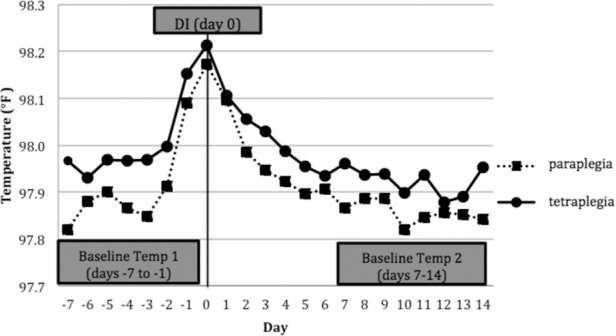
Background: Pneumonia and septicemia have the greatest impact on reduced life expectancy in persons with spinal cord injury (SCI). Fever is often the first presenting symptom of infection or inflammation. Thermoregulatory dysfunction in persons with SCI may preclude a typical febrile response to infection or inflammation and thus delay diagnostic workup. Objective: To determine the core temperature of persons with SCI in the setting of infection or inflammation and the frequency with which it meets criteria for the CDC definition of fever (>100.4°F). Methods: Retrospective review of hospitalized SCI patients over 5 years with a diagnosis of infection or inflammation (DI), defined by serum leukocytosis. In this study, 458 persons with paraplegia (PP) and 483 persons with tetraplegia (TP) had 4,191 DI episodes. Aural temperatures (Tau) on the day of DI, 7 days prior, and 14 days afterwards were abstracted from medical records. Main outcome measures were average Tau at DI, frequency of temperatures >100.4°F at DI, and average baseline temperatures before and after DI. Results: Average Tau at DI was 98.2°F (±1.5) and 98.2°F (±1.4) in the TP and PP groups, respectively, with only 11.6% to 14% of DI resulting in Tau >100.4°F. Baseline temperatures ranged from 97.9°F (±0.7) to 98.0°F (±0.8). Conclusion: SCI persons with leukocytosis infrequently mount a fever as defined by the CDC, and baseline temperatures were subnormal (<98.6°F). Thermoregulatory dysfunction likely accounts for these findings. Tau >100.4°F is not a sensitive predictor of infection or inflammation in persons with SCI. Clinicians should be vigilant for alternative symptoms of infection and inflammation in these patients, so diagnostic workup is not delayed.
Keywords: aural temperature; fever; infection; inflammation; spinal cord injury; thermoregulation.
Figures

References
-
- National Spinal Cord Injury Statistical Center. . Facts and Figures at a Glance. Birmingham, AL: University of Alabama at Birmingham; 2015.
-
- DeVivo MJ, Black KJ, Stover SL.. Causes of death during the first 12 years after spinal cord injury. Arch Phys Med Rehabil. 1993; 74( 3): 248– 254. - PubMed
-
- Cardenas DD, Hoffman JM, Kirshblum S, McKinley W.. Etiology and incidence of rehospitalization after traumatic spinal cord injury: A multicenter analysis. Arch Phys Med Rehabil. 2004; 85( 11): 1757– 1763. - PubMed
-
- Winslow C, Bode RK, Felton D, Chen D, Meyer PR Jr.. Impact of respiratory complications on length of stay and hospital costs in acute cervical spine injury. Chest. 2002; 121( 5): 1548– 1554. - PubMed
MeSH terms
LinkOut - more resources
Full Text Sources
Other Literature Sources
Medical
Miscellaneous