


Study on the Effectiveness of Virtual Reality Game-Based Training on Balance and Functional Performance in Individuals with Paraplegia
- PMID: 29339902
- PMCID: PMC5562034
- DOI: 10.1310/sci16-00003
Study on the Effectiveness of Virtual Reality Game-Based Training on Balance and Functional Performance in Individuals with Paraplegia
Abstract
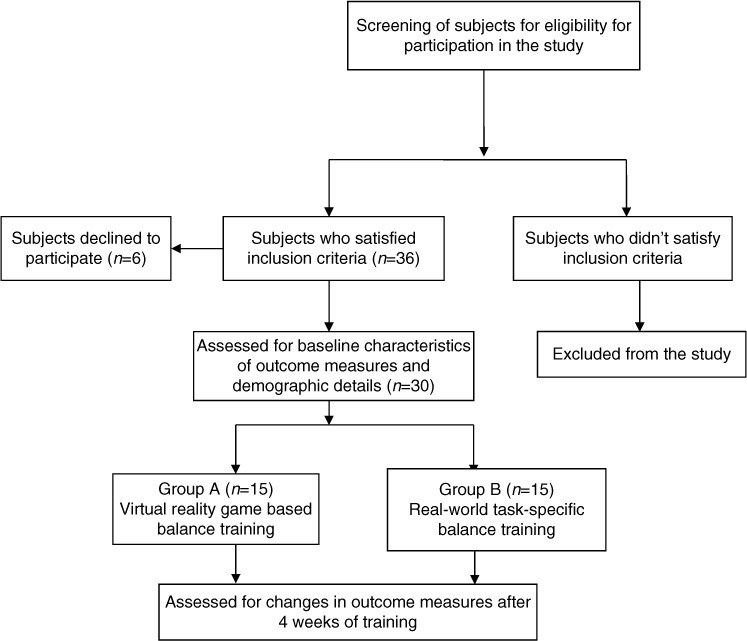
Objective: To determine whether there is any difference between virtual reality game-based balance training and real-world task-specific balance training in improving sitting balance and functional performance in individuals with paraplegia. Methods: The study was a pre test-post test experimental design. There were 30 participants (28 males, 2 females) with traumatic spinal cord injury randomly assigned to 2 groups (group A and B). The levels of spinal injury of the participants were between T6 and T12. The virtual reality game-based balance training and real-world task-specific balance training were used as interventions in groups A and B, respectively. The total duration of the intervention was 4 weeks, with a frequency of 5 times a week; each training session lasted 45 minutes. The outcome measures were modified Functional Reach Test (mFRT), t-shirt test, and the self-care component of the Spinal Cord Independence Measure-III (SCIM-III). Results: There was a significant difference for time (p = .001) and Time × Group effect (p = .001) in mFRT scores, group effect (p = .05) in t-shirt test scores, and time effect (p = .001) in the self-care component of SCIM-III. Conclusions: Virtual reality game-based training is better in improving balance and functional performance in individuals with paraplegia than real-world task-specific balance training.
Keywords: balance; paraplegia; rehabilitation; self-care; virtual reality.
References
-
- Somers MF. Spinal Cord Injury: Functional Rehabilitation. Englewood Cliffs, NJ: Appleton and Lange; 1992.
-
- Westgren N, Levi R.. Quality of life and traumatic spinal cord injury. Arch Phys Med Rehabil. 1998; 79: 1433– 1439. - PubMed
-
- Chen CL, Yeung KT, Bih LI, Wang CH, Chen MI, Chien JC.. The relationship between sitting stability and functional performance in patients with paraplegia. Arch Phys Med Rehabil. 2003; 84: 1276– 1281. - PubMed
-
- Thompson M, Medley A.. Forward and lateral sitting functional reach in younger, middle-aged, and older adults. J Geriatr Phys Ther. 2007; 30: 43– 48. - PubMed
-
- Kaminski TR, Bock C, Gentile AM.. The coordination between trunk and arm motion during pointing movements. Exp Brain Res. 1995; 106: 457– 466. - PubMed
MeSH terms
LinkOut - more resources
Full Text Sources
Other Literature Sources
Medical