


Examining relationships between perceptions and objective assessments of neighborhood environment and sedentary time: Data from the Washington, D.C. Cardiovascular Health and Needs Assessment
- PMID: 29340269
- PMCID: PMC5766749
- DOI: 10.1016/j.pmedr.2017.12.002
Examining relationships between perceptions and objective assessments of neighborhood environment and sedentary time: Data from the Washington, D.C. Cardiovascular Health and Needs Assessment
Abstract
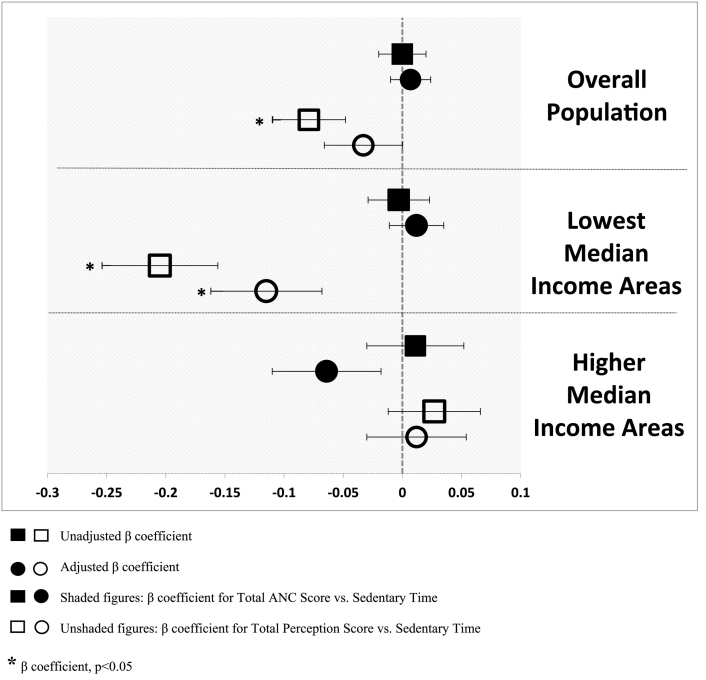
Sedentary time (ST) and neighborhood environment (NE) are predictors of cardiovascular (CV) health. However, little is known about ST's relationship with NE. We examined associations of perceived and objective NE with ST in the predominantly African American faith-based population of the Washington, D.C. CV Health and Needs Assessment. After using community-based research principles, participants reported NE perceptions, including sidewalks, recreational areas, and crime presence. Factor analysis was conducted to explore pertinent constructs; factor sums were created and combined as Total Perception Score (TPS) (higher score = more favorable perception). Objective NE was assessed using Google Maps and the Active Neighborhood Checklist (ANC). ST was self-reported. Linear regression determined relationships between TPS and ST, and ANC scores and ST, for 1) overall population, 2) lower median-income D.C. areas, and 3) higher median-income DC and Maryland areas. For the sample (N = 98.9% African-American, 78% female), lower median-income areas had significantly lower mean TPS and ANC scores than higher median-income areas (p < 0.001). Three factors (neighborhood violence, physical/social environment, and social cohesion) were associated with overall NE perception. Among those in lower median-income areas, there was a negative association between TPS and ST that remained after covariate adjustment; this was not observed in higher median-income areas. There was no association between ANC scores and ST. Poorer NE perception is associated with greater ST for those in lower income areas, while objective environment is not related to ST. Multi-level interventions are needed to improve NE perceptions in lower-median income areas, reduce ST, and improve CV health.
Keywords: Community-based participatory research; Neighborhood; Sedentary lifestyle.
Figures
References
-
- Armstrong T., Bull F. Development of the World Health Organization Global Physical Activity Questionnaire (GPAQ) J. Public Health. 2006;14(2):66–70.
-
- Ball K., Jeffery R.W., Crawford D.A., Roberts R.J., Salmon J., Timperio A.F. Mismatch between perceived and objective measures of physical activity environments. Prev. Med. 2008;47(3):294–298. - PubMed
-
- Borodulin K., Kärki A., Laatikainen T., Peltonen M., Luoto R. Daily sedentary time and risk of cardiovascular disease: the national FINRISK 2002 study. J. Phys. Act. Health. 2015;12(7):904–908. - PubMed
Grants and funding
LinkOut - more resources
Full Text Sources
Other Literature Sources
