Review
. 2018 Apr;9(2):82-94.
doi: 10.1007/s12672-017-0314-5. Epub 2018 Jan 16.

Harnessing a Different Dependency: How to Identify and Target Androgen Receptor-Positive Versus Quadruple-Negative Breast Cancer

Affiliations
Review

Harnessing a Different Dependency: How to Identify and Target Androgen Receptor-Positive Versus Quadruple-Negative Breast Cancer

Jessica L Christenson et al. Horm Cancer. 2018 Apr.

Abstract

The androgen receptor (AR) is a promising therapeutic target for a subset of triple-negative breast cancers (TNBCs) in which AR is expressed. However, the mechanistic action of AR and the degree to which primary and metastatic tumors depend on AR, both before and after conventional treatment, remain to be defined. We discuss preclinical and clinical data for AR+ TNBC, the difficulties in monitoring AR protein levels, new methods for determining AR status, the influence of AR on "stemness" in the context of TNBC, the role of combined inhibition of sex steroid production and AR, and the role of AR in regulation of the immune system. Although the exact role of AR in subsets of TNBC is still being characterized, new therapies that target AR and the production of androgens may provide additional options for patients with TNBC for whom chemotherapy is currently the sole treatment option.


Conflict of interest statement

JRE and ESBB declare that they are employed by and have stock ownership in Innocrin Pharmaceuticals, Inc. All other authors declare that they have no potential conflict of interest.

Figures
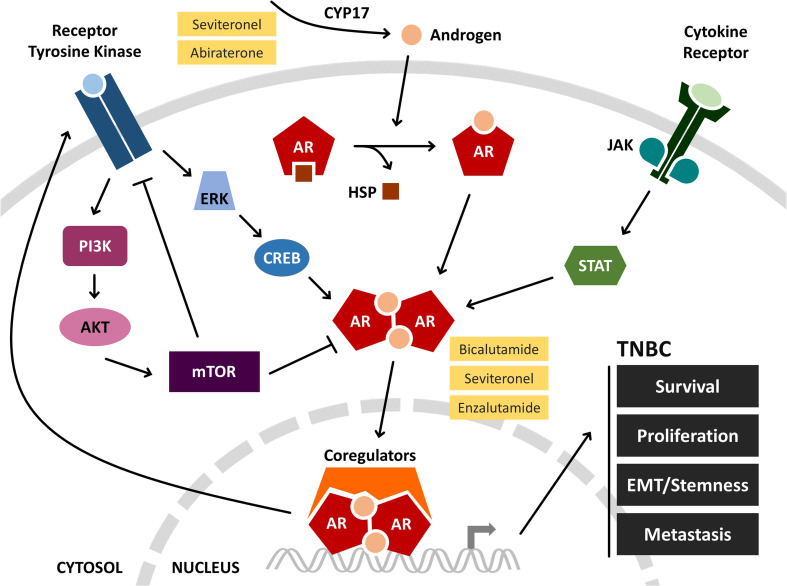
Fig. 1
Fig. 1
AR signaling and therapeutic interventions in TNBC. Androgen synthesis is catalyzed by the enzyme CYP17. Binding of androgens to AR causes dissociation from HSP and AR dimerization. AR dimers translocate to the nucleus, associate with coregulatory proteins, and initiate transcription. In TNBC, AR signaling promotes cancer progression, and this can be blocked at various stages with pharmacological inhibitors (yellow). Cross-talk between AR and other signaling pathways is being used to establish rational drug combinations that are currently being explored for their effectiveness. Interconnecting lines are indicative of overall effects, positive or negative, on pathway activation. AKT protein kinase B, AR androgen receptor, CREB cAMP response element-binding protein, CYP17 cytochrome P450 17, EMT epithelial-to-mesenchymal transition, ERK extracellular signal-regulated kinase, HSP heat shock protein, JAK Janus kinase, PI3K phosphatidylinositide 3-kinase, mTOR mechanistic target of rapamycin, STAT signal transducer and activator of transcription, TNBC triple-negative breast cancer
Fig. 2
Fig. 2
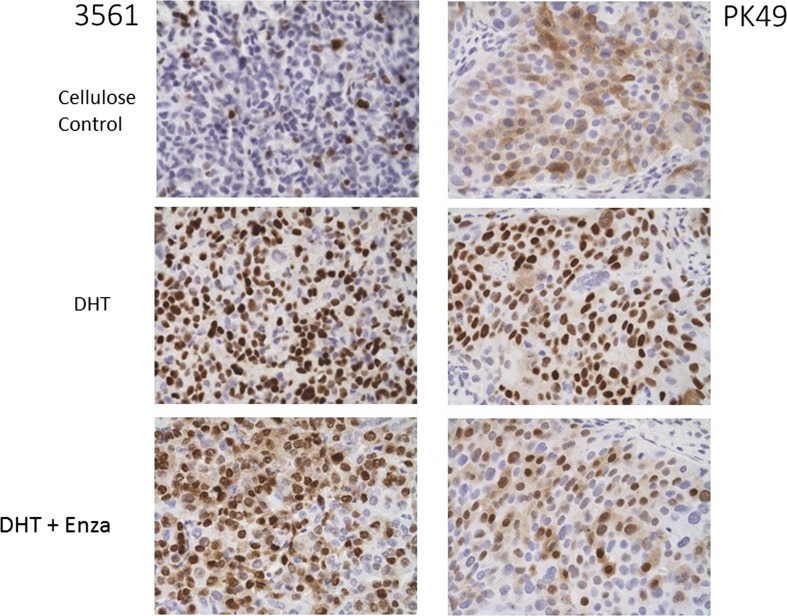
Two TNBC patient-derived xenografts grown in mice had low AR, but nuclear AR increased upon exposure of mice to DHT and this effect was reduced by subsequent treatment with the anti-androgen enzalutamide. Mice were implanted with silastic tubing containing either cellulose only (10 mg) or a mixture of cellulose and DHT (2 and 8 mg, respectively) at the time of placement of TNBC PDX tumor pieces into the mammary glands. When tumors reached an average of 55 mm3 in size, mice were either continued on DHT alone or given DHT + Enza in chow fed ad libitum for a target dose of 50 mg/kg/day for 3.5 weeks. FFPE tumors (PDX 3561 and PDX PK49) were stained for AR (SP107, CellMarque, ×40 magnification). AR androgen receptor, DHT dihydrotestosterone, Enza enzalutamide, PDX patient-derived xenografts, TNBC triple-negative breast cancer, FFPE formalin-fixed paraffin-embedded

Similar articles

Cited by

References

    1. Collins LC, Cole KS, Marotti JD, Hu R, Schnitt SJ, Tamimi RM. Androgen receptor expression in breast cancer in relation to molecular phenotype: results from the Nurses’ Health Study. Mod Pathol. 2011;24(7):924–931. doi: 10.1038/modpathol.2011.54. - DOI - PMC - PubMed
    1. Qi JP, Yang YL, Zhu H, Wang J, Jia Y, Liu N, Song YJ, Zan LK, Zhang X, Zhou M, Gu YH, Liu T, Hicks DG, Tang P. Expression of the androgen receptor and its correlation with molecular subtypes in 980 Chinese breast cancer patients. Breast Cancer (Auckl) 2012;6:1–8. - PMC - PubMed
    1. Guedj M, Marisa L, de Reynies A, Orsetti B, Schiappa R, Bibeau F, MacGrogan G, Lerebours F, Finetti P, Longy M, Bertheau P, Bertrand F, Bonnet F, Martin AL, Feugeas JP, Bièche I, Lehmann-Che J, Lidereau R, Birnbaum D, Bertucci F, de Thé H, Theillet C. A refined molecular taxonomy of breast cancer. Oncogene. 2012;31(9):1196–1206. doi: 10.1038/onc.2011.301. - DOI - PMC - PubMed
    1. Cochrane DR, Bernales S, Jacobsen BM, Cittelly DM, Howe EN, D'Amato NC, Spoelstra NS, Edgerton SM, Jean A, Guerrero J, et al. Role of the androgen receptor in breast cancer and preclinical analysis of enzalutamide. Breast Cancer Res. 2014;16(1):R7. doi: 10.1186/bcr3599. - DOI - PMC - PubMed
    1. Sas-Korczynska B, Adamczyk A, Niemiec J, Harazin-Lechowska A, Ambicka A, Jakubowicz J. Androgen receptor in male breast cancer. Pol J Pathol. 2015;66(4):347–352. doi: 10.5114/pjp.2015.57065. - DOI - PubMed

Publication types

MeSH terms

LinkOut - more resources