


Time Spent on Dedicated Patient Care and Documentation Tasks Before and After the Introduction of a Structured and Standardized Electronic Health Record
- PMID: 29342479
- PMCID: PMC5801881
- DOI: 10.1055/s-0037-1615747
Time Spent on Dedicated Patient Care and Documentation Tasks Before and After the Introduction of a Structured and Standardized Electronic Health Record
Abstract
Background: Physicians spend around 35% of their time documenting patient data. They are concerned that adopting a structured and standardized electronic health record (EHR) will lead to more time documenting and less time for patient care, especially during consultations.
Objective: This study measures the effect of the introduction of a structured and standardized EHR on documentation time and time for dedicated patient care during outpatient consultations.
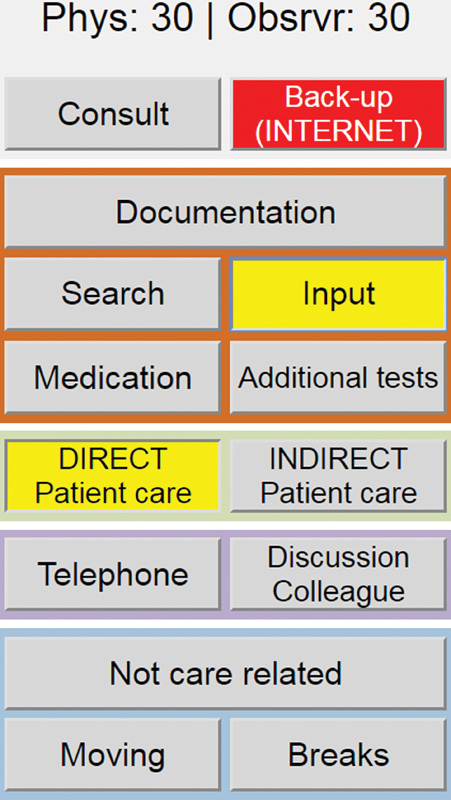
Methods: We measured physicians' time spent on four task categories during outpatient consultations: documentation, patient care, peer communication, and other activities. Physicians covered various specialties from two university hospitals that jointly implemented a structured and standardized EHR. Preimplementation, one hospital used a legacy-EHR, and one primarily paper-based records. The same physicians were observed 2 to 6 months before and 6 to 8 months after implementation.We analyzed consultation duration, and percentage of time spent on each task category. Differences in time distribution before and after implementation were tested using multilevel linear regression.
Results: We observed 24 physicians (162 hours, 439 consultations). We found no significant difference in consultation duration or number of consultations per hour. In the legacy-EHR center, we found the implementation associated with a significant decrease in time spent on dedicated patient care (-8.5%). In contrast, in the previously paper-based center, we found a significant increase in dedicated time spent on documentation (8.3%) and decrease in time on combined patient care and documentation (-4.6%). The effect on dedicated documentation time significantly differed between centers.
Conclusion: Implementation of a structured and standardized EHR was associated with 8.5% decrease in time for dedicated patient care during consultations in one center and 8.3% increase in dedicated documentation time in another center. These results are in line with physicians' concerns that the introduction of a structured and standardized EHR might lead to more documentation burden and less time for dedicated patient care.
Schattauer GmbH Stuttgart.
Conflict of interest statement
Conflict of Interest: None.
Figures
References
-
- Toll E. A piece of my mind. The cost of technology. JAMA. 2012;307(23):2497–2498. - PubMed
-
- Rathert C, Mittler J N, Banerjee S, McDaniel J. Patient-centered communication in the era of electronic health records: what does the evidence say? Patient Educ Couns. 2017;100(01):50–64. - PubMed
-
- Joukes E, De Keizer N, Abu-Hanna A, De Bruijne M, Cornet R.End-User experiences and expectations regarding data registration and reuse before the implementation of a (new) electronic health record: a case study in two university hospitals Stud Health Technol Inform 2015216997. Doi: 10.3233/978-1-61499-564-7-997 - PubMed
-
- International Health Terminology Standards Development Organisation.SNOMED InternationalAvailable at:http://www.snomed.org/. Accessed May 19, 2017
MeSH terms
LinkOut - more resources
Full Text Sources
Other Literature Sources
