. 2018 Jan 13;19(1):237.
doi: 10.3390/ijms19010237.

Anesthetic Preconditioning as Endogenous Neuroprotection in Glaucoma

Affiliations

Anesthetic Preconditioning as Endogenous Neuroprotection in Glaucoma

Tsung-Han Chou et al. Int J Mol Sci. .

Abstract

Blindness in glaucoma is the result of death of Retinal Ganglion Cells (RGCs) and their axons. RGC death is generally preceded by a stage of reversible dysfunction and structural remodeling. Current treatments aimed at reducing intraocular pressure (IOP) are ineffective or incompletely effective in management of the disease. IOP-independent neuroprotection or neuroprotection as adjuvant to IOP lowering in glaucoma remains a challenge as effective agents without side effects have not been identified yet. We show in DBA/2J mice with spontaneous IOP elevation and glaucoma that the lifespan of functional RGCs can be extended by preconditioning RGCs with retrobulbar lidocaine in one eye at four months of age that temporary blocks RGC axonal transport. The contralateral, PBS-injected eye served as control. Lidocaine-induced impairment of axonal transport to superior colliculi was assessed by intravitreal injection of cholera toxin B. Long-term (nine months) effect of lidocaine were assessed on RGC electrical responsiveness (PERG), IOP, expression of relevant protein (BDNF, TrkB, PSD95, GFAP, Synaptophysin, and GAPDH) and RGC density. While lidocaine treatment did not alter the age-related increase of IOP, TrkB expression was elevated, GFAP expression was decreased, RGC survival was improved by 35%, and PERG function was preserved. Results suggest that the lifespan of functional RGCs in mouse glaucoma can be extended by preconditioning RGCs in early stages of the disease using a minimally invasive treatment with retrobulbar lidocaine, a common ophthalmologic procedure. Lidocaine is inexpensive, safe and is approved by Food and Drug Administration (FDA) to be administered intravenously.

Keywords: glaucoma; lidocaine; mouse; neuroprotection; retinal ganglion cells.


Conflict of interest statement

The authors declare no conflict of interest. The founding sponsors had no role in the design of the study; in the collection, analyses, or interpretation of data; in the writing of the manuscript, and in the decision to publish the results.

Figures
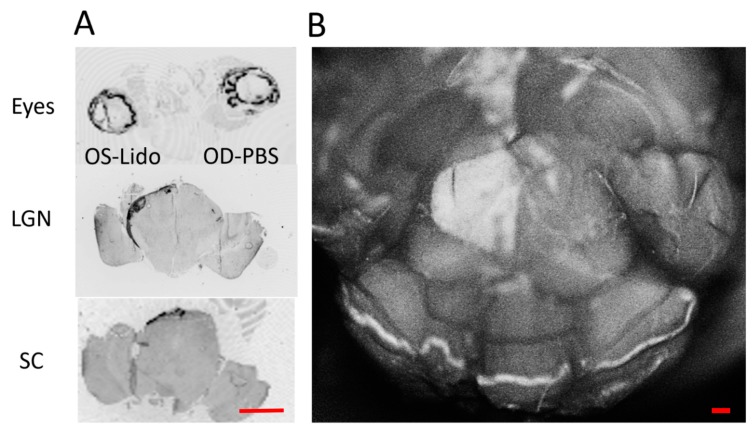
Figure 1
Figure 1
Retrobulbar lidocaine blocks axon transport. (A) Representative consecutive tissue sections from the eyes to the brain one day after retrobulbar lidocaine in the left eye, immediately followed by intravitreal injection of Alexa Fluor 488 Cholera Toxin B in both eyes. Fluorescence is evident in both eyes but it is absent in the lateral geniculate nucleus (LGN) and Superior Colliculi (SC) contralateral to the left eye. Fluorescence is present in the LGN and SC contralateral to the phosphate-buffered saline (PBS)-injected right eye; scale bar, 200 µm. (B) Confocal scanning laser ophthalmoscopy of the midbrain surface. The entire surface of the right SC receiving afferents from the lidocaine- injected right eye does not fluoresce, indicating impairment of axon transport in the lidocaine-treated eye; scale bar, 200 µm.
Figure 2
Figure 2
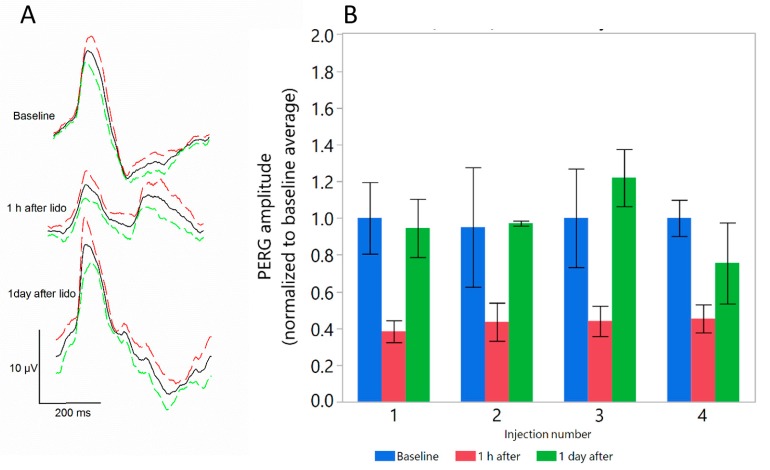
Retrobulbar lidocaine reversibly reduces Pattern Electroretinogram (PERG). (A) PERG waveforms in DBA/2J mice before and at different times after injection. Continuous black lines represent the grand-average waveform of all mice tested, and colored dashed lines represent the superior (red) and inferior (green) 95% confidence interval of the mean; (B) Peak-to-trough PERG amplitude decreases by about 60% one hour after lidocaine but recovers baseline values one day after injection. The effect is repeatable after four injections four days apart. Bars represent the mean ± SEM (N = 5).
Figure 3
Figure 3
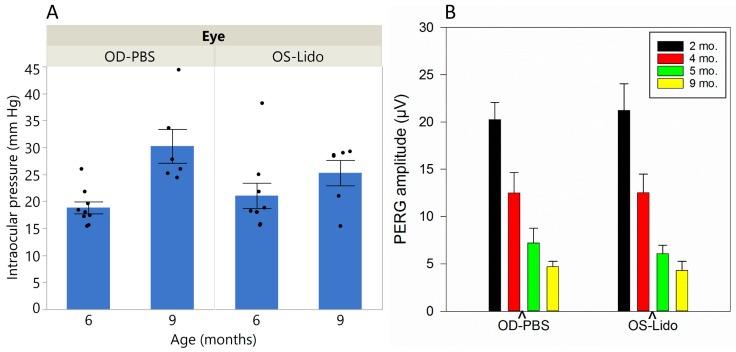
Intraocular pressure (IOP) and PERG amplitude as function of age in Lidocaine-treated and PBS-treated D2 mice. (A) IOP increases with age with no apparent differences between Lidocaine-treated and PBS-treated D2 mice. Bars represent the mean ± SEM (6 mo., N = 9; 9 mo., N = 6); black dots represent measurements in individual mice; (B) PERG amplitude declines with increasing age, with no apparent differences between Lidocaine-treated and PBS-treated D2 mice. Bars represent the mean ± SEM (2 mo., N = 7; 4 mo., N = 20; 5 mo., N = 9; 9 mo., N = 17).
Figure 4
Figure 4
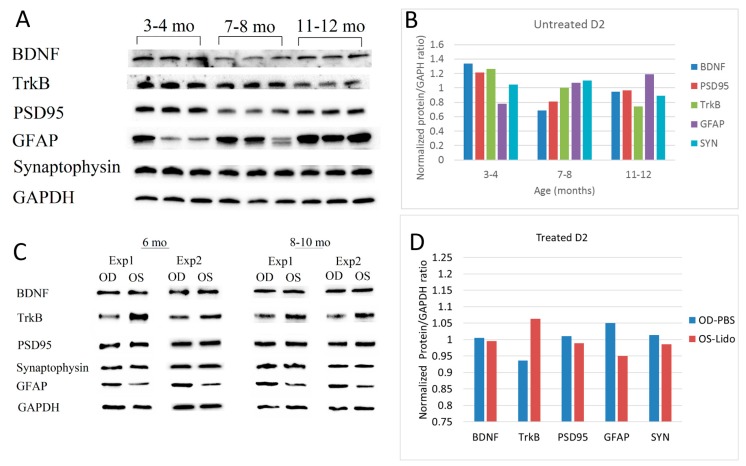
Age-related changes of relevant protein expression in untreated (A,B) and Lidocaine-treated (C,D) DBA/2J mice. (A) Western Blot images of Brain Derived Neurotrophic Factor (BDNF) (28 kDa), Tyrosine Receptor Kinase B (TrkB) (140 kDa), PSD95 (95 kDa), Synaptophysin (SYN) (38 kDa), Glial Fibrillary Acidic Protein (GFAP) (50 kDa) and Glyceraldehyde 3-phosphate Dehydrogenase GAPDH (37 kDa) proteins assessed in untreated mice of different ages (3 mice for age group, pooled retinas of both eyes); (B) Average protein expression (normalized protein/GAPDH ratio) as as function of age in untreated mice. Bars represent the average of 6 retinas for age group; (C) Representative Western Blot images of relevant retinal proteins in mice 6 and 8–10 old that received 4 retrobulbar injections of Lidocaine in the left eye and PBS in the right eye at 4 months of age; (D) Average protein expression in Lidocaine-treated (OS) and PBS-treated (OD) eyes. Bars represent the average ratios of 9 D2 mice of 6–10 months of age.
Figure 5
Figure 5
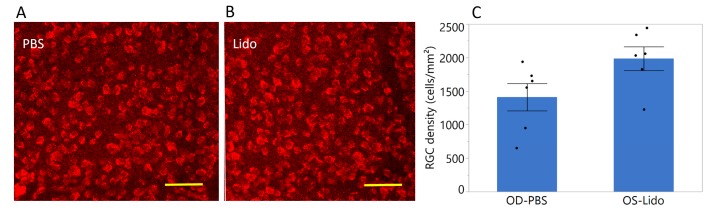
Retrobulbar lidocaine is neuroprotective in early DBA/2J glaucoma. (A,B) examples of confocal images of RBPMS-positive RGCs in whole-mounted retinas of one nine-month-old D2 that received four retrobulbar injections of lidocaine at four months of age in one eye (B) and an equal volume of PBS in the other eye (A), scale bar, 50 µm; (C) Mean RGC density in D2 mice nine mo. old treated with retrobulbar lidocaine in one eye and PBS in the contralateral eye at four months of age. RGC density is higher in lidocaine-treated eyes by 35% (p = 0.04). Error bars represent the SEM, N = 6. Black dots represent measurements in individual mice.
Figure 6
Figure 6
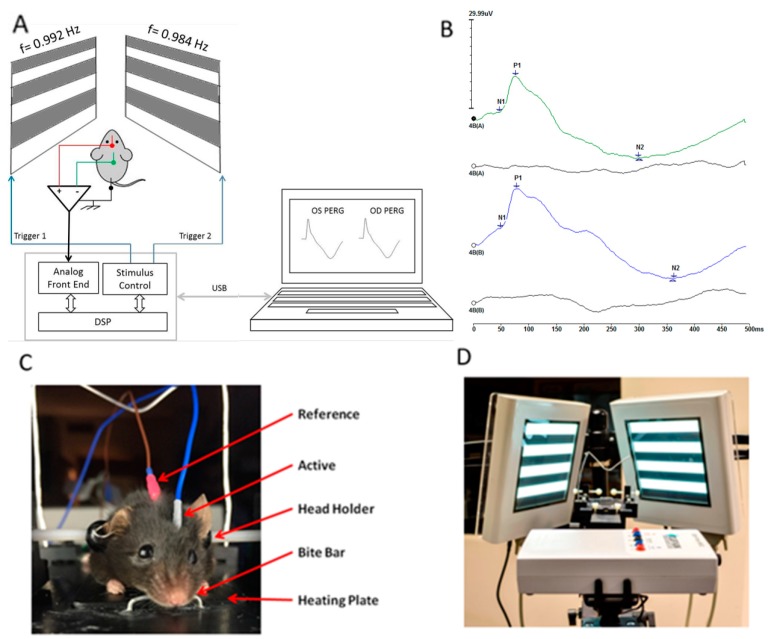
(A) Mouse PERG recording layout; (B) PERG waveforms simultaneously recorded from each eye using one common electrode in the snout; (C) Mouse with non-corneal subcutaneous needle electrodes resting on a feedback-controlled thermostatic plate; (D) Patterned visual stimuli generated on high luminance (800 cd/sqm) LED displays and presented at each eye independently with slightly different reversal frequency (right eye: 0.984 Hz; left eye: 0.992 Hz). Asynchronous averaging allows isolation of monocular PERGs.

References

    1. Almasieh M., Wilson A.M., Morquette B., Cueva Vargas J.L., Di Polo A. The molecular basis of retinal ganglion cell death in glaucoma. Prog. Retin. Eye Res. 2012;31:152–181. doi: 10.1016/j.preteyeres.2011.11.002. - DOI - PubMed
    1. Porciatti V., Ventura L.M. Retinal ganglion cell functional plasticity and optic neuropathy: A comprehensive model. J. Neuroophthalmol. 2012;32:354–358. doi: 10.1097/WNO.0b013e3182745600. - DOI - PMC - PubMed
    1. Jampel H.D., Chon B.H., Stamper R., Packer M., Han Y., Nguyen Q.H., Ianchulev T. Effectiveness of intraocular pressure-lowering medication determined by washout. JAMA Ophthalmol. 2014;132:390–395. doi: 10.1001/jamaophthalmol.2013.7677. - DOI - PubMed
    1. Levin L.A., Crowe M.E., Quigley H.A. Neuroprotection for glaucoma: Requirements for clinical translation. Exp. Eye Res. 2017;157:34–37. doi: 10.1016/j.exer.2016.12.005. - DOI - PMC - PubMed
    1. Leng T., Gao X., Dilger J.P., Lin J. Neuroprotective effect of lidocaine: Is there clinical potential? Int. J. Physiol. Pathophysiol. Pharmacol. 2016;8:9–13. - PMC - PubMed