


Insights into the genetics of blood pressure in black South African individuals: the Birth to Twenty cohort
- PMID: 29343252
- PMCID: PMC5773038
- DOI: 10.1186/s12920-018-0321-6
Insights into the genetics of blood pressure in black South African individuals: the Birth to Twenty cohort
Abstract
Background: Cardiovascular diseases (CVDs) are the leading cause of non-communicable disease deaths globally, with hypertension being a major risk factor contributing to CVDs. Blood pressure is a heritable trait, with relatively few genetic studies having been performed in Africans. This study aimed to identify genetic variants associated with variance in systolic (SBP) and diastolic (DBP) blood pressure in black South Africans.
Methods: Genotyping was performed using the Metabochip in a subset of participants (mixed sex; median age 17.9) and their adult female caregivers (median age 41.0) from the Birth to Twenty cohort (n = 1947). Data were analysed as a merged dataset (all participants and caregivers together) in GEMMA (v0.94.1) using univariate linear mixed models, incorporating a centered relatedness matrix to account for the relatedness between individuals and with adjustments for age, sex, BMI and principal components of the genotype information.
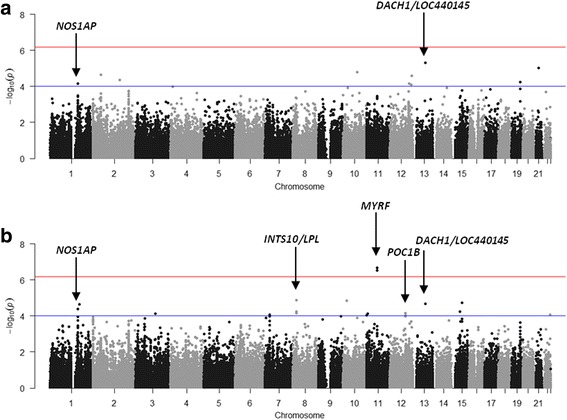
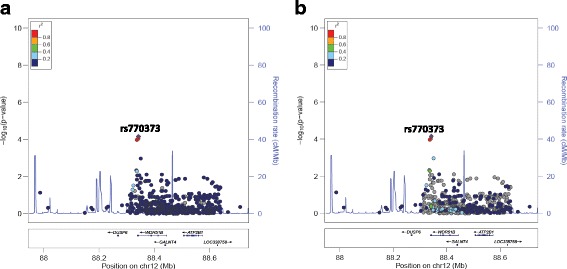
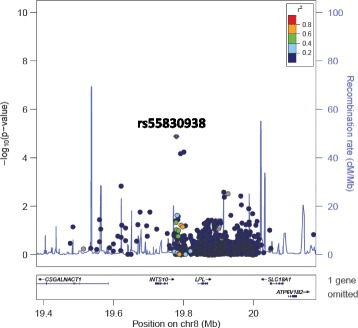
Results: Association analysis identified regions of interest in the NOS1AP (DBP: rs112468105 - p = 7.18 × 10⁻⁵ and SBP: rs4657181 - p = 4.04 × 10⁻⁵), MYRF (SBP: rs11230796 - p = 2.16 × 10⁻⁷, rs400075 - p = 2.88 × 10⁻⁷) and POC1B (SBP: rs770373 - p = 7.05 × 10⁻⁵, rs770374 - p = 9.05 × 10⁻⁵) genes and some intergenic regions (DACH1|LOC440145 (DBP: rs17240498 - p = 4.91 × 10⁻⁶ and SBP: rs17240498 - p = 2.10 × 10⁻⁵) and INTS10|LPL (SBP: rs55830938 - p = 1.30 × 10⁻⁵, rs73599609 - p = 5.78 × 10⁻⁵, rs73667448 - p = 6.86 × 10⁻⁵)).
Conclusions: The study provided further insight into the contribution of genetic variants to blood pressure in black South Africans. Future functional and replication studies in larger samples are required to confirm the role of the identified loci in blood pressure regulation and whether or not these variants are African-specific.
Keywords: Birth to Twenty; Metabochip; black South Africans; blood pressure; genetics.
Conflict of interest statement
Ethics approval and consent to participate
Written assent was obtained from all participants at 13 years of age in conjunction with written consent from caregivers prior to blood sample collection. Written consent was obtained from participants when they were over 18 years of age. Ethical clearance was obtained from the University of the Witwatersrand Human Research Ethics Committee (Medical) for collection of DNA samples and phenotype data from this cohort (M010556). Further clearance was obtained for use of these samples to identify genetic risks associated with blood pressure (M1411116) in a black South African population.
Consent for publication
Not applicable
Competing interests
The authors declare that they have no competing interests.
Publisher’s Note
Springer Nature remains neutral with regard to jurisdictional claims in published maps and institutional affiliations.
Figures


References
-
- World Health Organization Global status report on noncommunicable diseases. 2014;2014:176.
Publication types
MeSH terms
Grants and funding
LinkOut - more resources
Full Text Sources
Other Literature Sources
Miscellaneous
