. 2018 Jan 17;8(1):936.
doi: 10.1038/s41598-018-19335-9.

Prebiotic formation of cyclic dipeptides under potentially early Earth conditions

Affiliations

Prebiotic formation of cyclic dipeptides under potentially early Earth conditions

Jianxi Ying et al. Sci Rep. .

Abstract

Cyclic dipeptides, also known as 2,5-diketopiperazines (DKPs), represent the simplest peptides that were first completely characterized. DKPs can catalyze the chiral selection of reactions and are considered as peptide precursors. The origin of biochemical chirality and synthesis of peptides remains abstruse problem believed to be essential precondition to origin of life. Therefore, it is reasonable to believe that the DKPs could have played a key role in the origin of life. How the formation of the DKPs through the condensation of unprotected amino acids in simulated prebiotic conditions has been unclear. Herein, it was found that cyclo-Pro-Pro could be formed directly from unprotected proline in the aqueous solution of trimetaphosphate (P3m) under mild condition with the yield up to 97%. Other amino acids were found to form proline-containing DKPs under the same conditions in spite of lower yield. During the formation process of these DKPs, P3m promotes the formation of linear dipeptides in the first step of the mechanism. The above findings are helpful and significant for understanding the formation of DKPs in the process of chemical evolution of life.


Conflict of interest statement

The authors declare that they have no competing interests.

Figures
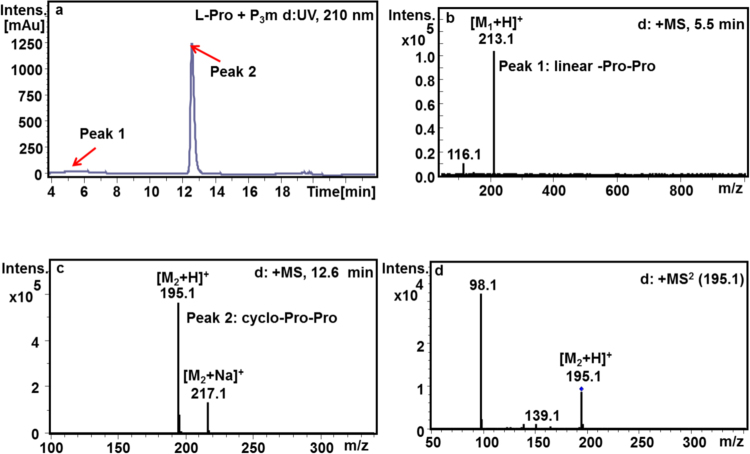
Figure 1
Figure 1
HPLC-MS profile for the reaction products of the L-Pro with P3m. (a) HPLC profile for the reaction products of the L-Pro with P3m at 210 nm. (b) MS profile for the LPD (peak 1, M1 = 212, R.T. = 5.5 min). (c) MS profile for the cyclo-Pro-Pro (peak 2, M2 = 194, R.T. = 12.6 min). (d) MS2 profile for the cyclo-Pro-Pro (M2 = 194, R.T. = 12.6 min).
Figure 2
Figure 2
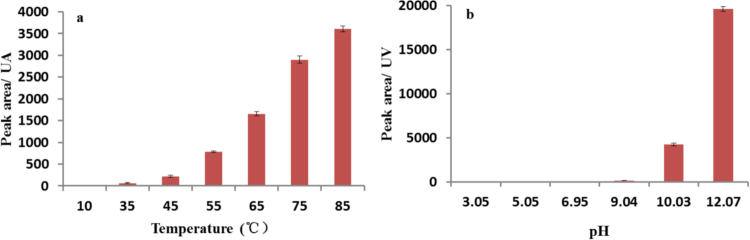
Effects of temperature and pH on the formation cyclo-Pro-Pro in the reaction of Pro with P3m. All reactions were controlled under standard conditions. (a) The formation of cyclo (Pro-Pro) at various temperature was assayed at pH 10.7. (b) The formation of cyclo-Pro-Pro at various pHs was assayed at 85 °C.
Figure 3
Figure 3
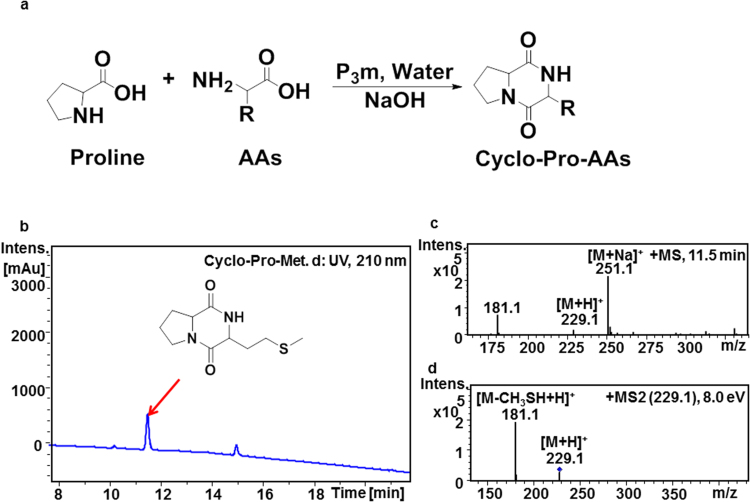
Reaction pathway and HPLC-MS/MS analysis of cyclo-Pro-AAs products. (a) The reaction pathway of cyclo-Pro-AAs, AAs stands for amino acids; (b) HPLC profile for the reaction product cyclo-Pro-Met of Pro with Met and P3m in aqueous solution; (c) MS profile for the product cyclo-Pro-Met (M = 228); (d) MS2 profile for the product cyclo-Pro-Met. HPLC-MS/MS profile for the reaction products of Pro with other amino acid could be found in the Supplementary Fig. S5.
Figure 4
Figure 4
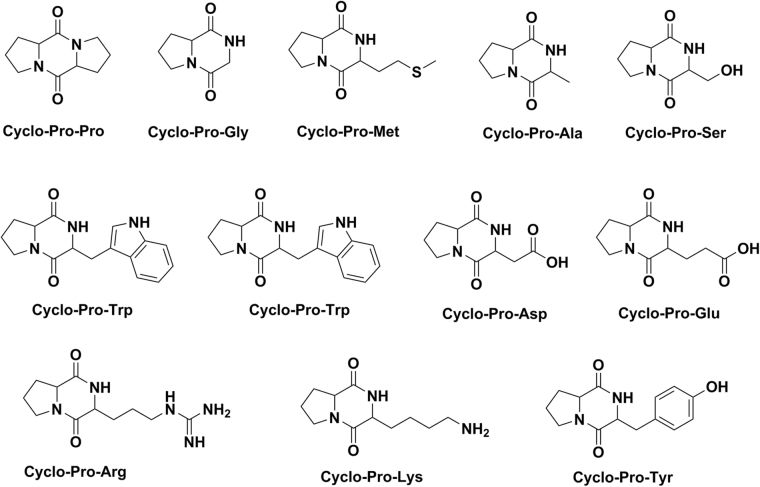
Representative structures of the product cyclo-Pro-AAs.
Figure 5
Figure 5
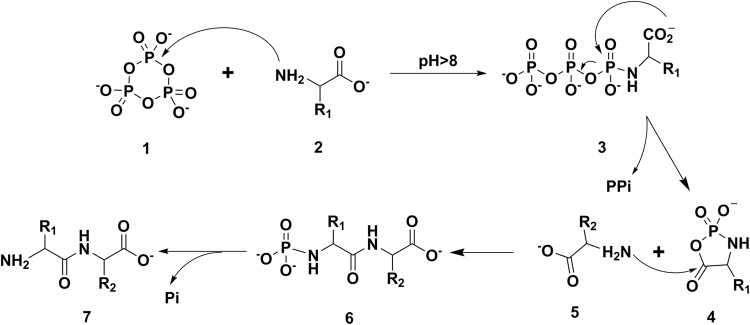
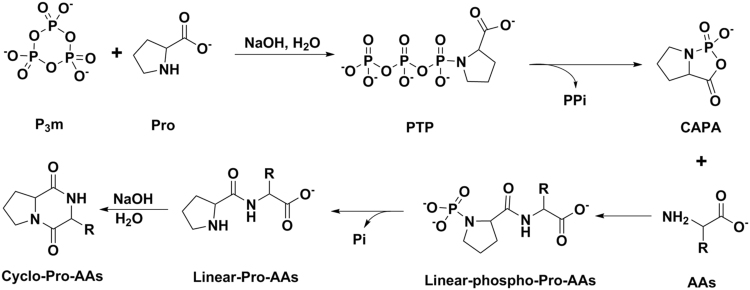
Mechanism for the linear dipeptide formation by P3m activation.
Figure 6
Figure 6
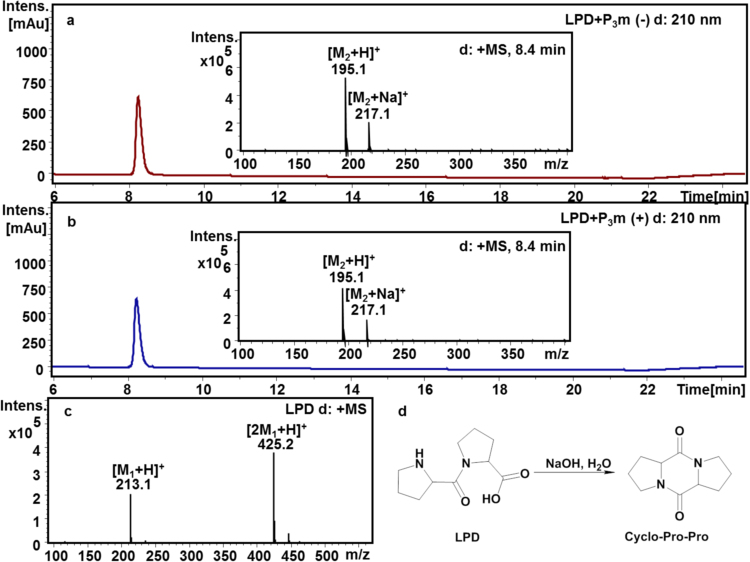
HPLC/MS profiles for the reaction products of LPD with or without P3m. (a) The HPLC/MS spectra of LPD in alkaline reaction solution without P3m. Integral area of the product cyclo-Pro-Pro is 6620 mAu·s (R.T. = 8.1~8.6 min, M2 = 194); (b) The reaction mixture of LPD in alkaline solution with P3m. Integral area of the product cyclo-Pro-Pro is 6929 mAu·s (R.T. = 8.1~8.6 min, M2 = 194); (c) The MS spectrum is derived from freshly prepared LPD aqueous solutions (M1 = 212); (d) A possible reaction mechanism of the cyclo-Pro-Pro formation through the cyclization of LPD in the alkaline aqueous solution.
Figure 7
Figure 7
Mechanism for the formation of proline-containing cyclic dipeptides PTP: Proline triphosphate; CAPA: Cyclic acylphosphoramidates.

References

    1. Prasad C. Bioactive cyclic dipeptides. Peptides. 1995;16:151–164. doi: 10.1016/0196-9781(94)00017-Z. - DOI - PubMed
    1. Nonappa AK, Lahtinen M, Kolehmainen E. Cyclic dipeptides: catalyst/promoter-free, rapid and environmentally benign cyclization of free amino acids. Green Chemistry. 2011;13:1203. doi: 10.1039/c1gc15043j. - DOI
    1. Jayatilake GS, Thornton MP, Leonard AC, Grimwade JE, Baker BJ. Metabolites from an Antarctic sponge-associated bacterium, Pseudomonas aeruginosa. Journal of Natural Products. 1996;59:293–296. doi: 10.1021/np960095b. - DOI - PubMed
    1. Ström K, Sjögren J, Broberg A, Schnürer J. Lactobacillus plantarum MiLAB 393 produces the antifungal cyclic dipeptides cyclo (L-Phe-L-Pro) and cyclo (L-Phe-trans-4-OH-L-Pro) and 3-phenyllactic acid. Appl Environ Microb. 2002;68:4322–4327. doi: 10.1128/AEM.68.9.4322-4327.2002. - DOI - PMC - PubMed
    1. Li Y, et al. Golmaenone, a new diketopiperazine alkaloid from the marine-derived fungus Aspergillus sp. Chemical and pharmaceutical bulletin. 2004;52:375–376. doi: 10.1248/cpb.52.375. - DOI - PubMed

Publication types