. 2018 Jan 17;8(1):988.
doi: 10.1038/s41598-017-18871-0.

Microdosimetric Modeling of Biological Effectiveness for Boron Neutron Capture Therapy Considering Intra- and Intercellular Heterogeneity in 10B Distribution

Affiliations

Microdosimetric Modeling of Biological Effectiveness for Boron Neutron Capture Therapy Considering Intra- and Intercellular Heterogeneity in 10B Distribution

Tatsuhiko Sato et al. Sci Rep. .

Abstract

We here propose a new model for estimating the biological effectiveness for boron neutron capture therapy (BNCT) considering intra- and intercellular heterogeneity in 10B distribution. The new model was developed from our previously established stochastic microdosimetric kinetic model that determines the surviving fraction of cells irradiated with any radiations. In the model, the probability density of the absorbed doses in microscopic scales is the fundamental physical index for characterizing the radiation fields. A new computational method was established to determine the probability density for application to BNCT using the Particle and Heavy Ion Transport code System PHITS. The parameters used in the model were determined from the measured surviving fraction of tumor cells administrated with two kinds of 10B compounds. The model quantitatively highlighted the indispensable need to consider the synergetic effect and the dose dependence of the biological effectiveness in the estimate of the therapeutic effect of BNCT. The model can predict the biological effectiveness of newly developed 10B compounds based on their intra- and intercellular distributions, and thus, it can play important roles not only in treatment planning but also in drug discovery research for future BNCT.


Conflict of interest statement

The authors declare that they have no competing interests.

Figures
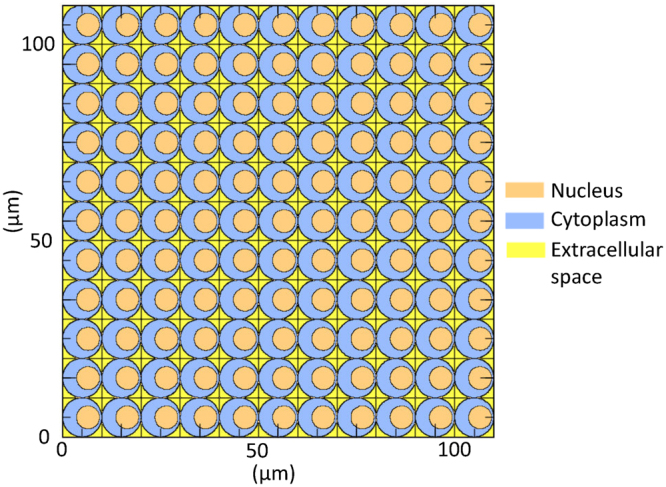
Figure 1
Figure 1
Cross-sectional view of our modeled cellular matrix depicted by PHITS.
Figure 2
Figure 2
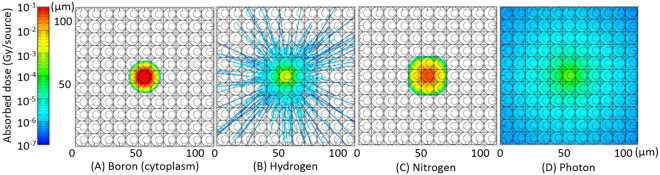
Cross-sectional views of calculated absorbed doses per source generation for each dose component.
Figure 3
Figure 3
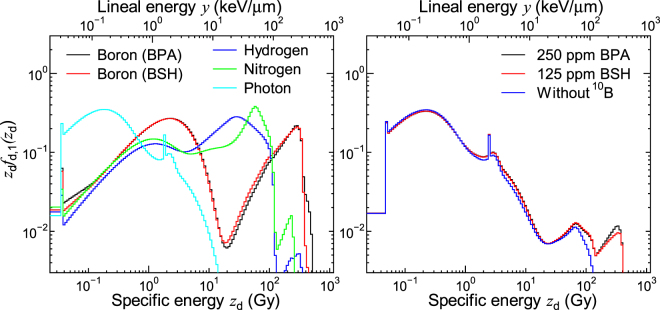
Calculated zdfd,1(zd) for each dose component (left) and some experimental conditions (right). The upper axis denotes the corresponding lineal energy, y, which is frequently compared with LET.
Figure 4
Figure 4
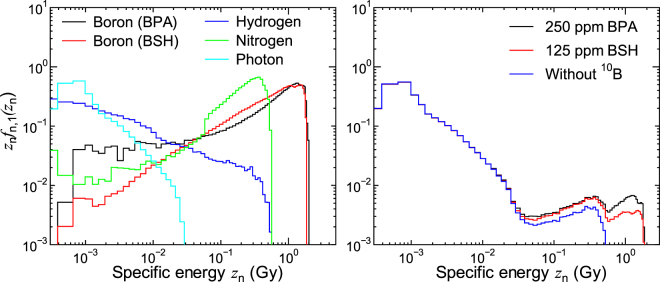
Calculated znfn,1(zn) for each dose component (left) and some experimental conditions (right).
Figure 5
Figure 5
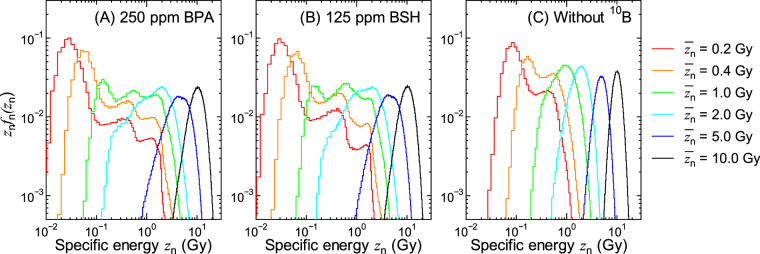
Calculated znfn(zn,zn¯) for some experimental conditions obtained by numerically solving Eqs (5) and (6)
Figure 6
Figure 6
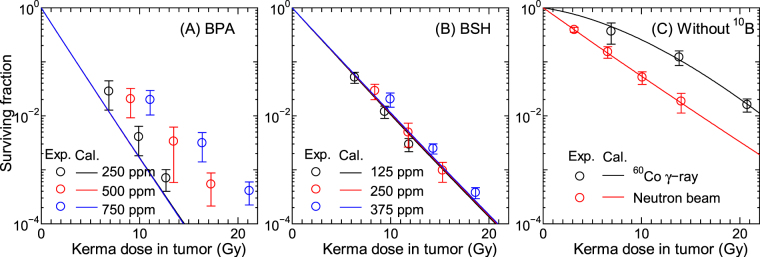
Measured and calculated SF for SCC VII squamous cell carcinomas administrated with (A) BPA, (B) BSH, and (C) without 10B compound, plotted as a function of total kerma dose in the tumor including the boron component. Those cells were inoculated into mice and irradiated by neutron beam of KUR except for the 60Co γ-ray data shown in Panel (C). The heterogeneity of the intercellular 10B distribution is not considered in this calculation.
Figure 7
Figure 7
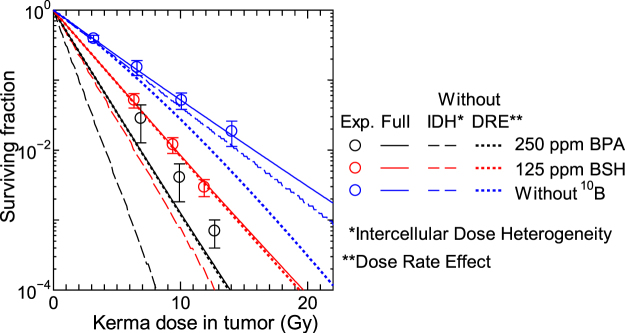
Calculated SF without considering the intercellular dose heterogeneity (IDH) or the dose rate effect (DRE), in comparison with the corresponding data with full consideration. Corresponding experimental data are also plotted in the graph.
Figure 8
Figure 8
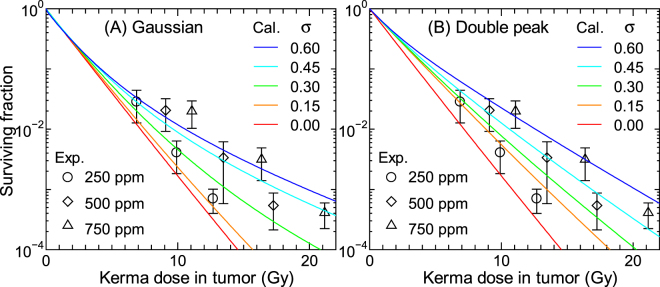
Calculated SF for 250 ppm BPA (17 μg/g) obtained under assumption that the intercellular heterogeneity of 10B concentrations can be expressed by the (A) Gaussian or (B) double-peak distributions with the standard deviation of σ. The corresponding experimental data including those for other 10B concentrations are also shown in the graph.
Figure 9
Figure 9
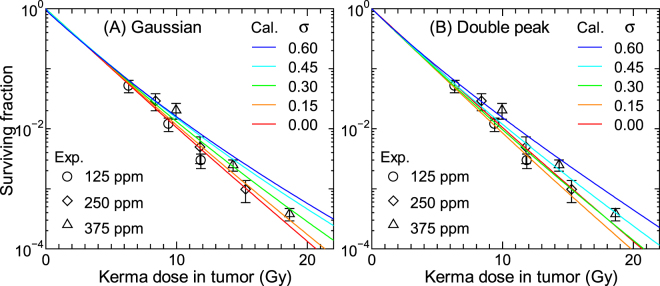
Calculated SF for 125 ppm BSH (17 μg/g) obtained under assumption that the intercellular heterogeneity of 10B concentrations can be expressed by the (A) Gaussian or (B) double-peak distributions with the standard deviation of σ. The corresponding experimental data including those for other 10B concentrations are also shown in the graph.
Figure 10
Figure 10
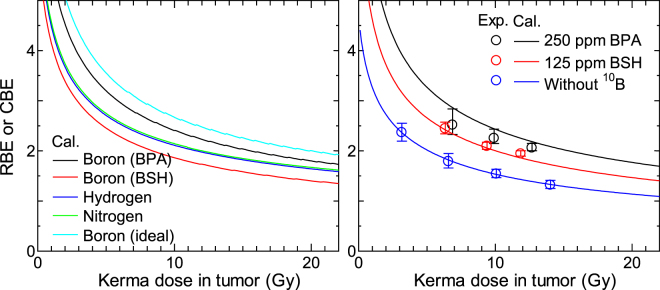
Calculated RBE or CBE for each dose component (left) and for some experimental conditions (right) as a function of the total kerma dose in tumor including the boron component. CBE for an ideal 10B compound that can be homogeneously distributed inside cell is also drawn in the left panel.
Figure 11
Figure 11
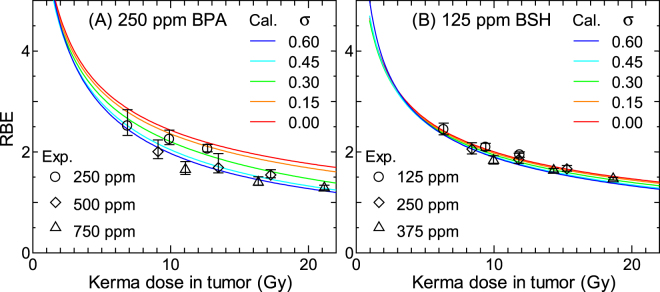
Calculated RBE for (A) 250 ppm BPA and (B) 125 ppm BSH considering the intercellular heterogeneity in 10B distributions. The Gaussian distributions with the standard deviation σ were assumed in the calculation. The corresponding experimental data including those for other 10B concentrations are also shown in the graphs.
Figure 12
Figure 12
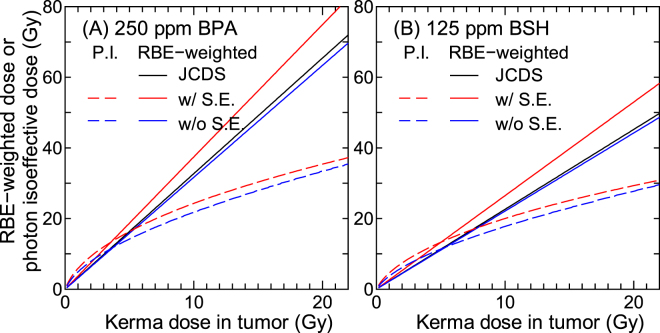
Calculated RBE-weighted doses and photon-isoeffective (P.I.) doses for (A) 250 ppm BPA and (B) 125 ppm BSH. Red and blue lines denote the data calculated with and without considering the synergetic effect (S.E.), respectively. The RBE-weighted doses estimated from the RBE and CBE values adopted in JCDS are also drawn in the graphs.

References

    1. Kumada H, et al. Verification of the computational dosimetry system in JAERI (JCDS) for boron neutron capture therapy. Phys. Med. Biol. 2004;49:3353–3365. doi: 10.1088/0031-9155/49/15/003. - DOI - PubMed
    1. Hopewell JW, Morris GM, Schwint A, Coderre JA. The radiobiological principles of boron neutron capture therapy: A critical review. Appl. Radiat. Isotopes. 2011;69:1756–1759. doi: 10.1016/j.apradiso.2011.04.019. - DOI - PubMed
    1. Bond VP, Varma MN, Sondhaus CA, Feinendegen LE. An Alternative to Absorbed Dose, Quality, and RBE at Low Exposures. Radiat. Res. 1985;104:S52–S57. doi: 10.2307/3576632. - DOI - PubMed
    1. Gabel D, Foster S, Fairchild RG. The Monte-Carlo Simulation of the Biological Effect of the B-10(N,Alpha)Li-7 Reaction in Cells and Tissue and Its Implication for Boron Neutron-Capture Therapy. Radiat. Res. 1987;111:14–25. doi: 10.2307/3577018. - DOI - PubMed
    1. van Vliet-Vroegindeweij C, Wheeler F, Stecher-Rasmussen F, Moss R, Huiskamp R. Microdosimetry model for boron neutron capture therapy: I. Determination of microscopic quantities of heavy particles on a cellular scale. Radiat. Res. 2001;155:490–497. doi: 10.1667/0033-7587(2001)155[0490:MMFBNC]2.0.CO;2. - DOI - PubMed

MeSH terms