


Can productivity and profitability be enhanced in intensively managed cereal systems while reducing the environmental footprint of production? Assessing sustainable intensification options in the breadbasket of India
- PMID: 29343882
- PMCID: PMC5727681
- DOI: 10.1016/j.agee.2017.10.006
Can productivity and profitability be enhanced in intensively managed cereal systems while reducing the environmental footprint of production? Assessing sustainable intensification options in the breadbasket of India
Abstract
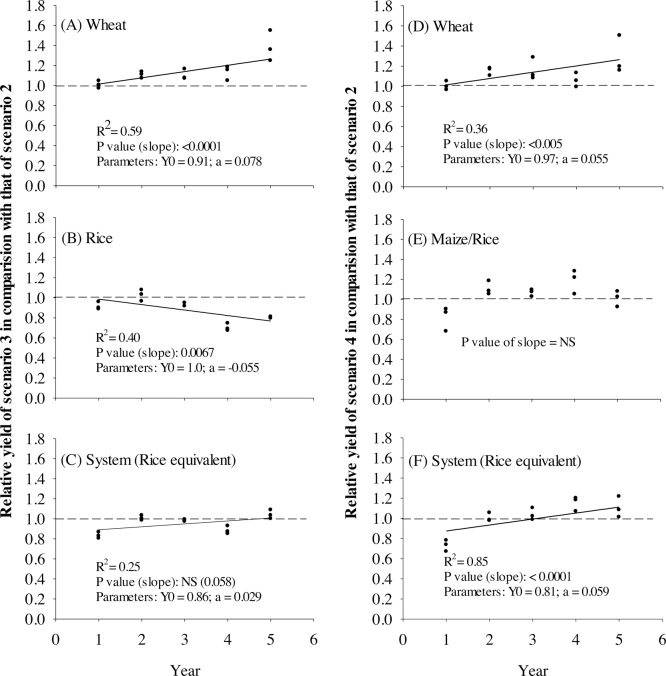
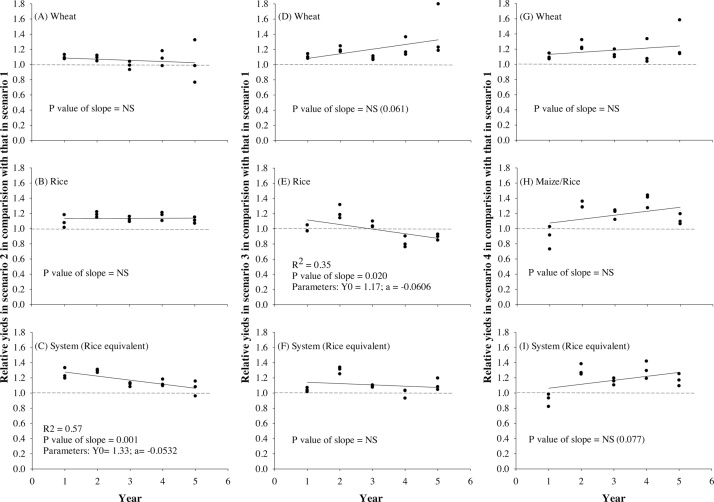
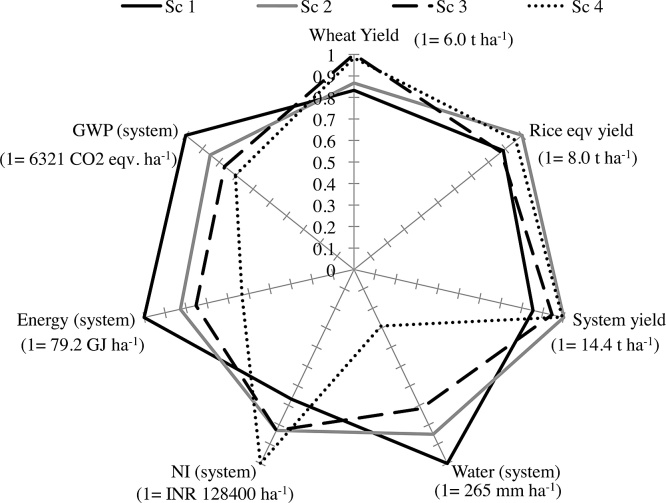
In the most productive area of the Indo-Gangetic Plains in Northwest India where high yields of rice and wheat are commonplace, a medium-term cropping system trial was conducted in Haryana State. The goal of the study was to identify integrated management options for further improving productivity and profitability while rationalizing resource use and reducing environmental externalities (i.e., "sustainable intensification", SI) by drawing on the principles of diversification, precision management, and conservation agriculture. Four scenarios were evaluated: Scenario 1 - "business-as-usual" [conventional puddled transplanted rice (PTR) followed by (fb) conventional-till wheat]; Scenario 2 - reduced tillage with opportunistic diversification and precision resource management [PTR fb zero-till (ZT) wheat fb ZT mungbean]; Scenario 3 - ZT for all crops with opportunistic diversification and precision resource management [ZT direct-seeded rice (ZT-DSR) fb ZT wheat fb ZT mungbean]; and Scenario 4 - ZT for all crops with strategic diversification and precision resource management [ZT maize fb ZT wheat fb ZT mungbean]. Results of this five-year study strongly suggest that, compared with business-as-usual practices, SI strategies that incorporate multi-objective yield, economic, and environmental criteria can be more productive when used in these production environments. For Scenarios 2, 3, and 4, system-level increases in productivity (10-17%) and profitability (24-50%) were observed while using less irrigation water (15-71% reduction) and energy (17-47% reduction), leading to 15-30% lower global warming potential (GWP), with the ranges reflecting the implications of specific innovations. Scenario 3, where early wheat sowing was combined with ZT along with no puddling during the rice phase, resulted in a 13% gain in wheat yield compared with Scenario 2. A similar gain in wheat yield was observed in Scenario 4 vis-à-vis Scenario 2. Compared to Scenario 1, wheat yields in Scenarios 3 and 4 were 15-17% higher, whereas, in Scenario 2, yield was either similar in normal years or higher in warmer years. During the rainy (kharif) season, ZT-DSR provided yields similar to or higher than those of PTR in the first three years and lower (11-30%) in Years 4 and 5, a result that provides a note of caution for interpreting technology performance through short-term trials or simply averaging results over several years. The resource use and economic and environmental advantages of DSR were more stable through time, including reductions in irrigation water (22-40%), production cost (11-17%), energy inputs (13-34%), and total GWP (14-32%). The integration of "best practices" in PTR in Scenario 2 resulted in reductions of 24% in irrigation water and 21% in GWP, with a positive impact on yield (0.9 t/ha) and profitability compared to conventional PTR, demonstrating the power of simple management changes to generate improved SI outcomes. When ZT maize was used as a diversification option instead of rice in Scenario 4, reductions in resource use jumped to 82-89% for irrigation water and 49-66% for energy inputs, with 13-40% lower GWP, similar or higher rice equivalent yield, and higher profitability (27-73%) in comparison to the rice-based scenarios. Despite these advantages, maize value chains are not robust in this part of India and public procurement is absent. Results do demonstrate that transformative opportunities exist to break the cycle of stagnating yields and inefficient resource use in the most productive cereal-based cropping systems of South Asia. However, these SI entry points need to be placed in the context of the major drivers of change in the region, including market conditions, risks, and declining labor availability, and matching with the needs and interests of different types of farmers.
Keywords: Direct-seeded rice; Global warming potential; Sustainability; Sustainable intensification; Terminal heat stress; Zero-tillage.
Figures
References
-
- Aryal J.P., Sapkota T.K., Jat M.L., Bishnoi D.K. On-farm economic and environmental impact of zero-tillage wheat: a case of north-west India. Exp. Agric. 2015;51:1–16.
-
- Audsley E., Stacey K., Parsons D.J., Williams A.G. Cranfield University; Cranfield, Bedford: 2009. Estimation of the Greenhouse Gas Emissions from Agricultural Pesticide Manufacture and Use.
-
- Balwinder-Singh, Humphreys E., Eberbach P.L., Katupitiya A., Yadvinder-Singh, Kukal S.S. Growth, yield and water productivity of zero till wheat as affected by rice straw mulch and irrigation schedule. Field Crops Res. 2011;121:209–225.
-
- Balwinder-Singh, Eberbach P.L., Humphreys E., Kukal S.S. The effect of rice straw mulch on evapotranspiration, transpiration and soil evaporation of irrigated wheat in Punjab, India. Field Crops Res. 2011;98:1847–1855.
LinkOut - more resources
Full Text Sources
Other Literature Sources
Research Materials