


Incidence and root causes of delays in emergency orthopaedic procedures: a single-centre experience of 36,017 consecutive cases over seven years
- PMID: 29344088
- PMCID: PMC5763611
- DOI: 10.1186/s13037-018-0149-1
Incidence and root causes of delays in emergency orthopaedic procedures: a single-centre experience of 36,017 consecutive cases over seven years
Abstract
Background: Emergency surgery is unplanned by definition and patients are scheduled for surgery with minimal preparation. Some patients who have sustained emergency orthopaedic trauma or other conditions must be operated on immediately or within a few hours, while others can wait until the hospital's resources permit and/or the patients' health status has been optimised as needed. This may affect the prioritisation procedures for both emergency and elective surgery and might result in waiting lists, not only for planned procedures but also for emergencies.
Method: The main purpose of this retrospective, observational, single-centre study was to evaluate and describe for the number and reasons of delays, as well as waiting times in emergency orthopaedic surgery using data derived from the hospital's records and registers. All the emergency patients scheduled for emergency surgery whose procedures were rescheduled and delayed between 1 January 2007 and 31 December 2013 were studied.
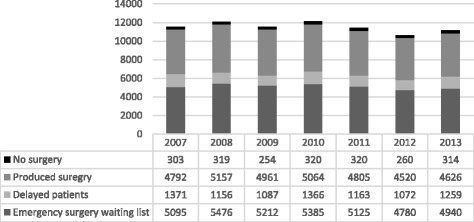
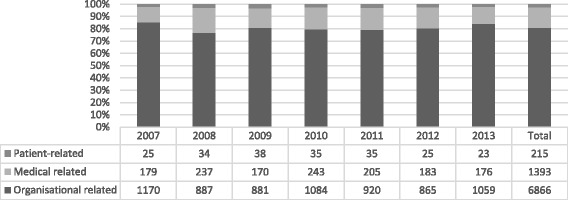
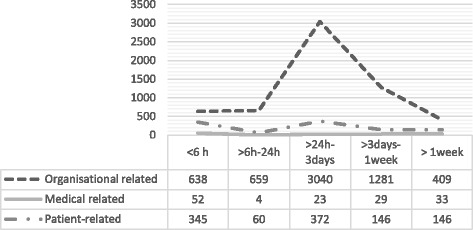
Result: We found that 24% (8474) of the 36,017 patients scheduled for emergency surgeries were delayed and rescheduled at least once, some several times. Eighty per cent of these delays were due to organisational causes. Twenty-one per cent of all the delayed patients had surgery within 24 h, whilst 41% waited for more than 24 h, up to 3 days.
Conclusion: A large number of the clinic's emergency orthopaedic procedures were rescheduled and delayed and the majority of the delays were related to organisational reasons. The results can be interpreted in two ways; first, organisational reasons are avoidable and the potential for improvement is great and, secondly and most importantly, the delays might negatively affect patient outcomes.
Keywords: Appointments and schedules; Cancellation; Emergency delays; Operating rooms/organisation and administration; Orthopaedic surgery; Perioperative nursing; Waiting lists.
Conflict of interest statement
The Regional Ethics Committee Review Board situated at the University of Gothenburg approved the study, Dnr: 531–12.The authors declare that they have no competing interests.Springer Nature remains neutral with regard to jurisdictional claims in published maps and institutional affiliations.
Figures
References
-
- The burden of musculoskeletal conditions at the start of the new millenium WHO Report 2003 [http://www.who.int/publications/en/]. - PubMed
-
- Swedish healt care act, SFS Hälso- och sjukvårdslag. 1982:763 [https://www.riksdagen.se/sv/dokument-lagar/dokument/svensk-forfattningss...].
-
- Lacqua MJ, Evans JT. Cancelled elective surgery: an evaluation. Am Surg. 1994;60:809–811. - PubMed
-
- Epstein RH, Dexter F. Rescheduling of previously cancelled surgical cases does not increase variability in operating room workload when cases are scheduled based on maximizing efficiency of use of operating room time. Anesth Analg. 2013;117:995–1002. doi: 10.1213/ANE.0b013e3182a0d9f6. - DOI - PubMed
LinkOut - more resources
Full Text Sources
Other Literature Sources
