. 2017 Dec;14(6):6999-7010.
doi: 10.3892/ol.2017.7134. Epub 2017 Oct 3.

Three-dimensional cell culture: A powerful tool in tumor research and drug discovery

Affiliations

Three-dimensional cell culture: A powerful tool in tumor research and drug discovery

Donglai Lv et al. Oncol Lett. 2017 Dec.

Abstract

In previous years, three-dimensional (3D) cell culture technology has become a focus of research in tumor cell biology, using a variety of methods and materials to mimic the in vivo microenvironment of cultured tumor cells ex vivo. These 3D tumor cells have demonstrated numerous different characteristics compared with traditional two-dimensional (2D) culture. 3D cell culture provides a useful platform for further identifying the biological characteristics of tumor cells, particularly in the drug sensitivity area of the key points of translational medicine. It promises to be a bridge between traditional 2D culture and animal experiments, and is of great importance for further research in the field of tumor biology. In the present review, previous 3D cell culture applications, focusing on anti-tumor drug susceptibility testing, are summarized.

Keywords: cell biology; drug discovery; three-dimensional culture; tumor cells.


Figures
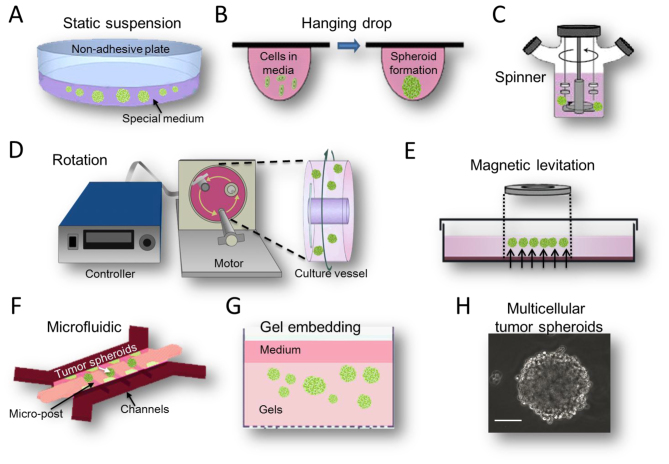
Figure 1.
Figure 1.
Methods available for MCTS formation. These methods include (A) static suspension; (B) hanging drop methods; (C) spinner bioreactor; (D) rotational bioreactor; (E) magnetic levitation; (F) microfluidic system; and (G) gel embedding. (H) A classic MCTS was observed by inverted phase contrast microscope (scale bar, 100 µm). MCTS, multicellular tumor spheroids.
Figure 2.
Figure 2.
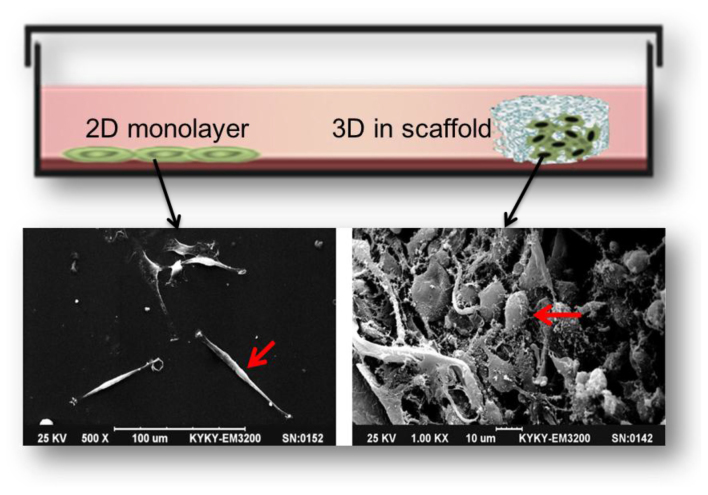
Comparison of tumor cells morphology between 2D and 3D scaffold culture. U87 cells in 2D (left) and 3D scaffold (right) in a scanning electron microscope image (scale bars, 100 and 10 µm). 2D, two dimensional; 3D, three dimensional.

References

    1. Abbott A. Cell culture: Biology's new dimension. Nature. 2003;424:870–872. doi: 10.1038/424870a. - DOI - PubMed
    1. Weigelt B, Ghajar CM, Bissell MJ. The need for complex 3D culture models to unravel novel pathways and identify accurate biomarkers in breast cancer. Adv Drug Deliv Rev. 2014;69–70:42–51. doi: 10.1016/j.addr.2014.01.001. - DOI - PMC - PubMed
    1. Jacks T, Weinberg RA. Taking the study of cancer cell survival to a new dimension. Cell. 2002;111:923–925. doi: 10.1016/S0092-8674(02)01229-1. - DOI - PubMed
    1. Breslin S, O'Driscoll L. Three-dimensional cell culture: The missing link in drug discovery. Drug Discov Today. 2013;18:240–249. doi: 10.1016/j.drudis.2012.10.003. - DOI - PubMed
    1. Griffith LG, Swartz MA. Capturing complex 3D tissue physiology in vitro. Nat Rev Mol Cell Biol. 2006;7:211–224. doi: 10.1038/nrm1858. - DOI - PubMed