. 2017 Dec;14(6):7467-7472.
doi: 10.3892/ol.2017.7153. Epub 2017 Oct 9.

Anticancer effect of triterpenes from Ganoderma lucidum in human prostate cancer cells

Affiliations

Anticancer effect of triterpenes from Ganoderma lucidum in human prostate cancer cells

Lijun Qu et al. Oncol Lett. 2017 Dec.

Abstract

Ganoderma lucidum, within the Polyporaceae family of Basidiomycota, is a popular traditional remedy medicine used in Asia to promote health and longevity. Compounds extracted from G. lucidum have revealed anticancer, antioxidant and liver protective effects. G. lucidum has been associated with prostate cancer cells. G. lucidum extracts contain numerous bioactive components; however, the exact functional monomer is unknown and the role of triterpenes from G. lucidum (GLT) in prostate cancer remain obscure. The present study investigated the effects of GLT on cell viability, migration, invasion and apoptosis in DU-145 human prostate cancer cells. The results demonstrated that a high dose (2 mg/ml) of GLT inhibits cell viability in a dose- and time-dependent manner by the regulation of matrix metalloproteases. Furthermore, GLT induced apoptosis of DU-145 cells. In general, GLT exerts its effect on cancer cells via numerous mechanisms and may have potential therapeutic use for the prevention and treatment of cancer.

Keywords: Ganoderma lucidum; apoptosis; metastasis; prostate cancer; triterpenes.


Figures
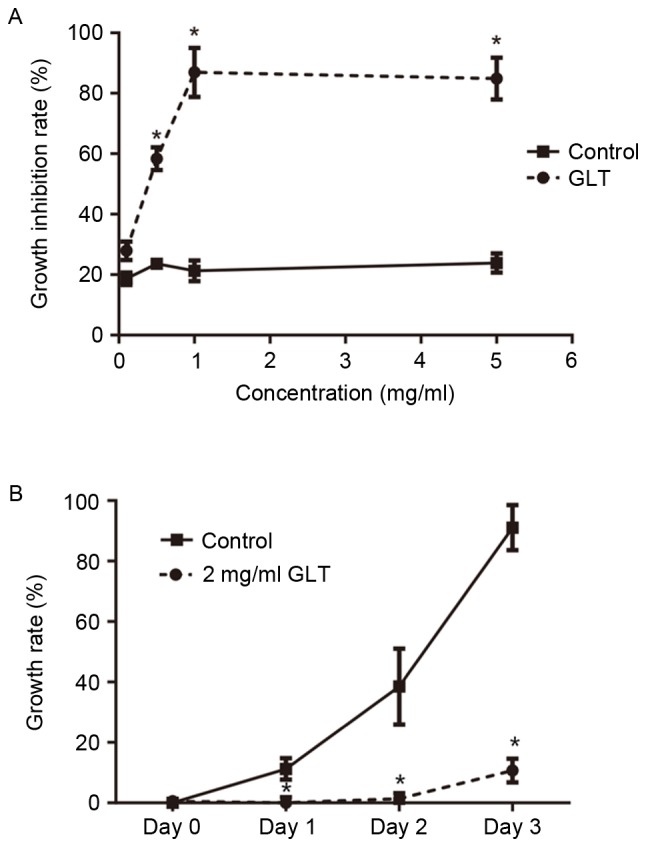
Figure 1.
Figure 1.
GLT inhibits the viability and proliferation of DU-145 prostate cancer cells. (A) DU-145 cells were treated with 0.1, 0.5, 1 and 5 mg/ml GLT for 24 h. Cell viability was determined using an MTT assay. (B) Cultured DU-145 cells were treated with 2 mg/ml GLT for 1, 2 and 3 days. The proliferation rates were determined using an MTT assay. *P<0.05 vs. control. GLT, Ganoderma lucidum triterpene.
Figure 2.
Figure 2.
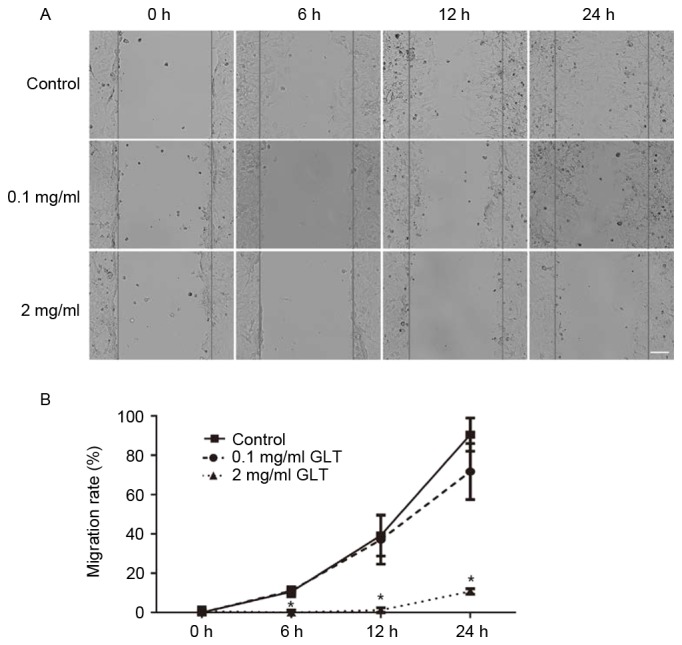
Would healing assay. (A) DU-145 cells were scratched using a fine sterile pipette tip to produce a narrow wound. The medium and debris were aspirated away and replaced with fresh medium in the presence of 0.1 and 2 mg/ml GLT or an equal volume of fresh medium for the control group. Images were captured prior to and 6, 12 and 24 h after the treatments. Scale bar, 20 µm. (B) Quantification of results. *P<0.05 vs. control. GLT, Ganoderma lucidum triterpene.
Figure 3.
Figure 3.
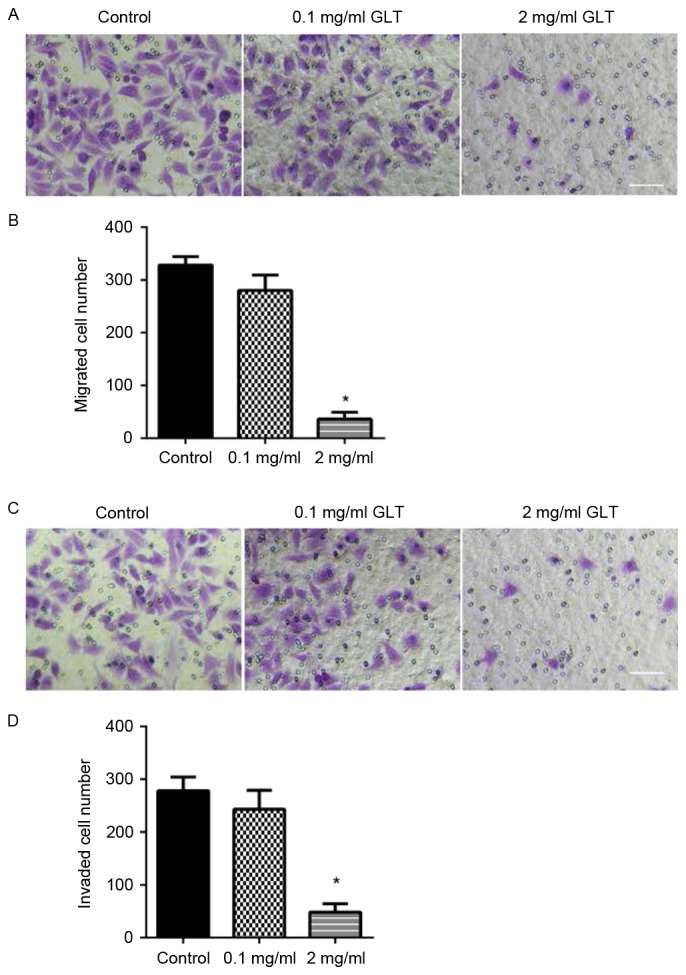
Transwell migration assay and invasion assay. DU-145 cells were placed in the upper invasion chamber and the lower compartment was loaded with DMEM containing 10% FBS. The cell migration chamber was inserted into the lower compartment and incubated at 37°C for 24 h, with or without the administration of GLT at the indicated concentrations. (A) Representative images. (B) Migrated cells were counted. (C) DU-145 cells were seeded at 4×10⁴ cells per well in serum-free DMEM in the upper compartment, with or without various concentrations of GLT and 24 h after the cells were harvested. Representative images. (D) Migrated cells were counted. *P<0.05 vs. control and 0.1 mg/ml groups. Scale bar, 20 µm. GLT, Ganoderma lucidum triterpene; DMEM, Dulbecco's modified Eagle's medium.
Figure 4.
Figure 4.
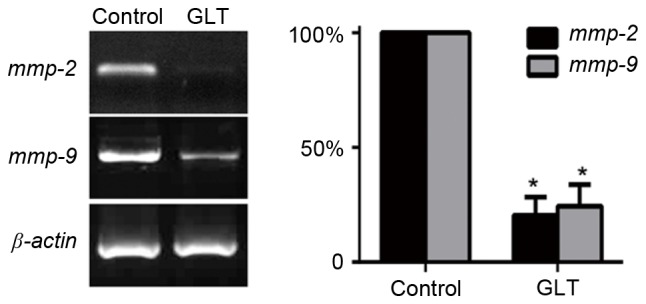
GLT administration suppresses the expression of MMPs. DU-145 cells were treated or not with 2 mg/ml GLT for 24 h, then cells were subjected to the reverse transcription-quantitative polymerase chain reaction. The expression levels of MMP-2 and MMP-9 are presented, with β-actin as the control (left panel). Normalized expression levels of MMPs are presented in the right panel. *P<0.05 vs. control. GLT, Ganoderma lucidum triterpene; MMP, matrix metalloproteinases.
Figure 5.
Figure 5.
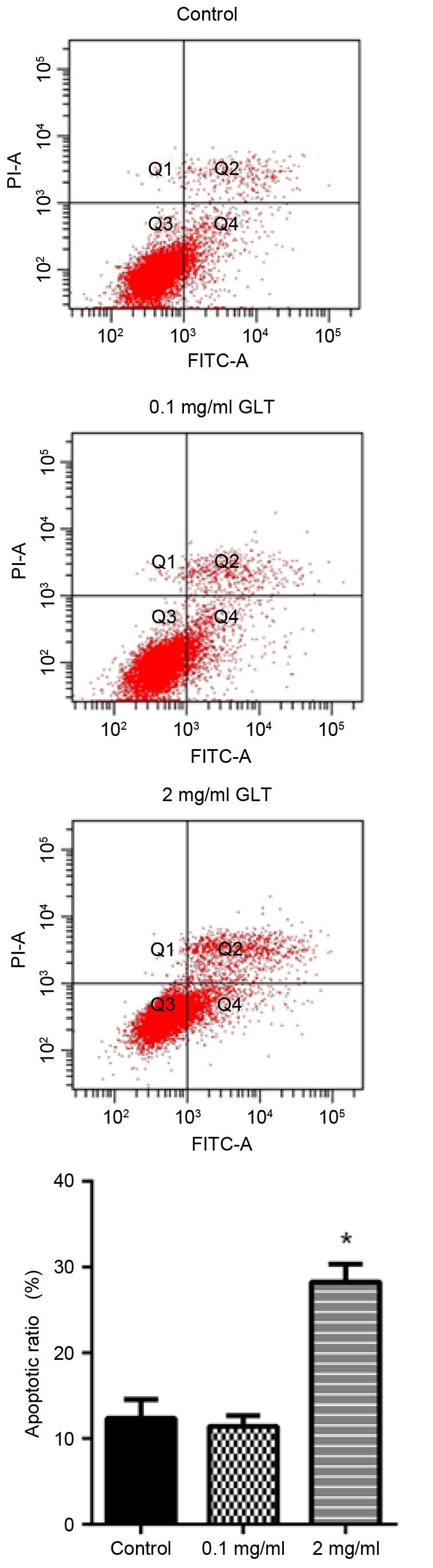
GLT induces the apoptosis of DU-145 cells. DU-145 cells were treated or not with 2 mg/ml GLT for 24 h, then cells were subjected to flow cytometry. The apoptotic rates were analyzed. *P<0.05 vs. control. GLT, Ganoderma lucidum triterpene; FITC, fluorescein isothiocyanate; PI, propidium iodide.

References

    1. Jemal A, Murray T, Samuels A, Ghafoor A, Ward E, Thun MJ. Cancer statistics, 2003. CA Cancer J Clin. 2003;53:5–26. doi: 10.3322/canjclin.53.1.5. - DOI - PubMed
    1. Taichman RS, Loberg RD, Mehra R, Pienta KJ. The evolving biology and treatment of prostate cancer. J Clin Invest. 2007;117:2351–2361. doi: 10.1172/JCI31791. - DOI - PMC - PubMed
    1. Norgaard M, Jensen AØ, Jacobsen JB, Cetin K, Fryzek JP, Sørensen HT. Skeletal related events, bone metastasis and survival of prostate cancer: A population based cohort study in Denmark (1999 to 2007) J Urol. 2010;184:162–167. doi: 10.1016/j.juro.2010.03.034. - DOI - PubMed
    1. Cheung WM, Hui WS, Chu PW, Chiu SW, Ip NY. Ganoderma extract activates MAP kinases and induces the neuronal differentiation of rat pheochromocytoma PC12 cells. FEBS Lett. 2000;486:291–296. doi: 10.1016/S0014-5793(00)02317-6. - DOI - PubMed
    1. Wang SY, Hsu ML, Hsu HC, Tzeng CH, Lee SS, Shiao MS, Ho CK. The anti-tumor effect of Ganoderma lucidum is mediated by cytokines released from activated macrophages and T lymphocytes. Int J Cancer. 1997;70:699–705. doi: 10.1002/(SICI)1097-0215(19970317)70:6<699::AID-IJC12>3.0.CO;2-5. - DOI - PubMed