


The sensitivity of the human thirst response to changes in plasma osmolality: a systematic review
- PMID: 29344350
- PMCID: PMC5763530
- DOI: 10.1186/s13741-017-0081-4
The sensitivity of the human thirst response to changes in plasma osmolality: a systematic review
Abstract
Background: Dehydration is highly prevalent and is associated with adverse cardiovascular and renal events. Clinical assessment of dehydration lacks sensitivity. Perhaps a patient's thirst can provide an accurate guide to fluid therapy. This systematic review examines the sensitivity of thirst in responding to changes in plasma osmolality in participants of any age with no condition directly effecting their sense of thirst.
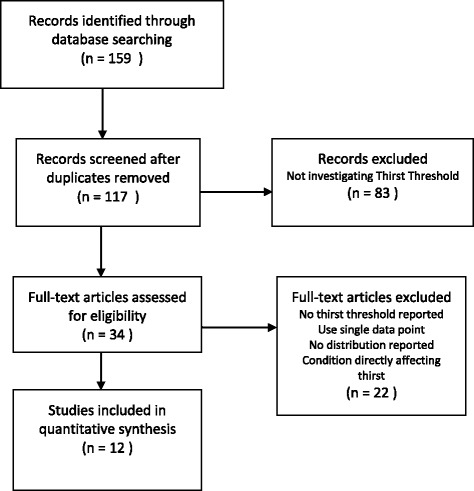
Methods: Medline and EMBASE were searched up to June 2017. Inclusion criteria were all studies reporting the plasma osmolality threshold for the sensation of thirst.
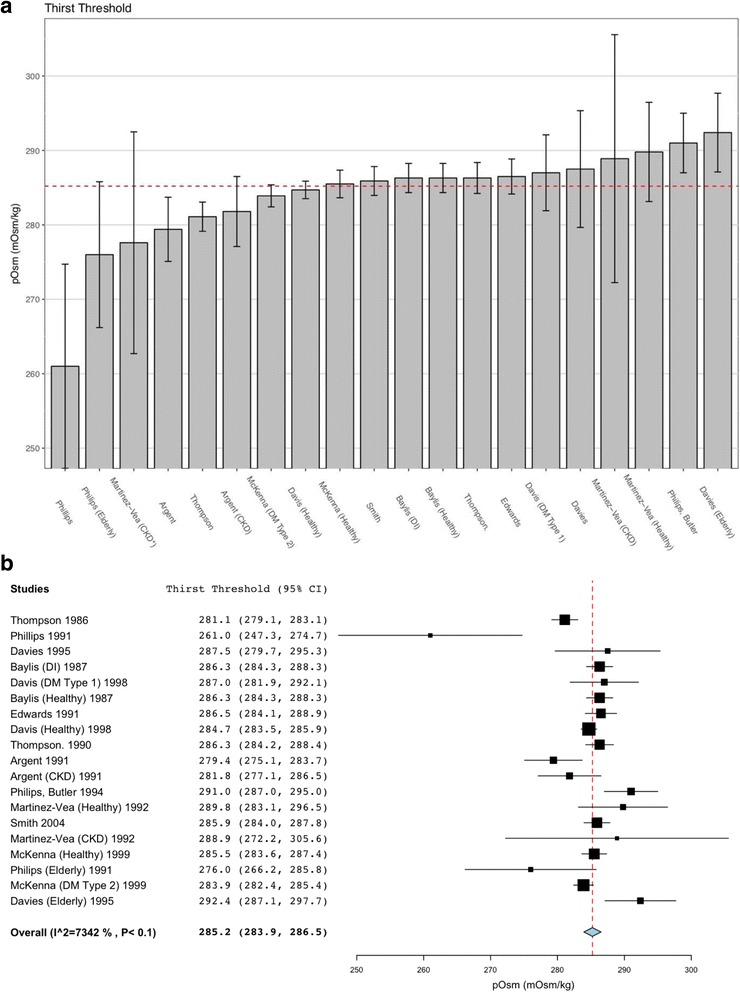
Results: A total of 12 trials were included that assessed thirst intensity on a visual analogue scale, as a function of plasma osmolality (pOsm), and employed linear regression to define the thirst threshold. This included 167 participants, both healthy controls and those with a range of pathologies, with a mean age of 41 (20-78) years.The value ±95% CI for the pOsm threshold for thirst sensation was found to be 285.23 ± 1.29 mOsm/kg. Above this threshold, thirst intensity as a function of pOsm had a mean ± SEM slope of 0.54 ± 0.07 cm/mOsm/kg. The mean ± 95% CI vasopressin release threshold was very similar to that of thirst, being 284.3 ± 0.71 mOsm/kg.Heterogeneity across studies can be accounted for by subtle variation in experimental protocol and data handling.
Conclusion: The thresholds for thirst activation and vasopressin release lie in the middle of the normal range of plasma osmolality. Thirst increases linearly as pOsm rises. Thus, osmotically balanced fluid administered as per a patient's sensation of thirst should result in a plasma osmolality within the normal range. This work received no funding.
Keywords: Dehydration; Osmoregulation; Thirst.
Conflict of interest statement
Not applicable.Not Applicable.FH declares that he/she has no competing interests. HM and MM are named co-inventors on a patent relating to a device to allow patient-controlled fluid delivery. MM is a paid consultant for Edwards Lifesciences and Deltex. MM is also University Chair endowed by Smiths Medical.Springer Nature remains neutral with regard to jurisdictional claims in published maps and institutional affiliations.
Figures

References
-
- Association HP . Listen to patients, speak up for change. 2010.
Publication types
LinkOut - more resources
Full Text Sources
Other Literature Sources
