


Green and Sustainable Separation of Natural Products from Agro-Industrial Waste: Challenges, Potentialities, and Perspectives on Emerging Approaches
- PMID: 29344754
- PMCID: PMC5772139
- DOI: 10.1007/s41061-017-0182-z
Green and Sustainable Separation of Natural Products from Agro-Industrial Waste: Challenges, Potentialities, and Perspectives on Emerging Approaches
Abstract
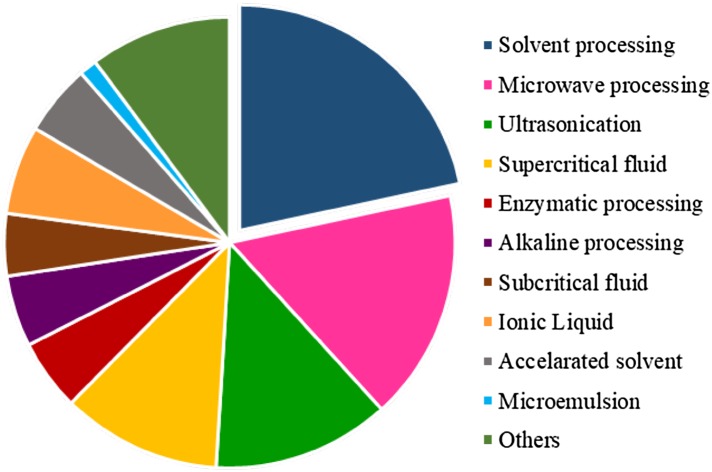
New generations of biorefinery combine innovative biomass waste resources from different origins, chemical extraction and/or synthesis of biomaterials, biofuels, and bioenergy via green and sustainable processes. From the very beginning, identifying and evaluating all potentially high value-added chemicals that could be removed from available renewable feedstocks requires robust, efficient, selective, reproducible, and benign analytical approaches. With this in mind, green and sustainable separation of natural products from agro-industrial waste is clearly attractive considering both socio-environmental and economic aspects. In this paper, the concepts of green and sustainable separation of natural products will be discussed, highlighting the main studies conducted on this topic over the last 10 years. The principal analytical techniques (such as solvent, microwave, ultrasound, and supercritical treatments), by-products (e.g., citrus, coffee, corn, and sugarcane waste) and target compounds (polyphenols, proteins, essential oils, etc.) will be presented, including the emerging green and sustainable separation approaches towards bioeconomy and circular economy contexts.
Keywords: Bioeconomy and circular economy; Biomass waste; Biorefinery; Green analytical techniques; Green and sustainable extraction; Sustainable separation.
Figures
References
-
- Liu J, Mooney H, Hull V, Davis SJ, Gaskell J, Hertel T, Lubchenco J, Seto KC, Gleick P, Kremen C, Li S. Systems integration for global sustainability. Science. 2015;347:12588320–12588329. - PubMed
-
- Kiser B. Circular economy: getting the circulation going. Nature. 2016;53:443–446. - PubMed
-
- Food and Agriculture Organization of the United Nations. World hunger on the rise again, reversing years of progress. http://www.fao.org/news/story/en/item/902489/icode/. Accessed 03 Jul 2017
-
- United Nations (2015) World Population prospects: the 2015 revision and key findings and advance tables. United Nations, New York. https://esa.un.org/unpd/wpp/publications/files/key_findings_wpp_2015.pdf. Accessed 20 Oct 2016
Publication types
MeSH terms
Substances
Grants and funding
LinkOut - more resources
Full Text Sources
Other Literature Sources