


Seroprevalence of Helicobacter pylori in Korea: A multicenter, nationwide study conducted in 2015 and 2016
- PMID: 29345022
- PMCID: PMC5900911
- DOI: 10.1111/hel.12463
Seroprevalence of Helicobacter pylori in Korea: A multicenter, nationwide study conducted in 2015 and 2016
Abstract
Background: The Korean College of Helicobacter and Upper Gastrointestinal Research has studied Helicobacter pylori (H. pylori) prevalence since 1998 and found a dynamic change in its prevalence in Korea. The aim of this study was to determine the recent H. pylori prevalence rate and compare it with that of previous studies according to socioeconomic variables.
Methods: We planned to enroll 4920 asymptomatic Korean adults from 21 centers according to the population distribution of seven geographic areas (Seoul, Gyeonggi, Gangwon, Chungcheong, Kyungsang, Cholla, and Jeju). We centrally collected serum and tested H. pylori serum IgG using a chemiluminescent enzyme immunoassay.
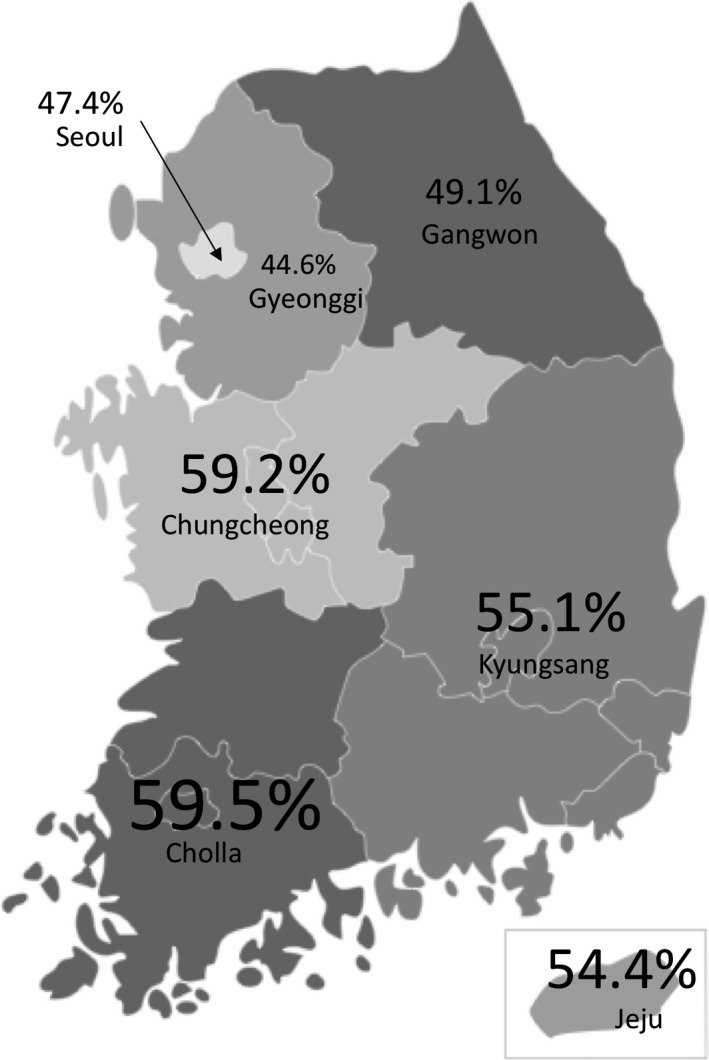
Results: We analyzed 4917 samples (4917/4920 = 99.9%) from January 2015 to December 2016. After excluding equivocal serologic results, the H. pylori seropositivity rate was 51.0% (2414/4734). We verified a decrease in H. pylori seroprevalence compared with previous studies performed in 1998, 2005, and 2011 (P < .0001). The H. pylori seroprevalence rate differed by area: Cholla (59.5%), Chungcheong (59.2%), Kyungsang (55.1%), Jeju (54.4%), Gangwon (49.1%), Seoul (47.4%), and Gyeonggi (44.6%). The rate was higher in those older than 40 years (38.1% in those aged 30-39 years and 57.7% in those aged 40-49 years) and was lower in city residents than in noncity residents at all ages.
Conclusions: Helicobacter pylori seroprevalence in Korea is decreasing and may vary according to population characteristics. This trend should be considered to inform H. pylori-related policies.
Keywords: Helicobacter pylori; Korea; prevalence.
© 2018 The Authors. Helicobacter Published by John Wiley & Sons Ltd.
Figures


References
-
- Hooi JKY, Lai WY, Ng WK, et al. Global prevalence of Helicobacter pylori Infection: systematic review and meta‐analysis. Gastroenterology. 2017;153:420‐429. - PubMed
-
- Malfertheiner P, Megraud F, O'Morain CA, et al. Management of Helicobacter pylori infection‐the Maastricht V/Florence consensus report. Gut. 2017;66:6‐30. - PubMed
-
- Plummer M, Franceschi S, Vignat J, Forman D, de Martel C. Global burden of gastric cancer attributable to Helicobacter pylori . Int J Cancer. 2015;136:487‐490. - PubMed
-
- Torre LA, Bray F, Siegel RL, Ferlay J, Lortet‐Tieulent J, Jemal A. Global cancer statistics, 2012. CA Cancer J Clin. 2015;65:87‐108. - PubMed
-
- Pan KF, Zhang L, Gerhard M, et al. A large randomised controlled intervention trial to prevent gastric cancer by eradication of Helicobacter pylori in Linqu County, China: baseline results and factors affecting the eradication. Gut. 2016;65:9‐18. - PubMed
MeSH terms
LinkOut - more resources
Full Text Sources
Other Literature Sources
