Review
. 2018 Jan 18;9(1):11.
doi: 10.3390/jfb9010011.

Formulation of Poloxamers for Drug Delivery

Affiliations
Review

Formulation of Poloxamers for Drug Delivery

Andrew M Bodratti et al. J Funct Biomater. .

Abstract

Poloxamers, also known as Pluronics®, are block copolymers of poly(ethylene oxide) (PEO) and poly(propylene oxide) (PPO), which have an amphiphilic character and useful association and adsorption properties emanating from this. Poloxamers find use in many applications that require solubilization or stabilization of compounds and also have notable physiological properties, including low toxicity. Accordingly, poloxamers serve well as excipients for pharmaceuticals. Current challenges facing nanomedicine revolve around the transport of typically water-insoluble drugs throughout the body, followed by targeted delivery. Judicious design of drug delivery systems leads to improved bioavailability, patient compliance and therapeutic outcomes. The rich phase behavior (micelles, hydrogels, lyotropic liquid crystals, etc.) of poloxamers makes them amenable to multiple types of processing and various product forms. In this review, we first present the general solution behavior of poloxamers, focusing on their self-assembly properties. This is followed by a discussion of how the self-assembly properties of poloxamers can be leveraged to encapsulate drugs using an array of processing techniques including direct solubilization, solvent displacement methods, emulsification and preparation of kinetically-frozen nanoparticles. Finally, we conclude with a summary and perspective.

Keywords: Pluronic; anticancer; excipient; formulation; hydrogel; micelle; nanomedicine; nanoparticle; poly(ethylene glycol); poly(ethylene oxide); solubilization.


Conflict of interest statement

The authors declare no conflict of interest.

Figures
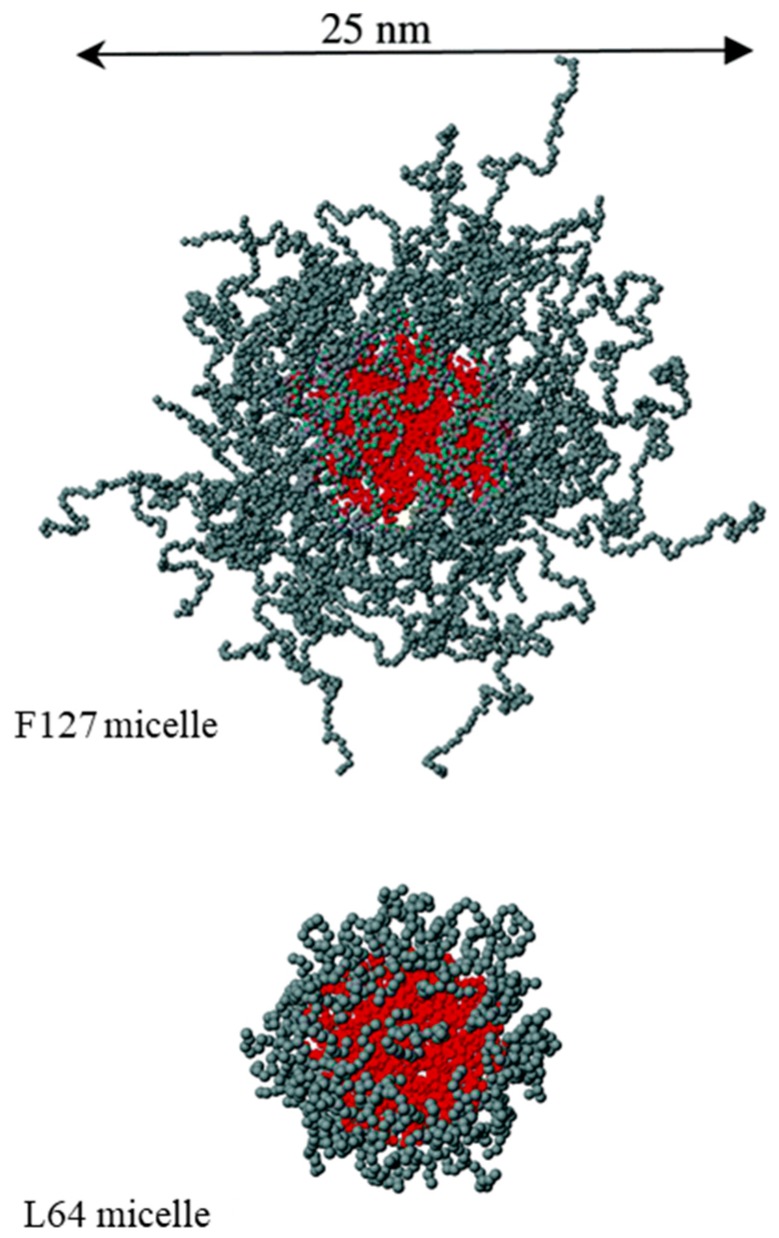
Figure 1
Figure 1
Configurations of Pluronic® F127 (EO100PO65EO100) and L64 (EO13PO30EO13) micelles determined from coarse-grained implicit solvent simulations. The micelle core is made up of the PPO blocks, while the corona is formed from the PEO blocks. Reprinted with permission from [55]. Copyright 2006 American Chemical Society.
Figure 2
Figure 2
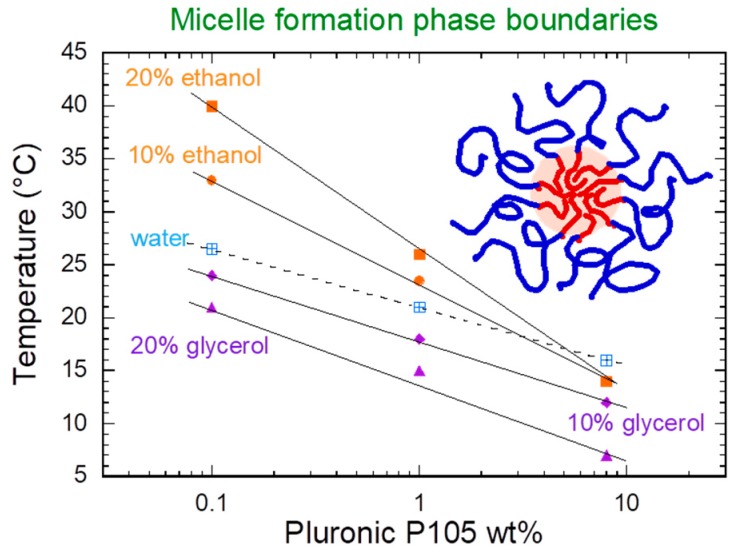
Micellization boundaries for aqueous Pluronic® P105 (EO27PO56EO27) solutions with added polar organic solvents. Micelles form at poloxamer concentrations and temperatures above the lines. Note that the micellization boundaries shift depending on the quality of the solvent. Data obtained from [69].
Figure 3
Figure 3
Ternary isothermal phase diagram of Pluronic® P84 (EO19PO43EO19) in water and p-xylene at 25 °C. l1, H1, V1, Lα, V2, H2 and l2 indicate normal (“oil-in-water”) micellar cubic, normal hexagonal, normal bicontinuous cubic, lamellar, reverse (“water-in-oil”) bicontinuous cubic, reverse hexagonal and reverse micellar lyotropic liquid crystalline phases, respectively. L1 and L2 indicate normal micellar and reverse micellar solutions. Reprinted with permission from [47]. Copyright 1998 American Chemical Society.
Figure 4
Figure 4
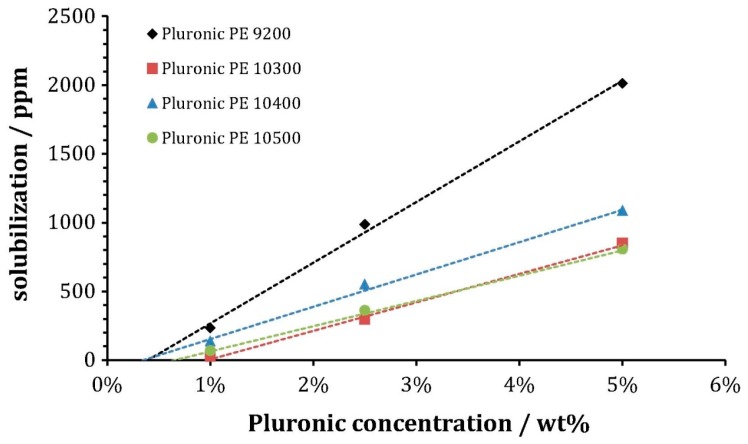
The amount of hydrophobic fenofibrate, a cholesterol reducer, solubilized in aqueous poloxamer solution increases linearly with block copolymer concentration. The fenofibrate was added to micellar aqueous poloxamer solutions and allowed to equilibrate for 24 h at 25 °C. Pluronic® PE 9200 (EO8PO47EO8), 10300 (EO16PO56EO16), 10400 (EO25PO56EO25) and 10500 (EO37PO56EO37). Reprinted from [92], Copyright 2016, with permission from Elsevier.
Figure 5
Figure 5
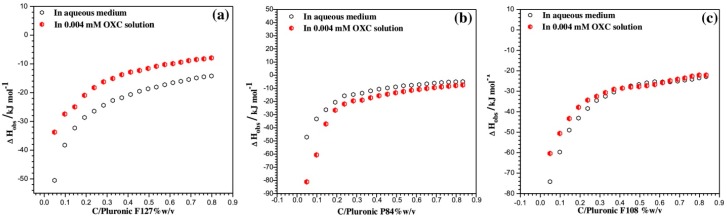
ITC curves generated from ITC experiments for the titration of different poloxamers ((a) Pluronic F127; (b) Pluronic P84; (c) Pluronic F108) into water (empty symbols) and aqueous 0.004 mM oxcarbazepine (OXC) solutions (filled symbols) at 37 °C. OXC is used to reduce the frequency of epileptic occurrences. The micellization process was endothermic for all poloxamers in both solutions. The presence of OXC made the micellization of Pluronic F127 (EO100PO65EO100) and F108 (EO132PO50EO132) less endothermic due to its interaction with the long PEO blocks. The micellization process was more endothermic in Pluronic® P84 (EO19PO43EO19) solutions, owing to strong hydrophobic interactions with the PPO block. Reprinted from [93], Copyright 2016, with permission from Elsevier.
Figure 6
Figure 6
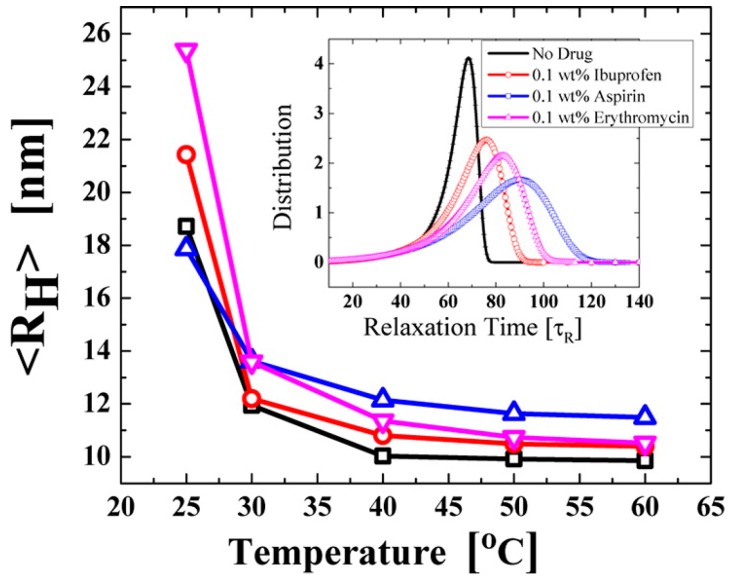
Dynamic light scattering measurement of aqueous 5.26 wt % F127-drug systems: no drug (squares), 0.1 wt % ibuprofen (circles), 0.1 wt % aspirin (up-triangles) and 0.1 wt % erythromycin (down-triangles). The drug was added to micellar F127 solutions by vigorous mixing at temperatures between 40 and 60 °C. The average hydrodynamic radius (RH) of the micelles decreased sharply with temperature at first. Aspirin, the least hydrophobic drug, led to the formation of the largest and most polydisperse micelles. The distribution of relaxation times, which were calculated from the autocorrelation scattering functions from the DLS measurement, is shown in the inset: no drugs (solid line), 0.1 wt % ibuprofen (circle-line), 0.1 wt % aspirin (square-line) and 0.1 wt % erythromycin (triangle-line). Wide distributions indicate high polydispersity. Ibuprofen, the most hydrophobic of the evaluated drugs, produced the most compact structures, while it resulted in the least polydisperse micelles. Reprinted with permission from [99]. Copyright 2013 American Chemical Society.
Figure 7
Figure 7
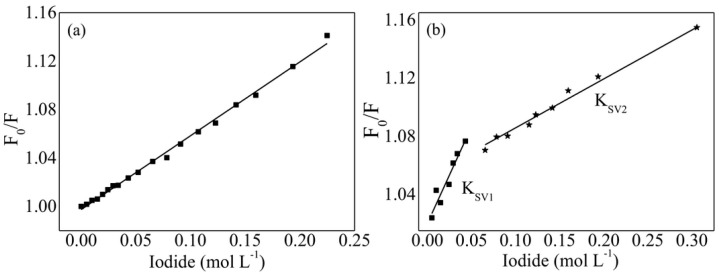
Stern–Volmer plots for (a) ERY-F127, where ERY is erythrosine, and (b) ERYBUT-F127, where ERYBUT is a butylated erythrosine ester derivative. Fo and F represent the fluorescence intensity of the photosensitizer in the absence and presence, respectively, of iodide, a water-soluble quencher. The samples were prepared by the ethanol thin film hydration method; micelles were re-dispersed by stirring with water at 60 °C for 8 h. In (b), two populations are observed. “ΚSV1” and “ΚSV2” correspond to ERYBUT located near the PEO (corona) and PPO (core) regions, respectively. Reprinted from [112]. Copyright 2016 Wiley.
Figure 8
Figure 8
Preparation of kinetically-frozen surfactant-stripped drug-loaded nanoparticles. The process is initiated by dissolving the desired active ingredient in 10% w/v of Pluronic® F127 (EO100PO65EO100) to produce drug-loaded micelles. As the temperature is decreased below the critical micellization temperature (to a temperature of 4 °C in this example), a majority of the self-assembled poloxamer chains dissociate away as unimers. The unimers are dialyzed out of the system, leaving behind poloxamer-stabilized nanoparticles [142].

References

    1. Moghimi S.M., Hunter A.C. Poloxamers and poloxamines in nanoparticle engineering and experimental medicine. Trends Biotechnol. 2000;18:412–420. doi: 10.1016/S0167-7799(00)01485-2. - DOI - PubMed
    1. Roy D., Cambre J.N., Sumerlin B.S. Future perspectives and recent advances in stimuli-responsive materials. Prog. Polym. Sci. 2010;35:278–301. doi: 10.1016/j.progpolymsci.2009.10.008. - DOI
    1. Herzberger J., Niederer K., Pohlit H., Seiwert J., Worm M., Wurm F.R., Frey H. Polymerization of Ethylene Oxide, Propylene Oxide, and Other Alkylene Oxides: Synthesis, Novel Polymer Architectures, and Bioconjugation. Chem. Rev. 2016;116:2170–2243. doi: 10.1021/acs.chemrev.5b00441. - DOI - PubMed
    1. Bodratti A.M., Sarkar B., Alexandridis P. Adsorption of poly(ethylene oxide)-containing amphiphilic polymers on solid-liquid interfaces: Fundamentals and applications. Adv. Colloid Interface Sci. 2017;244:132–163. doi: 10.1016/j.cis.2016.09.003. - DOI - PubMed
    1. Sarkar B., Venugopal V., Bodratti A.M., Tsianou M., Alexandridis P. Nanoparticle surface modification by amphiphilic polymers in aqueous media: Role of polar organic solvents. J. Colloid Interface Sci. 2013;397:1–8. doi: 10.1016/j.jcis.2013.01.034. - DOI - PubMed