


Current Cigarette Smoking Among Adults - United States, 2016
- PMID: 29346338
- PMCID: PMC5772802
- DOI: 10.15585/mmwr.mm6702a1
Current Cigarette Smoking Among Adults - United States, 2016
Abstract
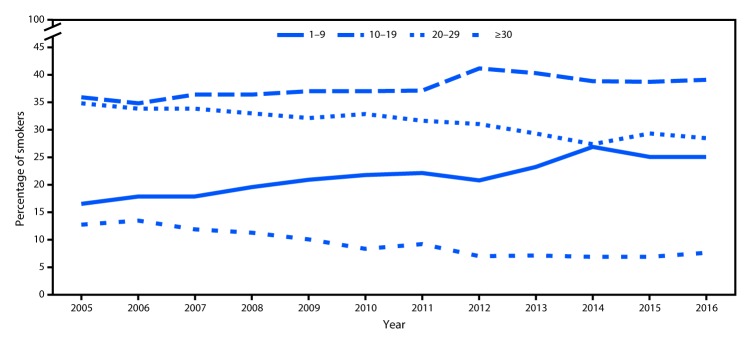
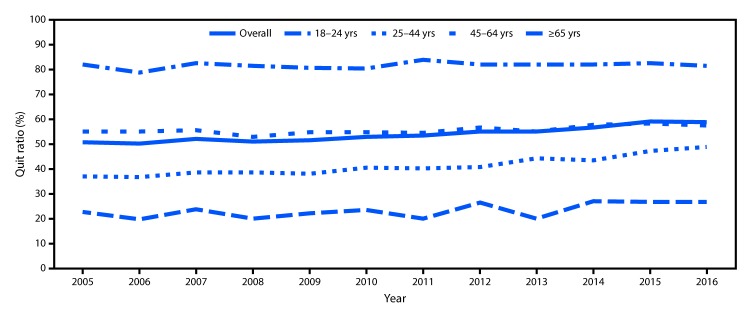
The U.S. Surgeon General has concluded that the burden of death and disease from tobacco use in the United States is overwhelmingly caused by cigarettes and other combusted tobacco products (1). Cigarettes are the most commonly used tobacco product among U.S. adults, and about 480,000 U.S. deaths per year are caused by cigarette smoking and secondhand smoke exposure (1). To assess progress toward the Healthy People 2020 target of reducing the proportion of U.S. adults aged ≥18 years who smoke cigarettes to ≤12.0% (objective TU-1.1),* CDC analyzed data from the 2016 National Health Interview Survey (NHIS). In 2016, the prevalence of current cigarette smoking among adults was 15.5%, which was a significant decline from 2005 (20.9%); however, no significant change has occurred since 2015 (15.1%). In 2016, the prevalence of cigarette smoking was higher among adults who were male, aged 25-64 years, American Indian/Alaska Native or multiracial, had a General Education Development (GED) certificate, lived below the federal poverty level, lived in the Midwest or South, were uninsured or insured through Medicaid, had a disability/limitation, were lesbian, gay, or bisexual (LGB), or had serious psychological distress. During 2005-2016, the percentage of ever smokers who quit smoking increased from 50.8% to 59.0%. Proven population-based interventions are critical to reducing the health and economic burden of smoking-related diseases among U.S. adults, particularly among subpopulations with the highest smoking prevalences (1,2).
Conflict of interest statement
No conflicts of interest were reported.
Figures
References
-
- US Department of Health and Human Services. The health consequences of smoking—50 years of progress: a report of the Surgeon General. Atlanta, GA: US Department of Health and Human Services, CDC, Coordinating Center for Health Promotion, National Center for Chronic Disease Prevention and Health Promotion, Office on Smoking and Health, 2014. http://www.surgeongeneral.gov/library/reports/50-years-of-progress/full-...
-
- CDC. Best practices for comprehensive tobacco control programs—2014. Atlanta: US Department of Health and Human Services, CDC, National Center for Chronic Disease Prevention and Health Promotion, Office on Smoking and Health, 2014. https://www.cdc.gov/tobacco/stateandcommunity/best_practices/index.htm
-
- Siahpush M, McNeill A, Hammond D, Fong GT. Socioeconomic and country variations in knowledge of health risks of tobacco smoking and toxic constituents of smoke: results from the 2002 International Tobacco Control (ITC) Four Country Survey. Tob Control 2006;15(Suppl 3):iii65–70. 10.1136/tc.2005.013276 - DOI - PMC - PubMed
MeSH terms
LinkOut - more resources
Full Text Sources
Other Literature Sources
Medical
