Geographical distribution of soil transmitted helminths and the effects of community type in South Asia and South East Asia - A systematic review
- PMID: 29346440
- PMCID: PMC5773013
- DOI: 10.1371/journal.pntd.0006153
Geographical distribution of soil transmitted helminths and the effects of community type in South Asia and South East Asia - A systematic review
Abstract
Background: Soil-transmitted helminth (STH) infections are among the most prevalent neglected tropical diseases (NTD) worldwide. Since the publication of the WHO road map to combat NTD in 2012, there has been a renewed commitment to control STH. In this study, we analysed the geographical distribution and effect of community type on prevalence of hookworm, Trichuris and Ascaris in south Asia and south east Asia.
Methodology: We conducted a systematic review of open-access literature published in PubMed Central and the Global Atlas of Helminth Infection. A total of 4182 articles were available and after applying selection criteria, 174 studies from the region were retained for analysis.
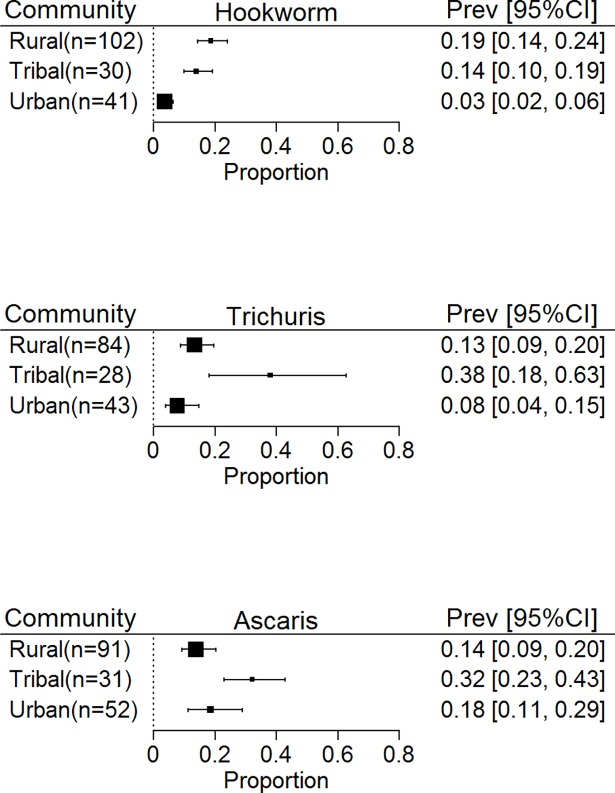
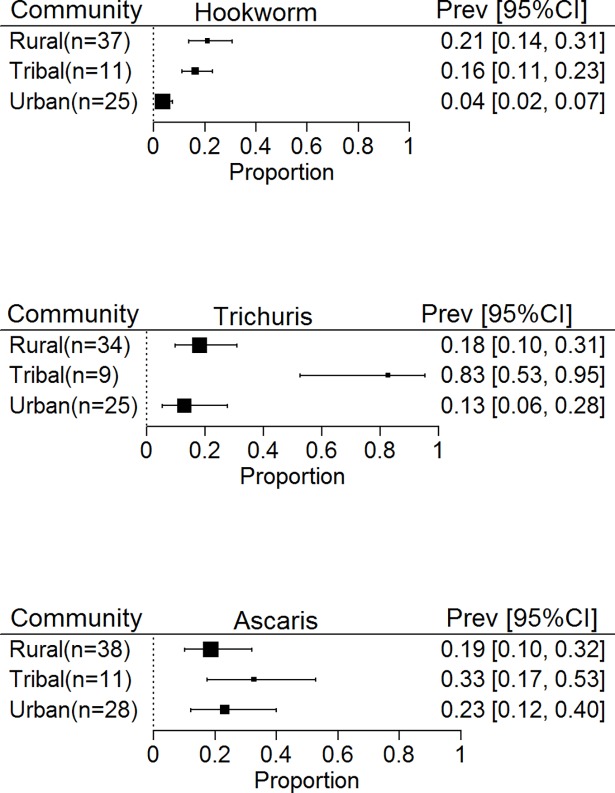
Principal findings: Ascaris was the commonest STH identified with an overall prevalence of 18% (95% CI, 14-23%) followed by Trichuris (14%, 9-19%) and hookworm (12%, 9-15%). Hookworm prevalence was highest in Laos, Vietnam and Cambodia. We found a geographical overlap in countries with high prevalence rates for Trichuris and Ascaris (Malaysia, Philippines, Myanmar, Vietnam and Bangladesh). When the effect of community type was examined, prevalence rates of hookworm was comparable in rural (19%, 14-24%) and tribal communities (14%, 10-19%). Tribal communities, however, showed higher prevalence of Trichuris (38%, 18-63%) and Ascaris (32%, 23-43%) than rural communities (13%, 9-20% and 14%, 9-20% respectively). Considerable between and within country heterogeneity in the distribution of STH (I2 >90%) was also noted. When available data from school aged children (SAC) were analysed, prevalence of Ascaris (25% 16-31%) and Trichuris (22%, 14-34%) were higher than among the general population while that of hookworm (10%, 7-16%) was comparable.
Conclusions/significance: Our analysis showed significant variation in prevalence rates between and within countries in the region. Highlighting the importance of community type in prevalence and species mix, we showed that tribal and rural communities had higher hookworm infections than urban communities and for ascariasis and trichuriasis, tribal populations had higher levels of infection than rural populations. We also found a higher prevalence of ascariasis and trichuriasis in SAC compared to the general population but comparable levels of hookworm infections. These key findings need to be taken into account in planning future MDA and other interventions.
Conflict of interest statement
The authors have declared that no competing interests exist.
Figures


References
-
- Hotez PJ, Alibek K. Central Asia's hidden burden of neglected tropical diseases. PLoS neglected tropical diseases. 2011;5(9):e1224 Epub 2011/10/08. doi: 10.1371/journal.pntd.0001224 ; PubMed Central PMCID: PMCPMC3181239. - DOI - PMC - PubMed
-
- Pullan RL, Smith JL, Jasrasaria R, Brooker SJ. Global numbers of infection and disease burden of soil transmitted helminth infections in 2010. Parasites & vectors. 2014;7:37 Epub 2014/01/23. doi: 10.1186/1756-3305-7-37 ; PubMed Central PMCID: PMCPMC3905661. - DOI - PMC - PubMed
-
- Stoltzfus RJ, Kvalsvig JD, Chwaya HM, Montresor A, Albonico M, Tielsch JM, et al. Effects of iron supplementation and anthelmintic treatment on motor and language development of preschool children in Zanzibar: double blind, placebo controlled study. BMJ (Clinical research ed). 2001;323(7326):1389–93. Epub 2001/12/18. ; PubMed Central PMCID: PMCPMC60982. - PMC - PubMed
-
- Awasthi S, Pande VK, Fletcher RH. Effectiveness and cost-effectiveness of albendazole in improving nutritional status of pre-school children in urban slums. Indian pediatrics. 2000;37(1):19–29. Epub 2000/04/04. . - PubMed
-
- Gyorkos TW, Gilbert NL. Blood drain: soil-transmitted helminths and anemia in pregnant women. PLoS neglected tropical diseases. 2014;8(7):e2912 Epub 2014/07/11. doi: 10.1371/journal.pntd.0002912 ; PubMed Central PMCID: PMCPMC4091787. - DOI - PMC - PubMed
Publication types
MeSH terms
Grants and funding
LinkOut - more resources
Full Text Sources
Other Literature Sources