


What should be included in the assessment of laypersons' paediatric basic life support skills? Results from a Delphi consensus study
- PMID: 29347956
- PMCID: PMC5774155
- DOI: 10.1186/s13049-018-0474-5
What should be included in the assessment of laypersons' paediatric basic life support skills? Results from a Delphi consensus study
Abstract
Background: Assessment of laypersons' Paediatric Basic Life Support (PBLS) skills is important to ensure acquisition of effective PBLS competencies. However limited evidence exists on which PBLS skills are essential for laypersons. The same challenges exist with respect to the assessment of foreign body airway obstruction management (FBAOM) skills. We aimed to establish international consensus on how to assess laypersons' PBLS and FBAOM skills.
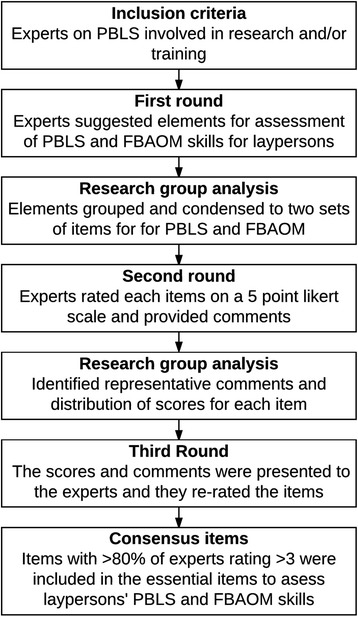
Methods: A Delphi consensus survey was conducted. Out of a total of 84 invited experts, 28 agreed to participate. During the first Delphi round experts suggested items to assess laypersons' PBLS and FBAOM skills. In the second round, the suggested items received comments from and were rated by 26 experts (93%) on a 5-point scale (1 = not relevant to 5 = essential). Revised items were anonymously presented in a third round for comments and 23 (82%) experts completed a re-rating. Items with a score above 3 by more than 80% of the experts in the third round were included in an assessment instrument.
Results: In the first round, 19 and 15 items were identified to assess PBLS and FBAOM skills, respectively. The ratings and comments from the last two rounds resulted in nine and eight essential assessment items for PBLS and FBAOM skills, respectively. The PBLS items included: "Responsiveness"," Call for help", "Open airway"," Check breathing", "Rescue breaths", "Compressions", "Ventilations", "Time factor" and "Use of AED". The FBAOM items included: "Identify different stages of foreign body airway obstruction", "Identify consciousness", "Call for help", "Back blows", "Chest thrusts/abdominal thrusts according to age", "Identify loss of consciousness and change to CPR", "Assessment of breathing" and "Ventilation".
Discussion: For assessment of laypersons some PBLS and FBAOM skills described in guidelines are more important than others. Four out of nine of PBLS skills focus on airway and breathing skills, supporting the major importance of these skills for laypersons' resuscitation attempts.
Conclusions: International consensus on how to assess laypersons' paediatric basic life support and foreign body airway obstruction management skills was established. The assessment of these skills may help to determine when laypersons have acquired competencies.
Trial registration: Not relevant.
Keywords: Assessment; Education, International consensus; Layperson; Paediatric basic life support; Training.
Conflict of interest statement
Ethics approval and consent to participate
Participants provided informed consent. Danish law exempts educational studies from ethical approval because they do not involve patients. An exemption letter from the Ethical Committee of the Capital Region Copenhagen, Denmark was obtained (protocol No. 15019693).
Consent for publication
Not applicable
Competing interests
The authors declare that they have no competing interests.
Publisher’s Note
Springer Nature remains neutral with regard to jurisdictional claims in published maps and institutional affiliations.
Figures
References
-
- Kitamura T, Iwami T, Kawamura T, Nagao K, Tanaka H, Nadkarni VM, et al. Conventional and chest-compression-only cardiopulmonary resuscitation by bystanders for children who have out-of-hospital cardiac arrests: a prospective, nationwide, population-based cohort study. Lancet. 2010;375(9723):1347–1354. doi: 10.1016/S0140-6736(10)60064-5. - DOI - PubMed
MeSH terms
Grants and funding
LinkOut - more resources
Full Text Sources
Other Literature Sources
Medical
Miscellaneous
