. 2017 Sep;2(6):537-545.
doi: 10.1016/j.bpsc.2017.03.008. Epub 2017 Mar 18.

Executive Dysfunction in Autism Spectrum Disorder Is Associated With a Failure to Modulate Frontoparietal-insular Hub Architecture

Affiliations

Executive Dysfunction in Autism Spectrum Disorder Is Associated With a Failure to Modulate Frontoparietal-insular Hub Architecture

Charles J Lynch et al. Biol Psychiatry Cogn Neurosci Neuroimaging. 2017 Sep.

Abstract

Background: Comorbid executive dysfunction in autism spectrum disorder (ASD) is a barrier to adaptive functioning, despite remittance of core social-communication symptoms. Network models of ASD address core symptoms but not comorbid executive dysfunction. Following recent demonstrations in healthy adults that, with increasing executive demands, hubs embedded within frontoparietal-insular control networks interact with a more diverse set of networks, we hypothesized that the capability of hubs to do so is perturbed in ASD and predicts executive behavior.

Methods: Seventy-five 7- to 13-year-old children with ASD (n = 35) and age- and IQ-matched typically developing control subjects (n = 40) completed both a resting-state and a selective attention task functional magnetic resonance imaging session. We assessed changes in the participation coefficient, a graph theory metric indexing hubness, of 264 brain regions comprising 12 functional networks between the two sessions. Parent reported executive impairment in everyday life was measured using the Behavior Rating Inventory of Executive Function.

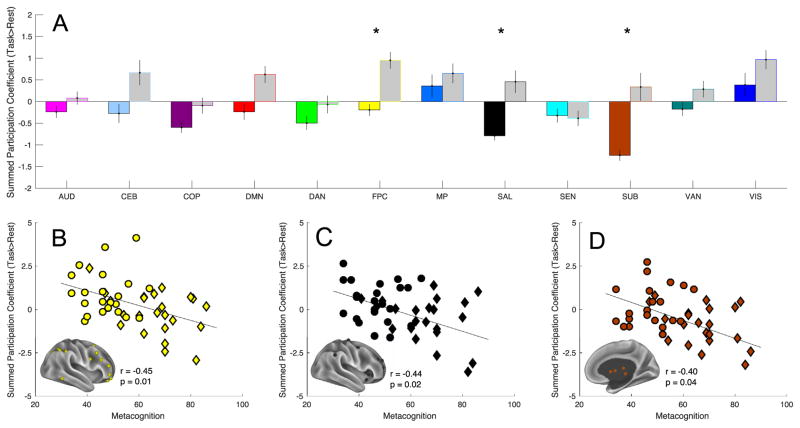
Results: The participation coefficient of the frontoparietal-insular cortex, including core nodes of the frontoparietal control and salience networks, significantly increased in typically developing children but not in children with ASD during the task relative to rest. Change in frontoparietal-insular participation coefficient predicted Behavior Rating Inventory of Executive Function scores indexing the ability to attend to task-oriented output, plan and organize, and sustain working memory.

Conclusions: Our results suggest that executive impairments in ASD emerge from a failure of frontoparietal-insular control regions to function as adaptive and integrative hubs in the brain's functional network architecture. Our results also demonstrate the utility of examining dynamic network function for elucidating potential biomarkers for disorders with comorbid executive dysfunction.

Keywords: Autism; Frontoparietal; Graph theory; Hubs; Networks; fMRI.


Figures

Figure 1
Figure 1
Regions of interest and network assignments (A). Typically developing children demonstrated significant task-induced increase (task > rest) in the participation coefficient of the frontoparietal control (FPC) network (B). Autism spectrum disorder children demonstrated significant task-induced decrease (task < rest) in the participation coefficient of the subcortical (SUB) network (C). *Denotes Holm-Bonferroni pcorrected < .05. Color-filled bars indicate resting state, gray-filled bars indicate task state. AUD, auditory; CEB, cerebellar; COP, cingulo-opercular; DAN, dorsal attention network; DMN, default mode network; MP, medial parietal; SAL, salience; SEN, sensorimotor; VAN, ventral attention network; VIS, visual.
Figure 2
Figure 2
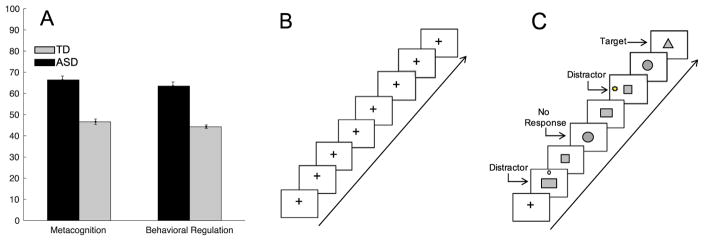
Worse scores on Behavior Rating Inventory of Executive Function indices of metacognition and behavioral regulation. Gray bar indicates typically developing (TD) group, black bar indicates autism spectrum disorder (ASD) group (A). Illustration of resting-state scan (B) and conditions in selective attention task (C).
Figure 3
Figure 3
Task-induced change in summed participation coefficient hubness of frontoparietal (yellow), salience (SAL) (black), subcortical (SUB) (brown) networks significantly differed between autism spectrum disorder children and typically developing children (A). *Denotes Bonferroni-Holm corrected. Gray-filled bars indicate the typically developing group, color-filled bars indicate the autism spectrum disorder group. Correlations between the change of these networks: panel (B) is frontoparietal control (FPC), panel (C) is salience, and panel (D) is subcortical—with Metacognition Index of the Behavior Rating Inventory of Executive Function. Autism spectrum disorder and typically developing subjects are plotted as diamonds and circles, respectively. AUD, auditory; CEB, cerebellar; COP, cingulo-opercular; DAN, dorsal attention network; DMN, default mode network; MP, medial parietal; SEN, sensorimotor; VAN, ventral attention network; VIS, visual.
Figure 4
Figure 4
Node-level analyses. Nodes showing significant task-induced increases (task > rest) in hubness in the typically developing group (A). Nodes showing significant task-induced decreases (task < rest) in hubness within the autism spectrum disorder group; no nodes showed task-induced increase (B). Nodes showing group differences in task-induced change in hubness (typically developing > autism spectrum disorder) (C). Nodes with significant correlations (all ps < .05) between summed participation coefficient (task > rest) and scores on the Metacognition Index of the Behavior Rating Inventory of Executive Function (D).

References

    1. Murray MJ. Attention-deficit/hyperactivity disorder in the context of autism spectrum disorders. Curr Psychiatry Rep. 2010;12:382–388. - PubMed
    1. Rosenthal M, Wallace GL, Lawson R, Wills MC, Dixon E, Yerys BE, Kenworthy L. Impairments in real-world executive function increase from childhood to adolescence in autism spectrum disorders. Neuropsychology. 2013;27:13–18. - PMC - PubMed
    1. Sikora DM, Vora P, Coury DL, Rosenberg D. Attention-deficit/hyperactivity disorder symptoms, adaptive functioning, and quality of life in children with autism spectrum disorder. Pediatrics. 2012;130(suppl 2):S91–S97. - PubMed
    1. Troyb E, Rosenthal M, Eigsti IM, Kelley E, Tyson K, Orinstein A, et al. Executive functioning in individuals with a history of ASDs who have achieved optimal outcomes. Child Neuropsychol. 2014;20:378–397. - PMC - PubMed
    1. Granader Y, Wallace GL, Hardy KK, Yerys BE, Lawson RA, Rosenthal M, et al. Characterizing the factor structure of parent reported executive function in autism spectrum disorders: The impact of cognitive inflexibility. J Autism Dev Disord. 2014;44:3056–3062. - PMC - PubMed

Publication types

MeSH terms