Review
. 2018 Jan 19;122(2):369-384.
doi: 10.1161/CIRCRESAHA.117.309008.

Flavonoids, Dairy Foods, and Cardiovascular and Metabolic Health: A Review of Emerging Biologic Pathways

Affiliations
Review

Flavonoids, Dairy Foods, and Cardiovascular and Metabolic Health: A Review of Emerging Biologic Pathways

Dariush Mozaffarian et al. Circ Res. .

Abstract

A growing body of nutritional science highlights the complex mechanisms and pleiotropic pathways of cardiometabolic effects of different foods. Among these, some of the most exciting advances are occurring in the area of flavonoids, bioactive phytochemicals found in plant foods; and in the area of dairy, including milk, yogurt, and cheese. Many of the relevant ingredients and mechanistic pathways are now being clarified, shedding new light on both the ingredients and the pathways for how diet influences health and well-being. Flavonoids, for example, have effects on skeletal muscle, adipocytes, liver, and pancreas, and myocardial, renal, and immune cells, for instance, related to 5'-monophosphate-activated protein kinase phosphorylation, endothelial NO synthase activation, and suppression of NF-κB (nuclear factor-κB) and TLR4 (toll-like receptor 4). Effects of dairy are similarly complex and may be mediated by specific amino acids, medium-chain and odd-chain saturated fats, unsaturated fats, branched-chain fats, natural trans fats, probiotics, vitamin K1/K2, and calcium, as well as by processing such as fermentation and homogenization. These characteristics of dairy foods influence diverse pathways including related to mammalian target of rapamycin, silent information regulator transcript-1, angiotensin-converting enzyme, peroxisome proliferator-activated receptors, osteocalcin, matrix glutamate protein, hepatic de novo lipogenesis, hepatic and adipose fatty acid oxidation and inflammation, and gut microbiome interactions such as intestinal integrity and endotoxemia. The complexity of these emerging pathways and corresponding biological responses highlights the rapid advances in nutritional science and the continued need to generate robust empirical evidence on the mechanistic and clinical effects of specific foods.

Keywords: cardiovascular disease; cheese; diabetes mellitus; flavonoids; milk; review; yogurt.


Figures

Figure 1
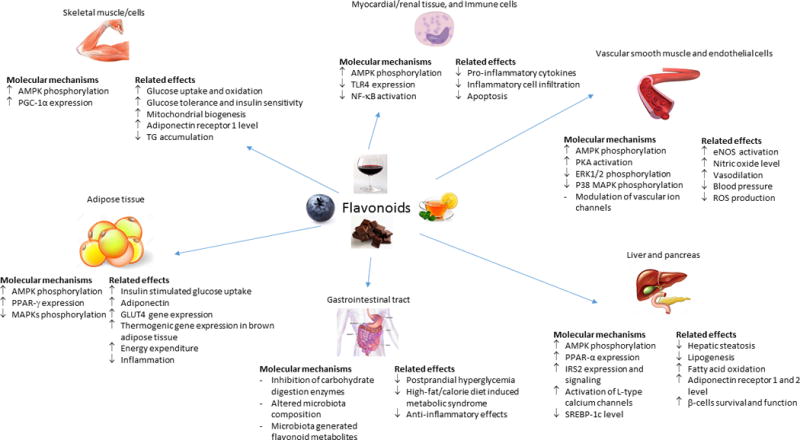
Figure 1. Selected cardiometabolic benefits of flavonoids and potential underlying molecular mechanisms
In vitro and animal studies support bioactivity of purified flavonoids or flavonoids-rich plant extracts across multiple tissues. Relevant molecular pathways appear to include: 1) Modulation of gene expression and signaling pathways. Enhancement of AMPK phosphorylation and activation appears to be a common mechanism affected by several types of flavonoids. Modulation of other signaling pathways have also been observed including increased expression of PPAR-γ and inhibition of NF- κB activation; 2) Interaction with gut-microbiota. Dietary flavonoids may alter gut-microbial composition due to probiotic-like properties and stimulate growth of specific bacteria (e.g. Akkermansia muciniphila) that may confer metabolic benefits. Conversely, metabolism of dietary flavonoids by gut bacteria generates downstream metabolites (e.g. phenolic acids) that may possess unique properties and/or reach higher circulating and tissue concentrations compared to parent flavonoids, thus enhance biologic activity of flavonoids; 3) Direct flavonoid-protein interactions. Growing evidence suggest flavonoids may stimulate and inhibit protein function, including ion channels in the vasculature and liver, and carbohydrate digestive enzymes (α-amylase and α-glucosidase) in the gastrointestinal tract. Such effects may partly contribute to regulation of vascular tone and glucose metabolism. Abbreviations: AMPK, 5’-monophosphate-activated protein kinase; ERK1/2, extracellular signal-regulated kinases 1 and 2; GLUT4, glucose transporter type 4; IRS2, insulin receptor substrate-2; MAPK, mitogen-activated protein kinase; NF-κB, nuclear factor-κB; PGC-1α, peroxisome proliferator-activated receptor-gamma coactivator-1α; PKA; protein kinase-A; PPAR, peroxisome proliferator-activated receptors; SREBP-1c, sterol regulatory element binding protein-1c; TG, triglycerides; TLR4, toll-like receptor 4,
Figure 2
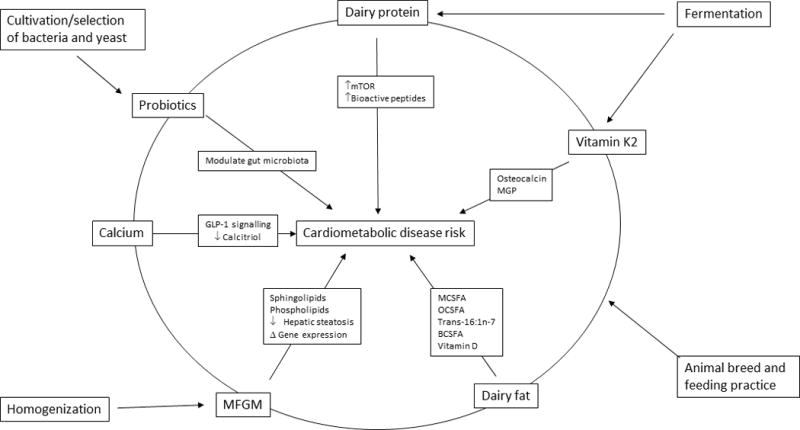
Figure 2. Relevant characteristics of dairy foods and selected molecular pathways potentially linked to cardiometabolic disease risk
Dairy foods are characterized by a complex mixture of nutrients and processing methods that may influence cardiovascular and metabolic pathways. Relevant constituents include specific fatty acids, calcium, and probiotics. Relevant processing methods may include animal breeding and feeding, fermentation, selection and cultivation of bacterial and yeast strains (e.g., as fermentation starters), and homogenization. Such modifications can alter the food’s composition (e.g., fermentation leads to production of vitamin K2 from vitamin K1) as well as its lipid structures (e.g., homogenization damages MFGM), each of which can affect downstream molecular and signaling pathways. Abbreviations: BCSFA, branched-chain saturated fats; GLP-1, glucagon-like peptide 1; MCSFA, medium-chain saturated fats; MFGM, milk-fat globule membranes; MGP, matrix glutamate protein; mTOR, mammalian target of rapamycin; OCSFA, odd chain saturated fats.

References

    1. Mozaffarian D. Dietary and Policy Priorities for Cardiovascular Disease, Diabetes, and Obesity: A Comprehensive Review. Circulation. 2016;133:187–225. - PMC - PubMed
    1. Micha R, Peñalvo J, Cudhea F, Imamura F, Rehm C, Mozaffarian D. Association between dietary factors and mortality from heart disease, stroke, and diabetes in the United States. JAMA. 2017 epub March 8. - PMC - PubMed
    1. Bloom D, Cafiero E, Jané-Llopis E, Abrahams-Gessel S, Bloom L, Fathima S, Feigl A, Gaziano T, Mowafi M, Pandya A, Prettner K, Rosenberg L, Seligman B, Stein A, Weinstein C. The Global Economic Burden of Noncommunicable Diseases. Geneva: World Economic Forum; 2011.
    1. Cassidy A, O’Reilly EJ, Kay C, Sampson L, Franz M, Forman JP, Curhan G, Rimm EB. Habitual intake of flavonoid subclasses and incident hypertension in adults. The American journal of clinical nutrition. 2011;93:338–47. - PMC - PubMed
    1. Ding M, Pan A, Manson JE, Willett WC, Malik V, Rosner B, Giovannucci E, Hu FB, Sun Q. Consumption of soy foods and isoflavones and risk of type 2 diabetes: a pooled analysis of three US cohorts. European journal of clinical nutrition. 2016;70:1381–1387. - PMC - PubMed

Publication types

MeSH terms