Review
. 2018 Aug;27(8):845-857.
doi: 10.1158/1055-9965.EPI-16-1046. Epub 2018 Jan 18.

A Review of Prostate Cancer Genome-Wide Association Studies (GWAS)

Affiliations
Review

A Review of Prostate Cancer Genome-Wide Association Studies (GWAS)

Sarah Benafif et al. Cancer Epidemiol Biomarkers Prev. 2018 Aug.

Abstract

Prostate cancer is the most common cancer in men in Europe and the United States. The genetic heritability of prostate cancer is contributed to by both rarely occurring genetic variants with higher penetrance and moderate to commonly occurring variants conferring lower risks. The number of identified variants belonging to the latter category has increased dramatically in the last 10 years with the development of the genome-wide association study (GWAS) and the collaboration of international consortia that have led to the sharing of large-scale genotyping data. Over 40 prostate cancer GWAS have been reported, with approximately 170 common variants now identified. Clinical utility of these variants could include strategies for population-based risk stratification to target prostate cancer screening to men with an increased genetic risk of disease development, while for those who develop prostate cancer, identifying genetic variants could allow treatment to be tailored based on a genetic profile in the early disease setting. Functional studies of identified variants are needed to fully understand underlying mechanisms of disease and identify novel targets for treatment. This review will outline the GWAS carried out in prostate cancer and the common variants identified so far, and how these may be utilized clinically in the screening for and management of prostate cancer. Cancer Epidemiol Biomarkers Prev; 27(8); 845-57. ©2018 AACR.


Figures

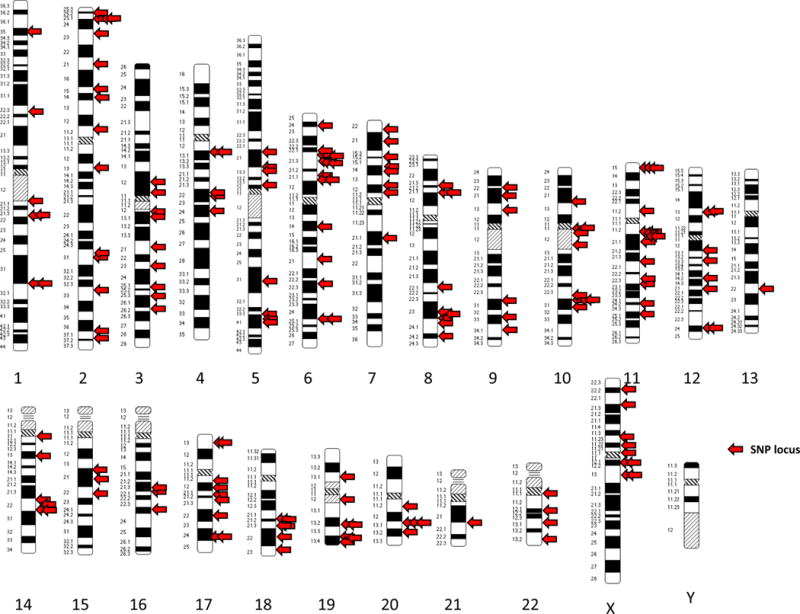
Figure 1
Figure 1. Prostate Cancer Risk Loci
Figure 1 demonstrates the distribution of loci associated with prostate cancer risk identified by GWAS studies (each red arrow represents an individual SNP)
Figure 2
Figure 2. Prostate Cancer Consortia
Figure 2 shows the consortia and studies investigating the role of genetic variants in prostate cancer. Large scale collaborative efforts and data sharing are needed to answer the various scientific and clinical questions related to prostate cancer genetics. Abbreviations and acronyms: BARCODE-1: The Use of Genetic Profiling to Guide Prostate Cancer Targeted Screening (IRAS ID147536; Research Ethics Number: 15/LO/1992); BPC3:Breast Prostate Cancer Cohort Consortium (http://epi.grants.cancer.gov/BPC3/); CAPS: Cancer in the Prostate in Sweden (http://ki.se/en/meb/cancer-of-the-prostate-in-sweden-caps); CGEMS: The Cancer Marker Susceptibility Projects (http://dceg.cancer.gov/research/how-we-study/genomicstudies/cgems-summary); ELLIPSE: Elucidating Loci Involved in Prostate Cancer (http://epi.grants.cancer.gov/gameon/); GENPET: An imaging study of FCH-PET-CT in men with prostate cancer and a BRCA gene mutation (IRAS ID 138894) (Research Ethics Number: 15/20/0242); GENPROS: Analysing outcomes after prostate cancer diagnosis and treatment in carriers of rare germline mutation in cancer predisposition genes. (NCT02705846); ICPCG: International Consortium of Prostate Cancer Genetics (www.icpcg.org); IMPACT: The Identification of Men with a Genetic Predisposition to Prostate Cancer: Targeted Screening in BRCA1/BRCA2 mutation carriers and controls (www.impact-study.co.uk); MADCaP: Men of African Decent and Prostate Cancer (http://epi.grants.cancer.gov/madcap); PRACTICAL: Prostate Cancer Association Group to Investigate Cancer Associated Alterations in the Genome (http://practical.ccge.medschl.cam.ac.uk); PROFILE: Germline genetic profiling: Correlation with targeted prostate cancer screening and treatment (NCT02543905); RGC: Radiogenomics Consortium (https://epi.grants.cancer.gov/radiogenomics/).
Figure 3
Figure 3. Composition of the OncoArray BeadChip
Figure 3 displays the proportion of SNPs assigned to each cancer type. The OncoArray genotyping microarray comprises ~533,000 SNPs. SNPs related to genetic modifiers of BRCA1/2 were also included as well as common cancer susceptibility loci.

References

    1. http://www.cancerresearchuk.org/health-professional/cancer-statistics/statistics-by-cancer-type/prostate-cancer/incidence#....

    1. Mucci LA, et al. Familial Risk and Heritability of Cancer Among Twins in Nordic Countries. JAMA. 2016;315(1):68–76. - PMC - PubMed
    1. Schumacher F, et al. Prostate cancer meta-analysis of more than 140,000 men identifies 63 novel prostate cancer susceptibility loci. Nature Genetics. 2017 under review. - PMC - PubMed
    1. Amundadottir LT, et al. A common variant associated with prostate cancer in European and African populations. Nat Genet. 2006;38(6):652–8. - PubMed
    1. Ewing CM, et al. Germline mutations in HOXB13 and prostate-cancer risk. N Engl J Med. 2012;366(2):141–9. - PMC - PubMed

Substances