


Artificial selection for improved energy efficiency is reaching its limits in broiler chickens
- PMID: 29348409
- PMCID: PMC5773546
- DOI: 10.1038/s41598-018-19231-2
Artificial selection for improved energy efficiency is reaching its limits in broiler chickens
Erratum in
-
Publisher Correction: Artificial selection for improved energy efficiency is reaching its limits in broiler chickens.Sci Rep. 2018 Mar 14;8(1):4785. doi: 10.1038/s41598-018-23133-8. Sci Rep. 2018. PMID: 29540754 Free PMC article.
Abstract
Modern broiler chickens are a major animal husbandry success story, both in terms of efficient resource utilisation and environmental sustainability. However, continuing artificial selection for both efficiency and rapid growth will be subject to both biological limits and animal welfare concerns. Using a novel analytical energy flow modelling approach, we predict how far such selection can go, given the biological limits of bird energy intake and partitioning of energy. We find that the biological potential for further improvements in efficiency, and hence environmental impact reduction, is minimal relative to past progress already made via artificial selection. An alternative breeding strategy to produce slower-growing birds to meet new welfare standards increases environmental burdens, compared to current birds. This unique analytic approach provides biologically sound guidelines for strategic planning of sustainable broiler production.
Conflict of interest statement
The authors declare that they have no competing interests.
Figures
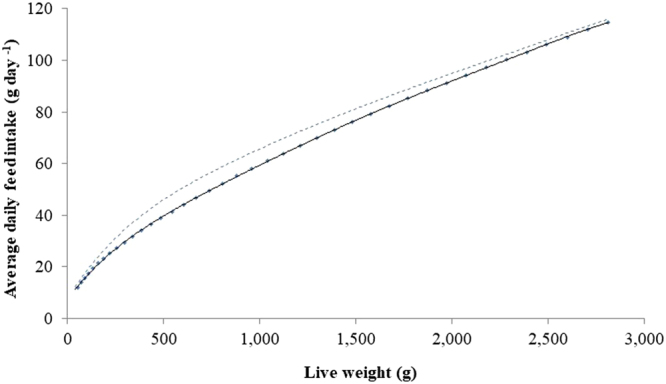
 ) and the potential average daily feed intake defined by the apparent biological limit of feed intake (broken line). Based on the data presented by Leeson et al..
 ) and the potential growth rate of future birds as defined by the different scenarios accessed; maximum energy efficiency (broken line) and increased welfare scenario (
 ).
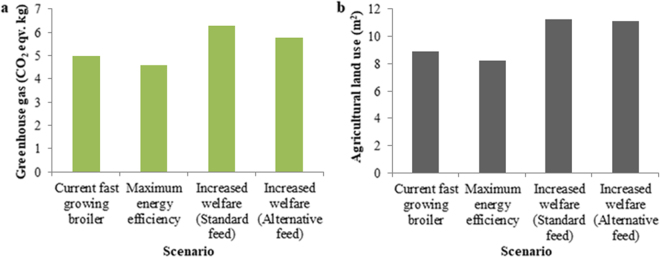
).
References
-
- Steinfeld, H. et al. Livestocks long shadow - environmental issues and options (2006).
-
- Williams, A. G., Audsley, E. & Sandars, D. L. D. Determining the environmental burdens and resource use in the production of agricultural and horticultural commodities., (Cranfield University and Defra, Bedford, UK, 2006).
-
- De Vries, M. & De Boer, I. Comparing environmental impacts for livestock products: A review of life cycle assessments, Livestock Science, vol. 128 (2009).
-
- Laughlin, K. The Evolution of Genetics, Breeding and Production. (Harper Adams University College, Newport, Shropshire 2007).
-
- Mussini, F. J. Comparative response of different broiler genotypes to dietary levels, University of Arkansas (2012).
Publication types
MeSH terms
LinkOut - more resources
Full Text Sources
Other Literature Sources
Miscellaneous
