. 2018 Jan 18;8(1):1156.
doi: 10.1038/s41598-018-19416-9.

Climate Degradation and Extreme Icing Events Constrain Life in Cold-Adapted Mammals

Affiliations

Climate Degradation and Extreme Icing Events Constrain Life in Cold-Adapted Mammals

J Berger et al. Sci Rep. .

Abstract

Despite the growth in knowledge about the effects of a warming Arctic on its cold-adapted species, the mechanisms by which these changes affect animal populations remain poorly understood. Increasing temperatures, declining sea ice and altered wind and precipitation patterns all may affect the fitness and abundance of species through multiple direct and indirect pathways. Here we demonstrate previously unknown effects of rain-on-snow (ROS) events, winter precipitation, and ice tidal surges on the Arctic's largest land mammal. Using novel field data across seven years and three Alaskan and Russian sites, we show arrested skeletal growth in juvenile muskoxen resulting from unusually dry winter conditions and gestational ROS events, with the inhibitory effects on growth from ROS events lasting up to three years post-partum. Further, we describe the simultaneous entombment of 52 muskoxen in ice during a Chukchi Sea winter tsunami (ivuniq in Iñupiat), and link rapid freezing to entrapment of Arctic whales and otters. Our results illustrate how once unusual, but increasingly frequent Arctic weather events affect some cold-adapted mammals, and suggest that an understanding of species responses to a changing Arctic can be enhanced by coalescing groundwork, rare events, and insights from local people.


Conflict of interest statement

The authors declare that they have no competing interests.

Figures
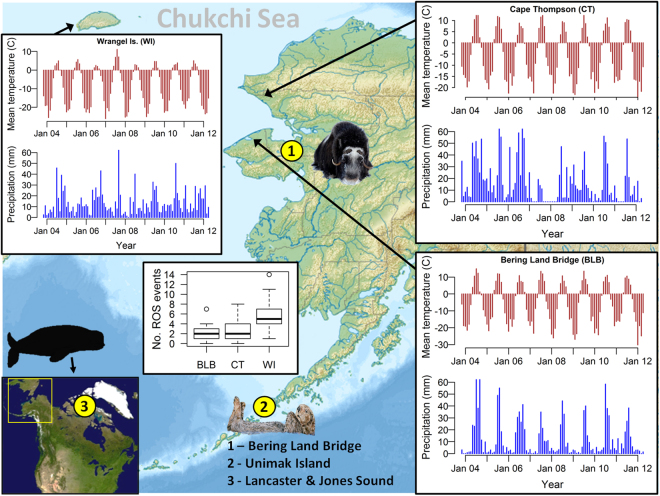
Figure 1
Figure 1
Monthly weather profiles (2004–2012) and number of ROS events/year (2006–2012) for our three study sites: Bering land Bridge (BLB), Cape Thompson (CT), and Wrangel Island (WI). Yellow circles and figurines denote locations and species/taxa affected by extreme icing events discussed in main text. Map of Beringia was modified by the authors from the original by Nikita A. Zemin (https://en.wikipedia.org/wiki/Juneau,_Alaska#/media/File:Relief_map_of_USA_Alaska.png), CC-BY SA 3.0 (https://creativecommons.org/licenses/by-sa/3.0/).
Figure 2
Figure 2
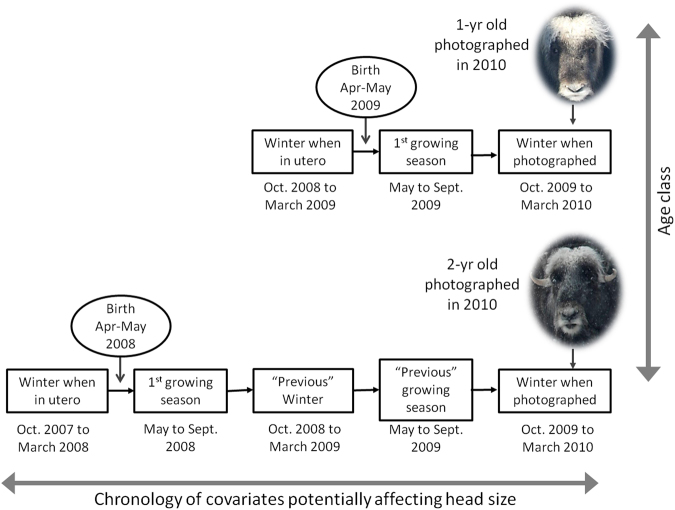
Schematic showing the timing of covariate data relative to when animals were photographed for: (top) 1-yr old; and (bottom) 2-yr old muskoxen (3-yr olds not shown). Path analysis models for each age class included winter condition covariates (extreme cold events, ROS events and mean precipitation) from the “previous winter” and from the winter when an individual was in utero; and growing season related covariates (iNDVI) from the “previous growing season” and for an individual’s “first growing season”. For 1-yr old muskoxen, the previous winter and previous growing season are the same as “in utero” and “first growing season”, respectively.
Figure 3
Figure 3
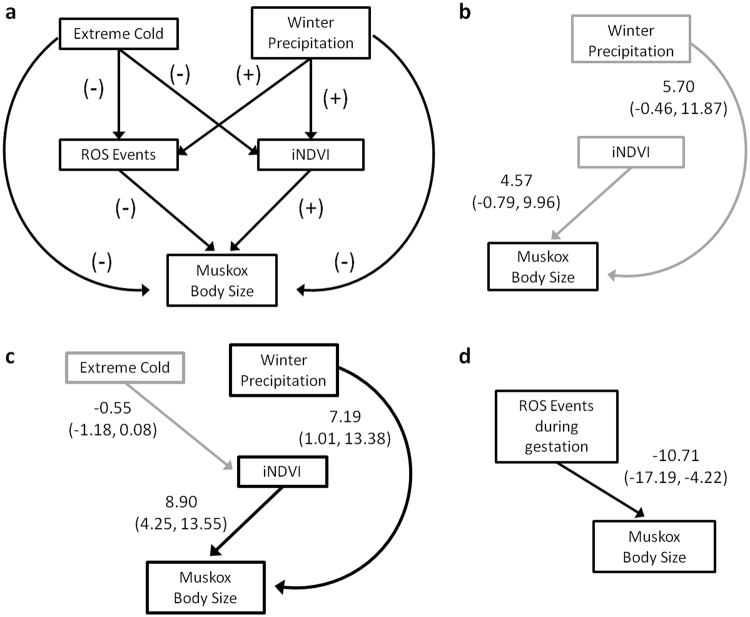
Initial conceptual model (a) of the potential direct and indirect effects of weather and food resources on muskoxen body size; and best models as determined by model selection for (b) 1-yr old; (c) 2-yr old; and (d) 3-yr old muskoxen. Mean posterior values and 95% credible intervals (in parenthesis) are given for standardized coefficients of each effect. Only results from links that directly or indirectly affect muskoxen are shown. Dark lines indicate 95% CI do not include 0, light lines indicate marginal inclusion of 0.
Figure 4
Figure 4
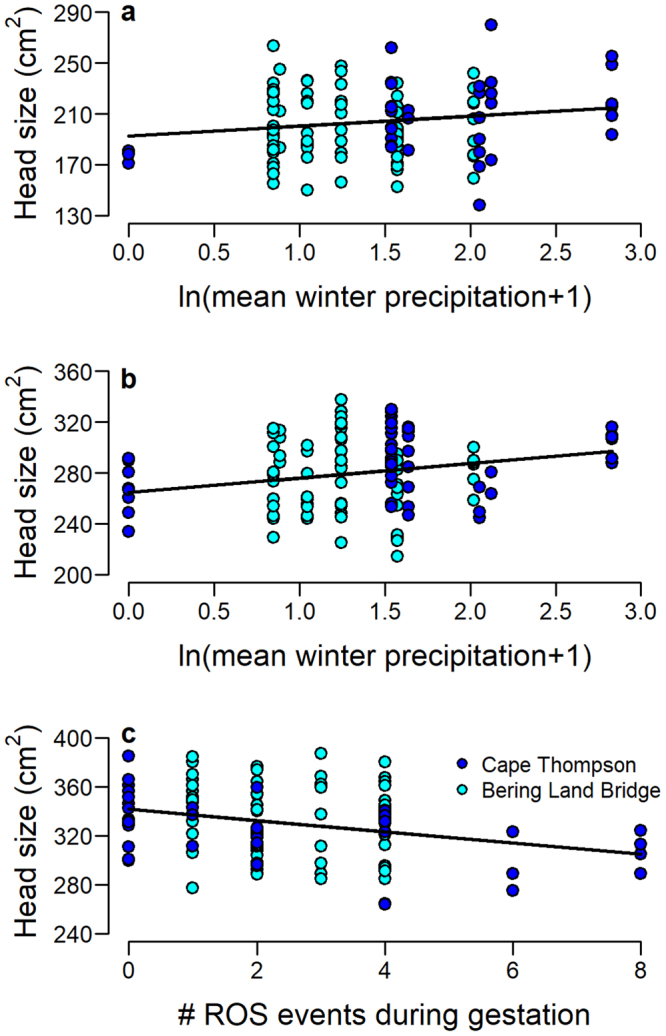
Relationships between head size and winter precipitation (with iNDVI held constant) for (a) 1-yr old; (b) 2-yr old; and (c) gestational ROS events for 3-yr old muskoxen. Lines indicate predicted values based on parameter estimates from Bayesian analyses.
Figure 5
Figure 5
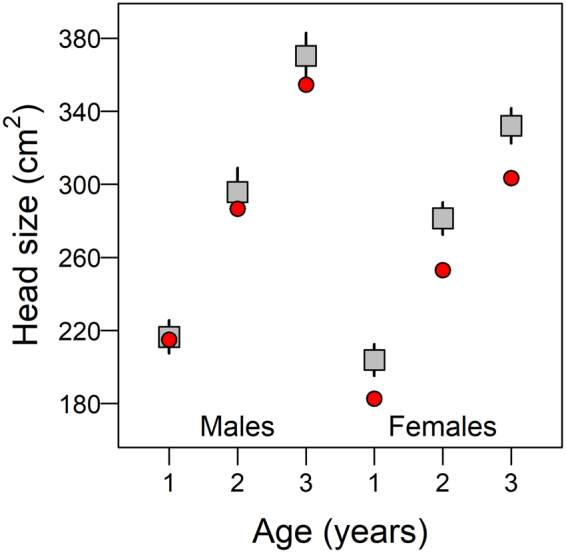
Mean head size and 99% confidence intervals (CI) by sex and age cohort for Alaskan data gathered between 2008 and 2013 (squares; N = 628), and mean head size data for Wrangel Island gathered in 2014 (circles; N = 45).
Figure 6
Figure 6
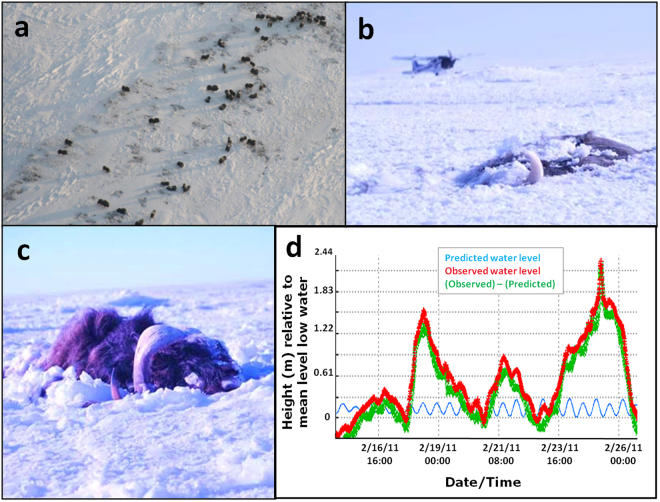
Overview of ivu mortality event. (a) Herd of muskoxen in Bering Land Bridge, Alaska on February 14, 2011; (b) and (c) the two most visible carcasses in March, 2011; (d) normal tidal flow at NOAA’s Red Dog station, along with predicted and observed water levels before and after the wind-whipped tidal surge (source: NOAA – see Methods).

References

    1. Putkonen J, et al. Rain on snow: little understood killer in the north. Eos. 2009;90:221–222. doi: 10.1029/2009EO260002. - DOI
    1. Darwin, C. On the origin of species by means of natural selection, J. Murray, London (1859).
    1. Post E, et al. Dynamics across the arctic associated with recent climate change. Science. 2009;325:1355–58. doi: 10.1126/science.1173113. - DOI - PubMed
    1. Rahmstorf S, Coumou D. Increase of extreme events in a warming world. Proc. Nat. Acad. Sci. 2011;108:17905–17909. doi: 10.1073/pnas.1101766108. - DOI - PMC - PubMed
    1. Post E, et al. Ecological consequences of sea-ice decline. Science. 2013;341:519–524. doi: 10.1126/science.1235225. - DOI - PubMed

Publication types