


Why is multiple micronutrient powder ineffective at reducing anaemia among 12-24 month olds in Colombia? Evidence from a randomised controlled trial
- PMID: 29349132
- PMCID: PMC5757801
- DOI: 10.1016/j.ssmph.2016.02.004
Why is multiple micronutrient powder ineffective at reducing anaemia among 12-24 month olds in Colombia? Evidence from a randomised controlled trial
Abstract
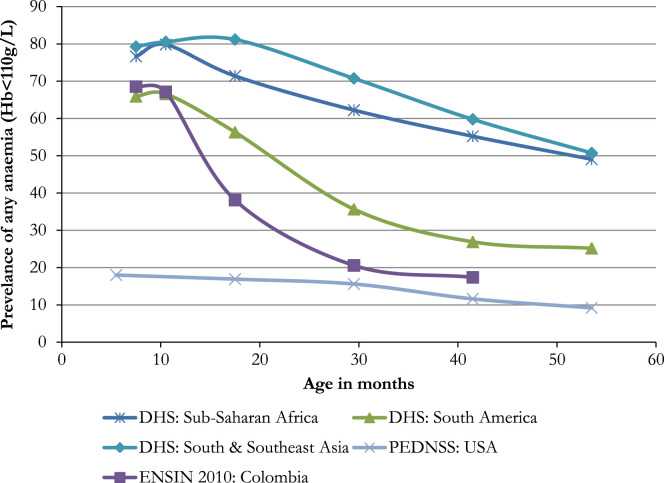
In Colombia's bottom socio-economic strata, 46.6% of children under two are anaemic. A prevalence of above 20% falls within the WHO guidelines for daily supplementation with multiple micronutrient powder (MNP). To evaluate the effect of daily MNP supplementation on anaemia amongst Colombian children aged 12-24 months we ran a cluster RCT (n=1440). In previous work, we found the intervention had no impact on haemoglobin or anaemia in this population. In this current paper, we investigate this null result and find it cannot be explained by an underpowered study design, inaccurate measurements, low adoption of and compliance with the intervention, or crowding out through dietary substitution. We conclude that our intervention was ineffective at reducing rates of childhood anaemia because MNP itself was inefficacious in our population, rather than poor implementation of or adherence to the planned intervention. Further analysis of our data and secondary data suggests that the evolution with age of childhood anaemia in Colombia, and its causes, appear different from those in settings where MNP has been effective. Firstly, rates of anaemia peak at much earlier ages and then fall rapidly. Secondly, anaemia that remains after the first year of life is relatively, and increasingly as children get older, unrelated to iron deficiency. We suggest that factors during gestation, birth, breastfeeding and early weaning may be important in explaining very high rates of anaemia in early infancy. However, the adverse effects of these factors appear to be largely mitigated by the introduction of solid foods that often include meat. This renders population wide MNP supplementation, provided after a diet of solid foods has become established, an ineffective instrument with which to target Colombia's childhood anaemia problem.
Keywords: Anaemia; Child; Colombia; Haemoglobin; Iron-deficiency; Micronutrients; Multiple micronutrient powder; Nutrition.
Figures
References
-
- Attanasio O.P., Fernandez C., Fitzsimons E.O., Grantham-McGregor S.M., Meghir C., Rubio-Codina M. Using the infrastructure of a conditional cash transfer program to deliver a scalable integrated early child development program in Colombia: Cluster randomized controlled trial. British Medical Journal. 2014;349 - PMC - PubMed
-
- Adu-Afarwuah S., Lartey A., Brown K.H., Zlotkin S., Briend A., Dewey K.G. Randomized comparison of 3 types of micronutrient supplements for home fortification of complementary foods in Ghana: Effects on growth and motor development. American Journal of Clinical Nutrition. 2007;86:412–420. - PubMed
-
- Allen L.H. Anemia and iron deficiency: Effects on pregnancy outcome. American Journal of Clinical Nutrition. 2000;71:1280S–1284SS. - PubMed
-
- Brabin B.J., Premji Z., Verhoeff F. An analysis of anemia and child mortality. J. Nutr. 2001;131:636S–645S. (discussion 646S–648S) - PubMed
-
- Balarajan Y., Ramakrishnan U., Ozaltin E., Shankar A.H., Subramanian S.V. Anaemia in low-income and middle-income countries. Lancet. 2011;378:2123–2135. - PubMed
LinkOut - more resources
Full Text Sources
Other Literature Sources
Medical
Molecular Biology Databases
Miscellaneous
