


Socioeconomic inequality in morbid obesity with body mass index more than 40 kg/m2 in the United States and England
- PMID: 29349213
- PMCID: PMC5769007
- DOI: 10.1016/j.ssmph.2016.12.012
Socioeconomic inequality in morbid obesity with body mass index more than 40 kg/m2 in the United States and England
Abstract
Introduction: This study evaluated socioeconomic inequality in morbid obesity (body mass index, BMI ≥40 kg/m2) through an analysis of population health survey data in the United States (US) and England (UK).
Methods: We analysed data for the National Health and Nutrition Examination Survey and the Health Survey for England for 2011 to 2014. Age-adjusted odds ratios (AOR) were used to evaluate income- and education-inequality.
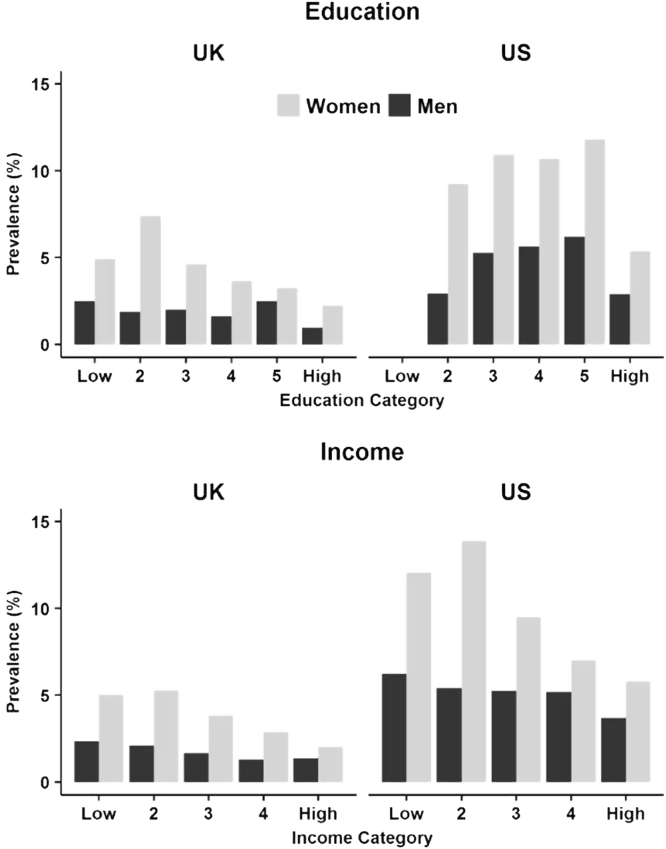
Results: There were 26,898 eligible UK and 10,628 US participants. Morbid obesity was more frequent in women than men, and higher in the US than the UK (men: US, 4.8%; UK, 1.7%; women US, 9.6%; UK, 3.7%). In the UK, morbid obesity showed graded income-inequality in both genders (AOR, for lowest income quintile: men, 1.83, 95% confidence interval 1.16 to 2.88; women, 2.18, 1.55 to 3.07), as well as education-inequality (AOR for no school qualifications, men 2.57, 1.64 to 4.02; women, 2.18, 1.55 to 3.07). In the US, morbid obesity showed a consistent gradient only for income in women (AOR for lowest income quintile 1.97, 1.19 to 3.25). When compared with all other US groups, having college education (AOR, men, 0.56, 0.29 to 1.08; women, 0.36, 0.22 to 0.60) or household income ≥$75 000 (AOR, men 0.52, 0.27 to 0.98; women, 0.51, 0.33 to 0.80) appeared to protect against morbid obesity.
Conclusions: Morbid obesity is associated with lower socioeconomic status in men and women in the UK. In the US, morbid obesity was twice as prevalent, but less strongly associated with socioeconomic status, suggesting that morbid obesity may now have spread to all but the highest socioeconomic groups.
Keywords: (AOR), age-adjusted odds ratio; (CSE), certificate of secondary education; (HSE), Health Survey for England; (NHANES), National Health and Nutrition Survey; Education; Health surveys; Income; Morbid; NCD, Non-communicable disease; Obesity; Socioeconomic position.
Figures
References
-
- Arterburn D., Maciejewski M., Tsevat J. Impact of morbid obesity on medical expenditures in adults. International Journal of Obesity and Related Metabolic Disorders. 2005;29(3):334–339. - PubMed
-
- Banks J., Marmot M., Oldfield Z., Smith J.P. Disease and disadvantage in the United States and in England. JAMA. 2006;295(17):2037–2045. - PubMed
-
- Beenackers M.A., Kamphuis C.B., Giskes K., Brug J., Kunst A.E., Burdorf A., van Lenthe F.J. Socioeconomic inequalities in occupational, leisure-time, and transport related physical activity among European adults: a systematic review. The International Journal of Behavioral Nutrition and Physical Activity. 2012;9(1):1–23. - PMC - PubMed
Grants and funding
LinkOut - more resources
Full Text Sources
Other Literature Sources
Molecular Biology Databases
