


Review
doi: 10.1002/psp4.12274.
Epub 2018 Jan 31.
Drug Dosing in Pregnant Women: Challenges and Opportunities in Using Physiologically Based Pharmacokinetic Modeling and Simulations
Affiliations
- PMID: 29349870
- PMCID: PMC5824116
- DOI: 10.1002/psp4.12274
Item in Clipboard
Review
Drug Dosing in Pregnant Women: Challenges and Opportunities in Using Physiologically Based Pharmacokinetic Modeling and Simulations
CPT Pharmacometrics Syst Pharmacol.
2018 Feb.
Abstract
The unmet medical need of providing evidence-based pharmacotherapy for pregnant women is recognized by the regulatory bodies. Physiologically based pharmacokinetic (PBPK) modeling offers an attractive platform to quantify anticipated changes in the pharmacokinetics (PKs) of drugs during pregnancy. Recent publications applying a pregnancy PBPK module to the prediction of maternal and fetal exposure of drugs are summarized. Future opportunities to use PBPK models to predict breast milk exposure and assess human fetotoxicity risks are presented.
© 2018 The Authors CPT: Pharmacometrics & Systems Pharmacology published by Wiley Periodicals, Inc. on behalf of American Society for Clinical Pharmacology and Therapeutics.
Figures
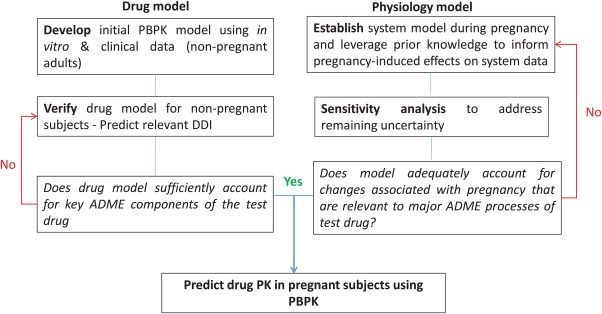
The best practice approach to physiologically based pharmacokinetic (PBPK) model development and application in pregnant women. ADME, absorption, distribution, metabolism, and excretion; DDI, drug‐to‐drug interaction; PK, pharmacokinetic.
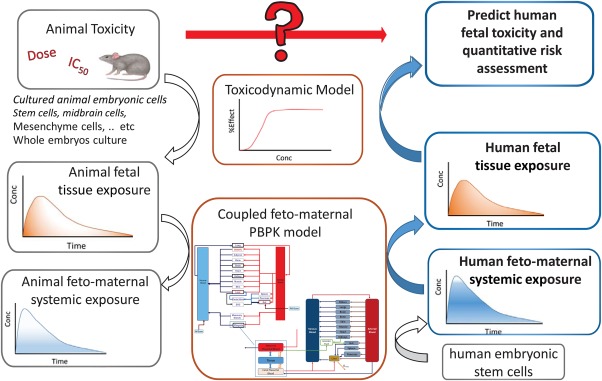
A mechanistic framework for applying a physiologically based pharmacokinetic (PBPK) feto‐maternal model for predicting human fetotoxicity risk from preclinical species described in the following steps. (1) Perform fetotoxicity studies in preclinical animals and establish exposure‐toxicity relationships. (2) Construct a coupled feto‐maternal PBPK model that accounts for gestational age related changes in the physiology and placenta to describe the relationship between fetal tissue and systemic concentrations together with maternal systemic concentration. (3) Use the constructed PBPK model to find the toxic doses that can cause feto‐toxic drug levels after accounting for species differences in physiological/biochemical parameters (number of placentas, weight, blood flow, transporters, and enzyme expression). (4) The human PBPK model can also be refined if in vitro and/or in vivo human data are available. (5) The human PBPK model that predicts the systemic exposure in fetus and mother can be used to predict the local fetal tissue concentration. (6) Fetal local tissue concentration can be linked to the predicted toxicity after accounting for any potential species differences in the toxicodynamic model. This figure is adapted from the publication by Abduljalil et al.51 Conc, concentration; IC50, half‐maximal inhibitory concentration.
References
-
- Adam, M.P. , Polifka, J.E. & Friedman, J.M. Evolving knowledge of the teratogenicity of medications in human pregnancy. Am. J. Med. Genet. C Semin. Med. Genet. 157C, 175–182 (2011). - PubMed
-
- Mirochnick, M. , Best, B.M. & Clarke, D.F. Antiretroviral pharmacology: special issues regarding pregnant women and neonates. Clin. Perinatol. 37, 907–927 (2010). - PubMed
Publication types
MeSH terms
Substances
LinkOut - more resources
Full Text Sources
Other Literature Sources
Medical
Miscellaneous
