


Quantitative DTI metrics in a canine model of Krabbe disease: comparisons versus age-matched controls across multiple ages
- PMID: 29350082
- PMCID: PMC5882059
- DOI: 10.1177/1971400917733431
Quantitative DTI metrics in a canine model of Krabbe disease: comparisons versus age-matched controls across multiple ages
Abstract
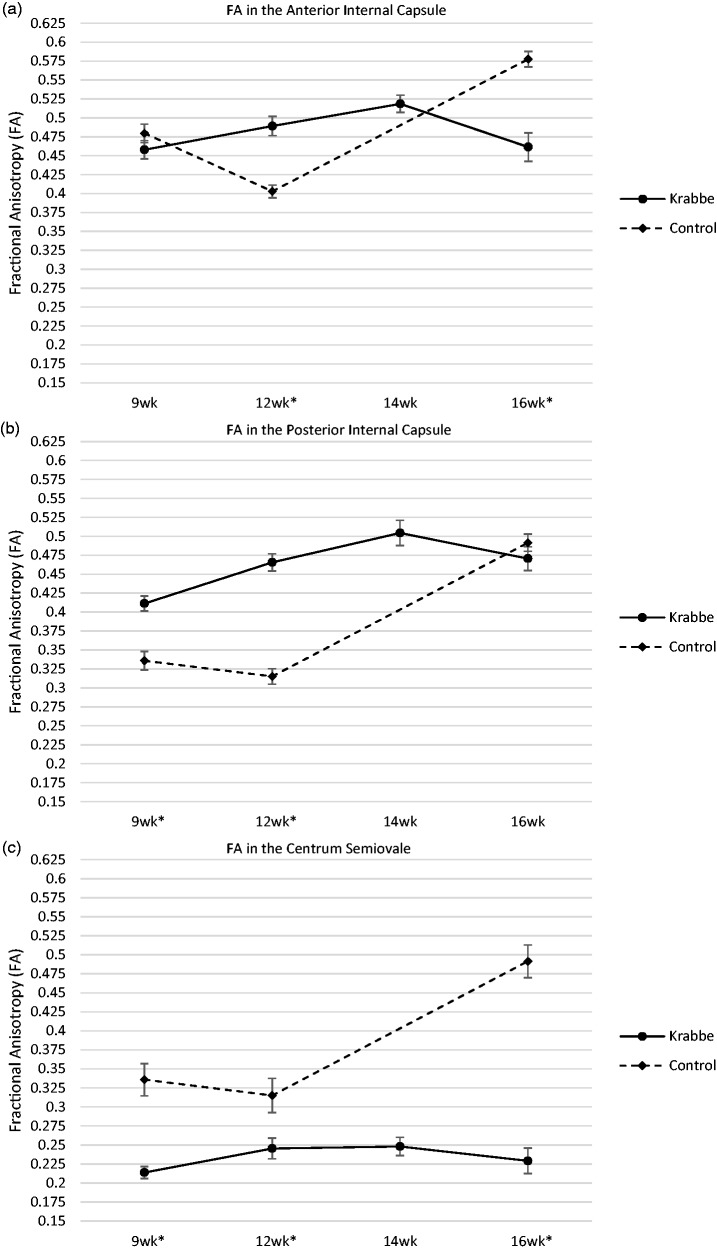
Purpose The purpose of this study was to compare quantitative diffusion tensor imaging metrics in dogs affected with a model of Krabbe disease to age-matched normal controls. We hypothesized that fractional anisotropy would be decreased and radial diffusivity would be increased in the Krabbe dogs. Methods We used a highly reproducible region-of-interest interrogation technique to measure fractional anisotropy and radial diffusivity in three different white matter regions within the internal capsule and centrum semiovale in four Krabbe affected brains and three age-matched normal control brains. Results Despite all four Krabbe dogs manifesting pelvic limb paralysis at the time of death, age-dependent differences in DTI metrics were observed. In the 9, 12, and 14 week old Krabbe dogs, FA values unexpectedly increased and RD values decreased. FA values were generally higher and RD values generally lower in both regions of the internal capsule in the Krabbe brains during this period. FA values in the brain from the 16 week old Krabbe dog decreased and were lower than in control brains and RD values increased and were higher than in control brain. Conclusion Our findings suggest that FA and RD in the internal capsule and centrum semiovale are affected differently at different ages, despite disease having progressed to pelvic limb paralysis in all dogs evaluated. In 9, 12, and 14 week old Krabbe dogs, higher FA values and lower RD values are seen in the internal capsule. However, in the 16 week old Krabbe dog, lower FA and higher RD values are seen, consistent with previous observations in Krabbe dogs, as well as observations in human Krabbe patients.
Keywords: Diffusion tensor; Krabbe; canine; fractional anisotropy; lysosomal storage disease; magnetic resonance; radial diffusivity.
Figures


References
-
- Beaulieu C. The basis of anisotropic water diffusion in the nervous system - a technical review. NMR Biomed 2002; 15: 435–455. - PubMed
-
- Beaulieu C, et al. Changes in water diffusion due to Wallerian degeneration in peripheral nerve. Magn Reson Med 1996; 36: 627–631. - PubMed
-
- Song SK, et al. Dysmyelination revealed through MRI as increased radial (but unchanged axial) diffusion of water. Neuroimage 2002; 17: 1429–1436. - PubMed
Publication types
MeSH terms
Grants and funding
LinkOut - more resources
Full Text Sources
Other Literature Sources
Medical
Miscellaneous
