. 2018 Feb;24(2):221-229.
doi: 10.3201/eid2402.170957.

Hypervirulent Klebsiella pneumoniae in Cryptogenic Liver Abscesses, Paris, France

Hypervirulent Klebsiella pneumoniae in Cryptogenic Liver Abscesses, Paris, France

Benjamin Rossi et al. Emerg Infect Dis. 2018 Feb.

Abstract

Liver abscesses containing hypervirulent Klebsiella pneumoniae have emerged during the past 2 decades, originally in Southeast Asia and then worldwide. We hypothesized that hypervirulent K. pneumoniae might also be emerging in France. In a retrospective, monocentric, cohort study, we analyzed characteristics and outcomes for 199 consecutive patients in Paris, France, with liver abscesses during 2010-2015. We focused on 31 patients with abscesses containing K. pneumoniae. This bacterium was present in most (14/27, 52%) cryptogenic liver abscesses. Cryptogenic K. pneumoniae abscesses were more frequently community-acquired (p<0.00001) and monomicrobial (p = 0.008), less likely to involve cancer patients (p<0.01), and relapsed less often (p<0.01) than did noncryptogenic K. pneumoniae liver abscesses. K. pneumoniae isolates from cryptogenic abscesses belonged to either the K1 or K2 serotypes and had more virulence factors than noncryptogenic K. pneumoniae isolates. Hypervirulent K. pneumoniae are emerging as the main pathogen isolated from cryptogenic liver abscesses in the study area.

Keywords: France; Klebsiella pneumoniae; Paris; bacteria; cryptogenic liver abscesses; hypervirulent.


Figures
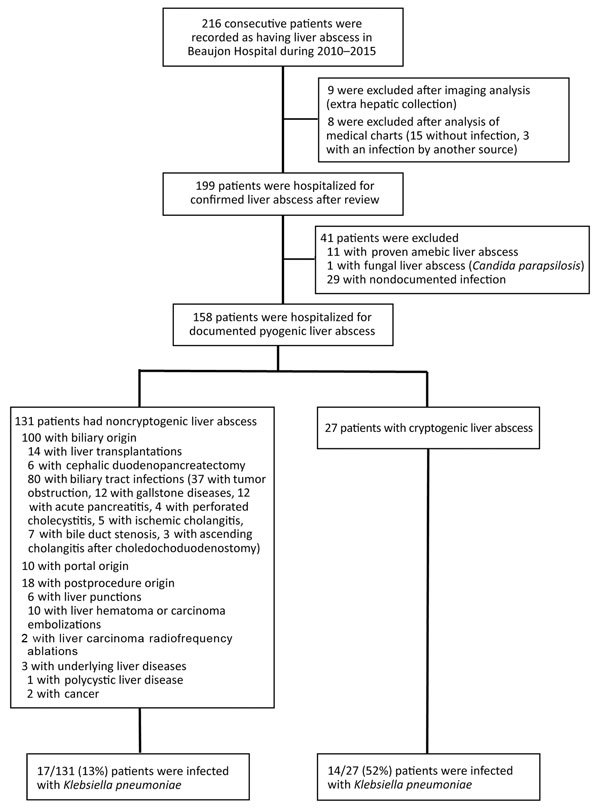
Figure 1
Figure 1
Flow chart for selection of 158 patients with microbiologically proven pyogenic liver abscesses and determination of Klebsiella pneumoniae infection, Hôpital Beaujon, Clichy, France, 2010−2015.
Figure 2
Figure 2
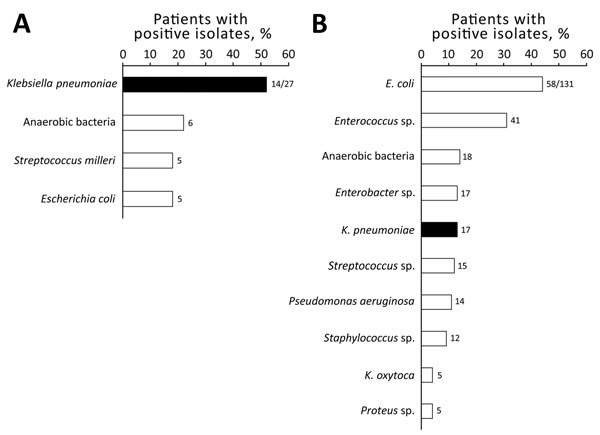
Bacteria isolated from patients with A) cryptogenic (n = 27) and B) noncryptogenic (n = 131) liver abscesses, Hôpital Beaujon, Clichy, France, 2010−2015. Black bars indicate Klebsiella pneumoniae. Values above bars indicate number of isolates. Differences for each bacterial species between cryptogenic and noncryptogenic abscesses were statistically significant for K. pneumoniae (p = 0.00005), Enterococcus species (p = 0.0001), Staphylococcus species (p = 0.0009), and Enterobacter species (p = 0.05). Five (18%) of 27 cryptogenic abscesses were polymicrobial, and 63 (48%) of 131 noncryptogenic abscesses were polymicrobial. Enterococcus species isolates were mainly E. faecalis (21 isolates) and E. faecium (21 isolates). For Streptococcus species isolates, 13/15 were S. milleri. Staphylococcus aureus represented 5 (42%) of 12 Staphylococcus species isolates.

References

    1. Kaplan GG, Gregson DB, Laupland KB. Population-based study of the epidemiology of and the risk factors for pyogenic liver abscess. Clin Gastroenterol Hepatol. 2004;2:1032–8. 10.1016/S1542-3565(04)00459-8 - DOI - PubMed
    1. Hansen PS, Schønheyder HC. Pyogenic hepatic abscess. A 10-year population-based retrospective study. APMIS. 1998;106:396–402. 10.1111/j.1699-0463.1998.tb01363.x - DOI - PubMed
    1. Lardière-Deguelte S, Ragot E, Amroun K, Piardi T, Dokmak S, Bruno O, et al. Hepatic abscess: Diagnosis and management. J Visc Surg. 2015;152:231–43. 10.1016/j.jviscsurg.2015.01.013 - DOI - PubMed
    1. Meddings L, Myers RP, Hubbard J, Shaheen AA, Laupland KB, Dixon E, et al. A population-based study of pyogenic liver abscesses in the United States: incidence, mortality, and temporal trends. Am J Gastroenterol. 2010;105:117–24. 10.1038/ajg.2009.614 - DOI - PubMed
    1. Kuo S-H, Lee Y-T, Li C-R, Tseng C-J, Chao W-N, Wang P-H, et al. Mortality in Emergency Department Sepsis score as a prognostic indicator in patients with pyogenic liver abscess. Am J Emerg Med. 2013;31:916–21. 10.1016/j.ajem.2013.02.045 - DOI - PubMed

LinkOut - more resources