Review
. 2018 Jan 19;19(1):294.
doi: 10.3390/ijms19010294.

Telomeres: Implications for Cancer Development

Affiliations
Review

Telomeres: Implications for Cancer Development

Aina Bernal et al. Int J Mol Sci. .

Abstract

Telomeres facilitate the protection of natural ends of chromosomes from constitutive exposure to the DNA damage response (DDR). This is most likely achieved by a lariat structure that hides the linear telomeric DNA through protein-protein and protein-DNA interactions. The telomere shortening associated with DNA replication in the absence of a compensatory mechanism culminates in unmasked telomeres. Then, the subsequent activation of the DDR will define the fate of cells according to the functionality of cell cycle checkpoints. Dysfunctional telomeres can suppress cancer development by engaging replicative senescence or apoptotic pathways, but they can also promote tumour initiation. Studies in telomere dynamics and karyotype analysis underpin telomere crisis as a key event driving genomic instability. Significant attainment of telomerase or alternative lengthening of telomeres (ALT)-pathway to maintain telomere length may be permissive and required for clonal evolution of genomically-unstable cells during progression to malignancy. We summarise current knowledge of the role of telomeres in the maintenance of chromosomal stability and carcinogenesis.

Keywords: cancer; chromosome instability; telomere-dysfunction.


Conflict of interest statement

The authors declare no conflict of interest.

Figures
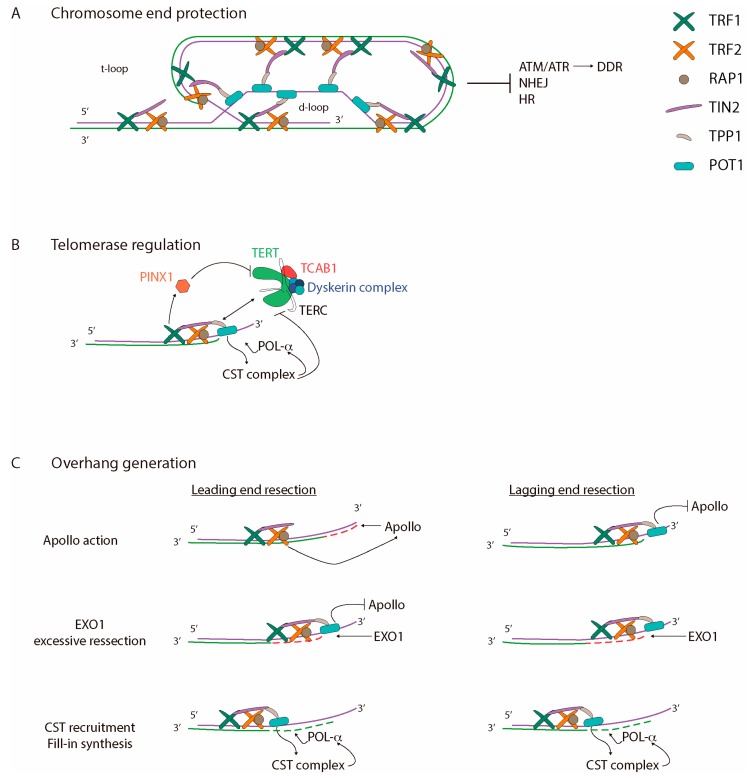
Figure 1
Figure 1
Telomere structure and maintenance. Human telomeres are specialised nucleoprotein structures that cap the end of chromosomes. Telomeric DNA is coated by shelterin proteins that regulate (A) chromosome end protection; (B) telomerase regulation; and (C) overhang generation. (A) Telomeres adopt a t-loop structure that prevents DNA damage response (DDR), by blocking ATM and ATR activation, and DNA repair activities via NHEJ and HR; (B) telomerase action is tightly regulated and only acts at telomeres during S-phase. Telomerase preferentially acts in short telomeres, maybe by indirect inhibition through TRF1 and PINX1 and/or other unknown mechanisms. TPP1 physically interacts with telomerase, and is essential for telomerase recruitment together with TIN2. It has been suggested that POT1-TPP1 is implicated in telomerase-telomere engagement. Besides that, POT1-TPP1 stimulates telomerase action until a certain threshold of telomeric repeats is reached. Once telomerase is blocked by CTC1-STN1-TEN1 (CST) and/or POT1, CST facilitates fill-in synthesis of the C-strand by polymerase-α (POL-α) recruitment; (C) Mammalian chromosomes terminate in a 3′ G-rich overhang that is essential for t-loop formation. DNA replication originates blunt ends in the leading strands, and non-blunt ends in the lagging strands. TRF2 recruits Apollo that resects 5′ strand from leading ends (dashed red line) to generate a 3′ overhang. Then, EXO1 excessively resects the leading and lagging strands (dashed red lines) to generate longer overhangs. In addition, finally, POT1 facilitates the 5′-strand fill-in (dashed green lines) by the recruitment of POL-α, through the CST complex.
Figure 2
Figure 2
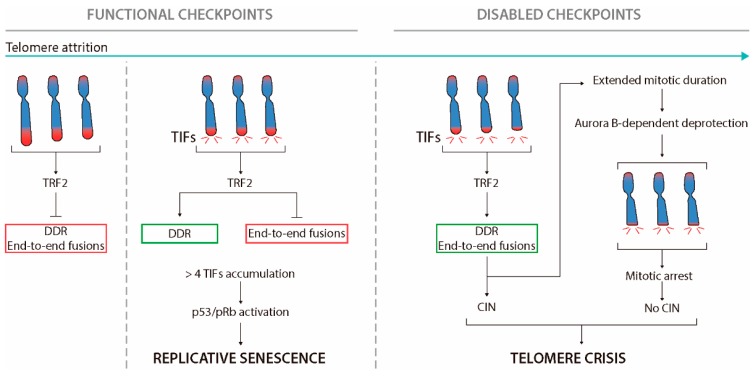
Telomere hypothesis of senescence and cancer. Telomere attrition occurs in cycling cells lacking telomerase activity or with reduced levels (green arrow). Long enough telomeres protect chromosome ends from DDR activation and end-to-end fusions (red box). After numerous PDs, few telomeres become too short and a local DDR signalling is activated at chromosome ends. At this stage, telomeres are not fully unprotected, as end-to-end fusions are prevented (red box) although the activation of the DDR (green box). Proliferation continues until a threshold of 4–5 TIFs directs cells to replicative arrest and senescence or apoptosis. In cells with functional checkpoints, excessive telomere shortening limits the proliferation of incipient cancer cells. Nevertheless, loss of the Rb and p53 tumour suppressors pathways allows cells to bypass cell cycle arrest in the presence of more than five telomere-induced foci (TIFs) per cell. During this lifespan extension period, further shortening leads to insufficient TRF2 retention at telomeres. These fully deprotected chromosome ends, in addition to activate the DDR, they promote the formation of end-to-end fusions (green box). It has been long speculated that the huge reorganisation of the genome associated to persistent telomere-dependent chromosomal instability (CIN) could allow the generation of pre-neoplastic cells if ultimately telomere length is stabilised. Otherwise, cells are directed to telomere crisis owing to massive genome remodelling, due to breakage-fusion-bridge (BFB) cycles, or/and to prolonged mitotic arrest and Aurora B-dependent TRF2 eviction from telomeres. Figure adapted from Arnoult and Karlseder 2015 [93].

References

    1. McClintock B. The stability of broken ends of chromosomes in Zea mays. Genetics. 1941;26:234–282. - PMC - PubMed
    1. Müller H.J. The remaking of chromosomes. Collect. Net-Woods Hole. 1938;13:181–198.
    1. Moyzis R.K., Buckingham J.M., Cram L.S., Dani M., Deaven L.L., Jones M.D., Meyne J., Ratliff R.L., Wu J.-R. A highly conserved repetitive DNA sequence, (TTAGGG)n, present at the telomeres of human chromosomes. Proc. Natl. Acad. Sci. USA. 1988;85:6622–6626. doi: 10.1073/pnas.85.18.6622. - DOI - PMC - PubMed
    1. Meyne J., Ratliff R.L., Moyzis R.K. Conservation of the human telomere sequence (TTAGGG)n among vertebrates. Proc. Natl. Acad. Sci. USA. 1989;86:7049–7053. doi: 10.1073/pnas.86.18.7049. - DOI - PMC - PubMed
    1. Makarov V.L., Hirose Y., Langmore J.P. Long G tails at both ends of human chromosomes suggest a C strand degradation mechanism for telomere shortening. Cell. 1997;88:657–666. doi: 10.1016/S0092-8674(00)81908-X. - DOI - PubMed

LinkOut - more resources