


Studying medical communication with video vignettes: a randomized study on how variations in video-vignette introduction format and camera focus influence analogue patients' engagement
- PMID: 29351736
- PMCID: PMC5775584
- DOI: 10.1186/s12874-018-0472-3
Studying medical communication with video vignettes: a randomized study on how variations in video-vignette introduction format and camera focus influence analogue patients' engagement
Abstract
Background: Video vignettes are used to test the effects of physicians' communication on patient outcomes. Methodological choices in video-vignette development may have far-stretching consequences for participants' engagement with the video, and thus the ecological validity of this design. To supplement the scant evidence in this field, this study tested how variations in video-vignette introduction format and camera focus influence participants' engagement with a video vignette showing a bad news consultation.
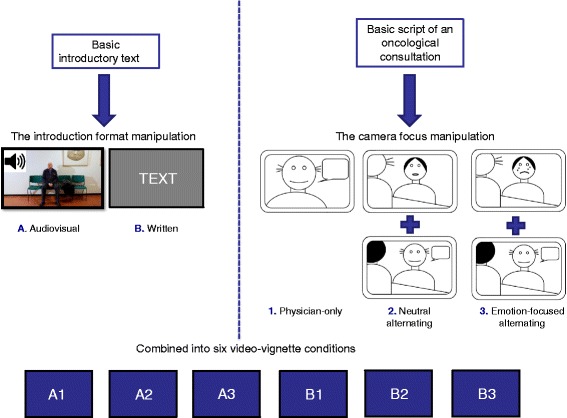
Methods: Introduction format (A = audiovisual vs. B = written) and camera focus (1 = the physician only, 2 = the physician and the patient at neutral moments alternately, 3 = the physician and the patient at emotional moments alternately) were varied in a randomized 2 × 3 between-subjects design. One hundred eighty-one students were randomly assigned to watch one of the six resulting video-vignette conditions as so-called analogue patients, i.e., they were instructed to imagine themselves being in the video patient's situation. Four dimensions of self-reported engagement were assessed retrospectively. Emotional engagement was additionally measured by recording participants' electrodermal and cardiovascular activity continuously while watching. Analyses of variance were used to test the effects of introduction format, camera focus and their interaction.
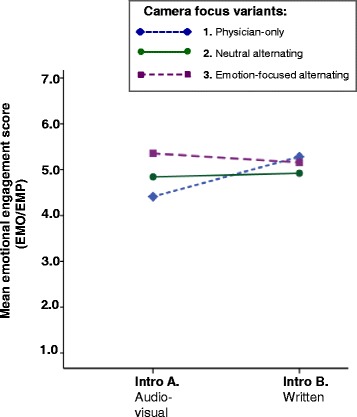
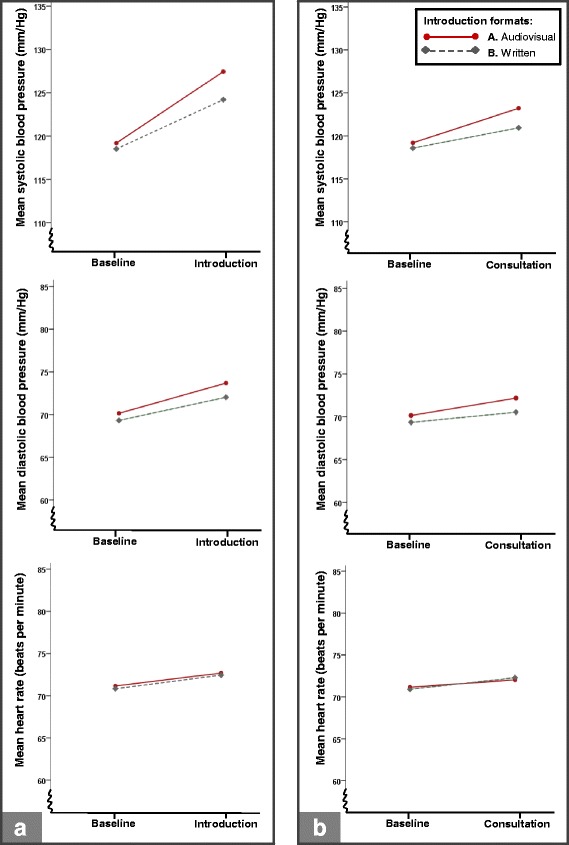
Results: The audiovisual introduction induced a stronger blood pressure response during watching the introduction (p = 0.048, [Formula: see text]= 0.05) and the consultation part of the vignette (p = 0.051, [Formula: see text]= 0.05), when compared to the written introduction. With respect to camera focus, results revealed that the variant focusing on the patient at emotional moments evoked a higher level of electrodermal activity (p = 0.003, [Formula: see text]= 0.06), when compared to the other two variants. Furthermore, an interaction effect was shown on self-reported emotional engagement (p = 0.045, [Formula: see text]= 0.04): the physician-only variant resulted in lower emotional engagement if the vignette was preceded by the audiovisual introduction. No effects were shown on the other dimensions of self-reported engagement.
Conclusions: Our findings imply that using an audiovisual introduction combined with alternating camera focus depicting patient's emotions results in the highest levels of emotional engagement in analogue patients. This evidence can inform methodological decisions during the development of video vignettes, and thereby enhance the ecological validity of future video-vignettes studies.
Keywords: Analogue patients; Camera viewpoint; Engagement; Introduction; Patient-provider communication; Psychophysiology; Video-vignettes design.
Conflict of interest statement
Ethics approval and consent to participate
The study protocol was approved by the Ethics Committee of the department of Communication Science at the University of Amsterdam (2014-CW-30). Written informed consent was obtained from all participants.
Consent for publication
Written informed consent for publication of the image that is part of Fig. 1 was obtained from the professional actor that acted as the male video patient in the video vignettes. A copy of the consent form is available for review by the Editor of this journal.
Competing interests
The authors declare that they have no competing interests.
Publisher’s Note
Springer Nature remains neutral with regard to jurisdictional claims in published maps and institutional affiliations.
Figures

References
Publication types
MeSH terms
LinkOut - more resources
Full Text Sources
Other Literature Sources
Medical
Research Materials
