


A Longitudinal Study of How Quality Mentorship and Research Experience Integrate Underrepresented Minorities into STEM Careers
- PMID: 29351912
- PMCID: PMC6007776
- DOI: 10.1187/cbe.17-04-0066
A Longitudinal Study of How Quality Mentorship and Research Experience Integrate Underrepresented Minorities into STEM Careers
Abstract
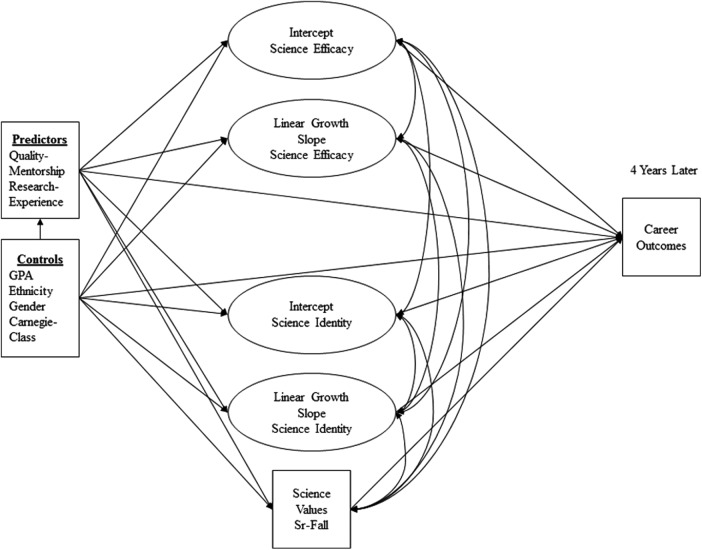
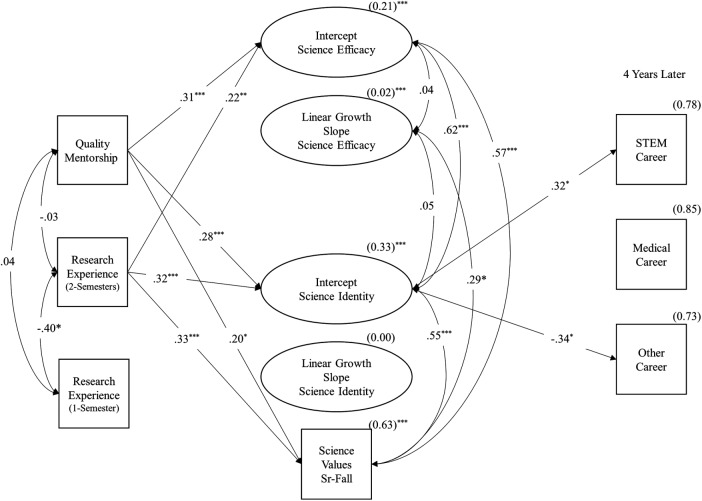
African Americans, Latinos, and Native Americans are historically underrepresented minorities (URMs) among science, technology, engineering, and mathematics (STEM) degree earners. Viewed from a perspective of social influence, this pattern suggests that URMs do not integrate into the STEM academic community at the same rate as non-URM students. Estrada and colleagues recently showed that Kelman's tripartite integration model of social influence (TIMSI) predicted URM persistence into science fields. In this paper, we longitudinally examine the integration of URMs into the STEM community by using growth-curve analyses to measure the development of TIMIS's key variables (science efficacy, identity, and values) from junior year through the postbaccalaureate year. Results showed that quality mentorship and research experience occurring in the junior and senior years were positively related to student science efficacy, identity, and values at that same time period. Longitudinal modeling of TIMSI further shows that, while efficacy is important, and perhaps a necessary predictor of moving toward a STEM career, past experiences of efficacy may not be sufficient for maintaining longer-term persistence. In contrast, science identity and values do continue to be predictive of STEM career pathway persistence up to 4 years after graduation.
© 2018 M. Estrada et al. CBE—Life Sciences Education © 2018 The American Society for Cell Biology. This article is distributed by The American Society for Cell Biology under license from the author(s). It is available to the public under an Attribution–Noncommercial–Share Alike 3.0 Unported Creative Commons License (http://creativecommons.org/licenses/by-nc-sa/3.0).
Figures
References
-
- Ambady N., Shih M., Kim A., Pittinsky T. L. (2001). Stereotype susceptibility in children: Effects of identity activation on quantitative performance. Psychological Science, (5), 385–390. - PubMed
-
- Bandura A. (1997). Self-efficacy: The exercise of control. New York: Freeman.
-
- Barlow A. E., Villarejo M. (2004). Making a difference for minorities: Evaluation of an educational enrichment program. Journal of Research in Science Teaching, (9), 861–881.
-
- Brown S. D., Lent R. W., Larkin K. C. (1989). Self-efficacy as a moderator of scholastic aptitude–academic performance relationships. Journal of Vocational Behavior, , 64–75.
Publication types
MeSH terms
Grants and funding
LinkOut - more resources
Full Text Sources
Other Literature Sources
Miscellaneous
