


State-of-the-art and future directions for extinction as a translational model for fear and anxiety
- PMID: 29352025
- PMCID: PMC5790824
- DOI: 10.1098/rstb.2017.0025
State-of-the-art and future directions for extinction as a translational model for fear and anxiety
Erratum in
-
Correction to 'State-of-the-art and future directions for extinction as a translational model for fear and anxiety'.Philos Trans R Soc Lond B Biol Sci. 2018 Oct 8;373(1760):20180432. doi: 10.1098/rstb.2018.0432. Philos Trans R Soc Lond B Biol Sci. 2018. PMID: 30297482 Free PMC article. No abstract available.
Abstract
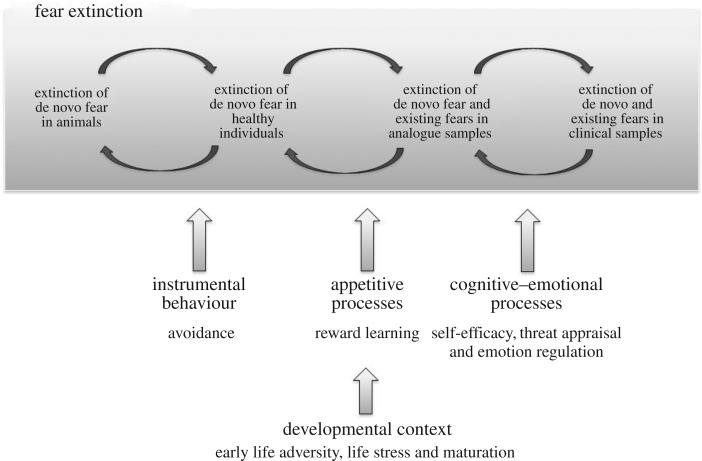
Through advances in both basic and clinical scientific research, Pavlovian fear conditioning and extinction have become an exemplary translational model for understanding and treating anxiety disorders. Discoveries in associative and neurobiological mechanisms underlying extinction have informed techniques for optimizing exposure therapy that enhance the formation of inhibitory associations and their consolidation and retrieval over time and context. Strategies that enhance formation include maximizing prediction-error correction by violating expectancies, deepened extinction, occasional reinforced extinction, attentional control and removal of safety signals/behaviours. Strategies that enhance consolidation include pharmacological agonists of NMDA (i.e. d-cycloserine) and mental rehearsal. Strategies that enhance retrieval include multiple contexts, retrieval cues, and pharmacological blockade of contextual encoding. Stimulus variability and positive affect are posited to influence the formation and the retrieval of inhibitory associations. Inhibitory regulation through affect labelling is considered a complement to extinction. The translational value of extinction will be increased by more investigation of elements central to extinction itself, such as extinction generalization, and interactions with other learning processes, such as instrumental avoidance reward learning, and with other clinically relevant cognitive-emotional processes, such as self-efficacy, threat appraisal and emotion regulation, will add translational value. Moreover, framing fear extinction and related processes within a developmental context will increase their clinical relevance.This article is part of a discussion meeting issue 'Of mice and mental health: facilitating dialogue between basic and clinical neuroscientists'.
Keywords: exposure therapy; fear and anxiety; fear extinction; translational model.
© 2018 The Author(s).
Conflict of interest statement
We declare we have no competing interests.
Figures

References
-
- Jones MC. 1924. A laboratory study of fear: the case of Peter. Pedagogical Seminary. 31, 308–315. (10.1080/08856559.1924.9944851) - DOI
-
- Wolpe J. 1958. Psychotherapy by reciprocal inhibition. Stanford, CA: Stanford University Press.
Publication types
MeSH terms
LinkOut - more resources
Full Text Sources
Other Literature Sources
Medical
