. 2018 Jul;19(7):1765-1778.
doi: 10.1111/mpp.12659. Epub 2018 Mar 2.

The common bean COK-4 and the Arabidopsis FER kinase domain share similar functions in plant growth and defence

Affiliations

The common bean COK-4 and the Arabidopsis FER kinase domain share similar functions in plant growth and defence

Rafhael Felipin Azevedo et al. Mol Plant Pathol. 2018 Jul.

Abstract

Receptor-like kinases are membrane proteins that can be shared by diverse signalling pathways. Among them, the Arabidopsis thaliana FERONIA (FER) plays a role in the balance between distinct signals to control growth and defence. We have found that COK-4, a putative kinase encoded in the common bean anthracnose resistance locus Co-4, which is transcriptionally regulated during the immune response, is highly similar to the kinase domain of FER. To assess whether COK-4 is a functional orthologue of FER, we expressed COK-4 in the wild-type Col-0 and the fer-5 mutant of Arabidopsis and evaluated FER-associated traits. We observed that fer-5 plants show an enhanced apoplastic and stomatal defence against Pseudomonas syringae. In addition, the fer-5 mutant shows reduced biomass, smaller guard cell size, greater number of stomata per leaf area, fewer leaves, faster transition to reproductive stage and lower seed weight per plant than the wild-type Col-0. Except for the stomatal complex length and number of stomata, COK-4 expression in fer-5 lines partially or completely rescued both defence and developmental defects of fer-5 to the wild-type level. Notably, COK-4 may have an additive effect to FER, as the expression of COK-4 in Col-0 resulted in enhanced defence and growth phenotypes in comparison with wild-type Col-0 plants. Altogether, these findings indicate that the common bean COK-4 shares at least some of the multiple functions of the Arabidopsis FER kinase domain, acting in both the induction of plant growth and regulation of plant defence.

Keywords: Arabidopsis thaliana; Co-4 locus; FERONIA; Phaseolus vulgaris; plant growth and development; plant immunity.


Figures

Figure 1
Figure 1
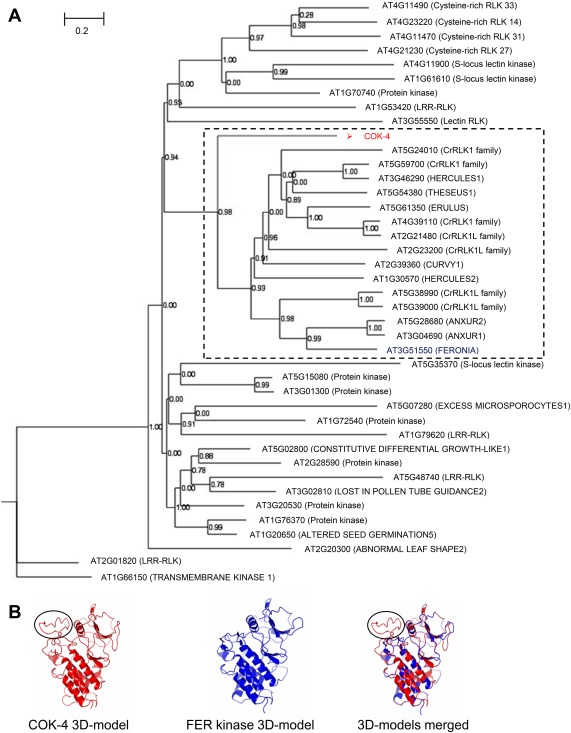
COK‐4 is highly similar to the Arabidopsis FERONIA (FER) kinase domain. (A) Phylogenetic tree showing the clustering of the predicted COK‐4 protein with 15 of the 17 Catharanthus roseus RLK1‐like (CrRLK1L) family members of Arabidopsis (broken square). The phylogenetic tree was obtained using the top 40 different protein kinases of Arabidopsis with significant alignment (threshold E‐value ≤ 3 × 10−33) with the predicted COK‐4 protein from the common bean line SEL 1308 [National Center for Biotechnology Information (NCBI) accession number AAF98554; Melotto and Kelly, 2001], using the maximum parsimony method from MAFFT software (Katoh and Standley, 2013). The nodes were confirmed by 1000 bootstraps. (B) Three‐dimensional (3D) protein structure of FER and COK‐4 kinase domains showing that both kinases have similar structures. The protein models were obtained with SWISS‐MODEL (https://swissmodel.expasy.org) and the alignment of the models was made using CCP4G v.2.10.6 (McNicholas et al., 2011). The black circles indicate the COK‐4 protein region that does not fit within the FER kinase domain structure. This region contains the transmembrane region of COK‐4 predicted by Melotto and Kelly (2001). LRR, leucine‐rich repeat; RLK, receptor‐like kinase.
Figure 2
Figure 2
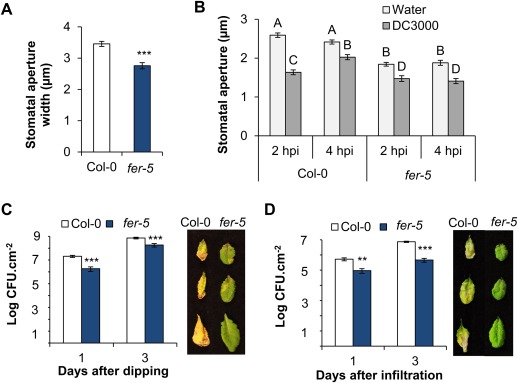
A functional FERONIA (FER) kinase domain contributes to stomatal opening and Arabidopsis susceptibility to Pseudomonas syringae pv. tomato (Pst) DC3000. (A) Stomatal aperture width in untreated Col‐0 and fer‐5 mature leaves. Results are shown as the mean (n = 120 ± SE) and statistical significance between the means was calculated with Student's t‐test (***P ≤ 0.001). (B) Stomatal aperture width in leaves inoculated with Pst DC3000 [1 × 108 colony‐forming units (CFU)/mL] at two time points: 2 and 4 h post‐inoculation (hpi). Results are shown as the mean (120 < n < 180 ± SE) and statistical significance amongst the means, indicated by different letters above the bars, was calculated with analysis of variance (ANOVA) followed by Scott–Knott's test (P ≤ 0.05). (C, D) Apoplastic bacterial population in leaves after dip inoculation with 1 × 108 CFU/mL (C) or vacuum infiltration with 1 × 106 CFU/mL (D) of Pst DC3000, 1 and 3 days after inoculation. Results are shown as the mean (n = 6 ± SE) (Student's t‐test; ***p ≤ 0.001 and **p ≤ 0.01). Photographs on the right were taken from various leaves at 3 days post‐inoculation.
Figure 3
Figure 3
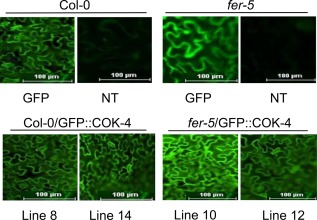
Transgenic lines expressing constructs driven by the 35S promoter. Fluorescence micrographs of Col‐0 and fer‐5 Arabidopsis leaves expressing either the green fluorescent protein gene (GFP) or the GFP::COK‐4 construct, as well as non‐transformed (NT) Col‐0 and fer‐5 leaves as a negative control. Two independent transgenic lines expressing GFP::COK‐4 were selected for further experimentation.
Figure 4
Figure 4
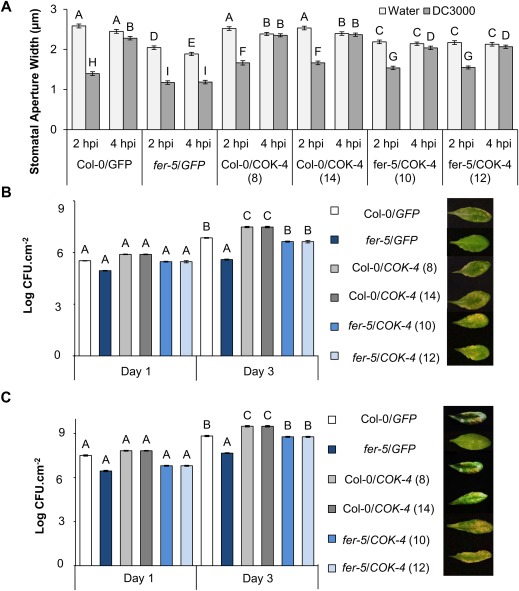
COK‐4 expression increases susceptibility to Pseudomonas syringae pv. tomato (Pst) DC3000. (A) Stomatal aperture width at 2 and 4 h post‐inoculation (hpi) with Pst DC3000 (1 × 108 CFU/mL). Results are shown as the mean (n = 240 ± SE). (B, C) Apoplastic bacterial population in leaves 1 and 3 days after dip inoculation with 1 × 108 CFU/mL (B) or vacuum infiltration with 1 × 106 CFU/mL (C) of Pst DC3000. Results are shown as the mean (n = 18 ± SE), and the statistical significance among the means, indicated by different letters above the bars, was calculated with analysis of variance (ANOVA) followed by Scott–Knott's test (P ≤ 0.05). It should be noted that some error bars are too small to appear at the graph scale. Photographs on the right were taken from various leaves at 3 days post‐inoculation.
Figure 5
Figure 5
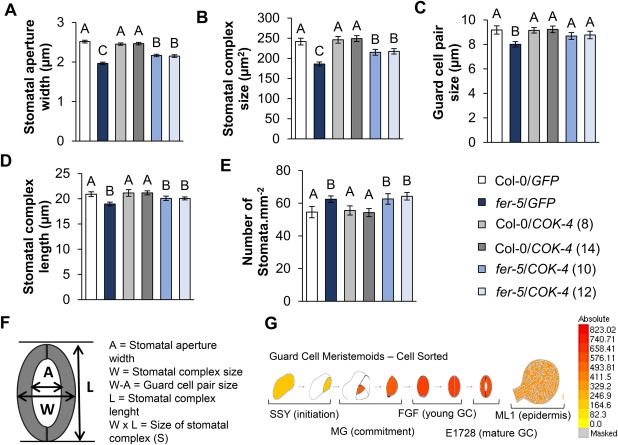
COK‐4 is required for normal stomatal development. Measurements were taken at 3 h after the lights were turned on in the morning: (A) stomatal aperture width; (B) stomatal complex size; (C) guard cell pair size; (D) stomatal complex length; (E) number of stomata per leaf area. Results are shown as the mean (n = 540 to 61 ± SE), and statistical significance amongst the means, indicated by different letters above the bars, was calculated with analysis of variance (ANOVA) followed by Scott–Knott's test (P ≤ 0.05). (F) Diagram representing the measurements taken from stoma‐forming guard cells. (G) Schematic representation of FERONIA (FER) gene expression during guard cell development in Arabidopsis adapted from eFBrowser.
Figure 6
Figure 6
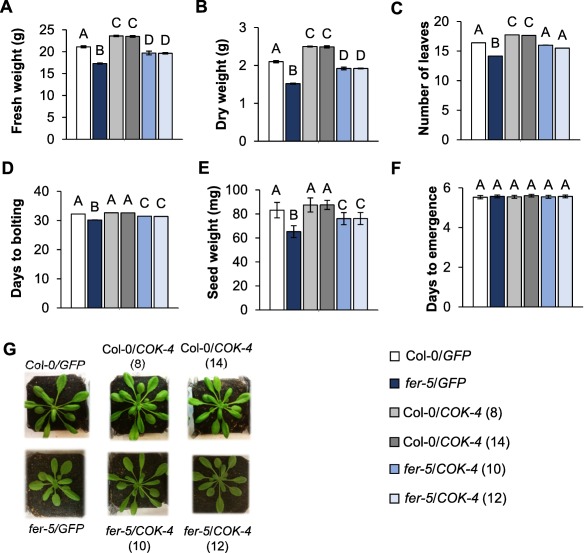
COK‐4 induces some aspects of plant growth and development. The graphs show the average fresh and dry weights of 4–5‐week‐old Arabidopsis rosettes (n = 30 ± SE) (A, B), number of leaves at maturity (4–5‐week‐old plants) (n = 20 ± SE) (C), days to bolting (n = 28 ± SE) (D), seed weight per plant (n = 5 ± SE) (E) and days to seedling emergence (n = 51 ± SE) (F). Statistical significance among the means, indicated by different letters above the bars, was calculated with analysis of variance (ANOVA) followed by Scott–Knott's test (P ≤ 0.05). (G) Representative photographs of 4–5‐week‐old plants used for each measurement. Note that error bars in (C) and (D) are too small to appear in the graphs.
Figure 7
Figure 7
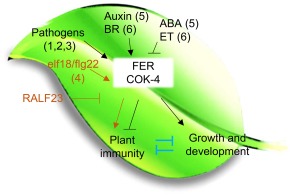
Working model for the possible roles of COK‐4 in the crosstalk between different signals in the control of plant shoot growth/development and immunity. The model is based on our results and previously published data: (1) Keinath et al. (2010); (2) Kessler et al. (2010); (3) Masachis et al. (2016); (4) Stegmann et al. (2017); (5) Yu et al. (2012); (6) Deslaurier and Larsen (2010). Orange arrows and bars indicate an alternative pathway for FERONIA (FER) function in immunity (Stegmann et al., 2017). Blue bars in the model indicate the possible existence of negative crossregulation of plant immunity and growth that is independent of FER/COK‐4. Arrows indicate positive regulation and bars indicate negative regulation. ABA, abscisic acid; BR, brassinosteroid; ET, ethylene; RALF, rapid alkalinization factor.

References

    1. Abe, H. , Urao, T. , Ito, T. , Seki, M. , Shinozaki, K. and Yamaguchi‐Shinozaki, K. (2003) Arabidopsis AtMYC2 (bHLH) and AtMYB2 (MYB) function as transcriptional activators in abscisic acid signaling. Plant Cell, 15, 63–78. - PMC - PubMed
    1. Adrian, J. , Chang, J. , Ballenger, C.E. , Bargmann, B.O. , Alassimone, J. , Davies, K.A. , Lau, O.S. , Matos, J.L. , Hachez, C. , Lanctot, A. , Vatén, A. , Birnbaum, K.D. and Bergmann, D.C. (2015) Transcriptome dynamics of the stomatal lineage: birth, amplification, and termination of a self‐renewing population. Dev. Cell, 33, 107–118. - PMC - PubMed
    1. Altschul, S.F. , Madden, T.L. , Schaffer, A.A. , Zhang, J. , Zhang, Z. , Miller, W. and Lipman, D.J. (1997) Gapped BLAST and PSI‐BLAST: a new generation of protein database search programs. Nucleic Acids Res. 25, 3389–3402. - PMC - PubMed
    1. Altschul, S.F. , Wootton, J.C. , Gertz, E.M. , Agarwala, R. , Morgulis, A. , Schaffer, A.A. and Yu, Y.K. (2005) Protein database searches using compositionally adjusted substitution matrices. FEBS J. 272, 5101–5109. - PMC - PubMed
    1. Belkhadir, Y. , Yang, L. , Hetzel, J. , Dangl, J.L. and Chory, J. (2014) The growth–defense pivot: crisis management in plants mediated by LRR‐RK surface receptors. Trends Biochem. Sci. 39, 447–456. - PMC - PubMed

Publication types

MeSH terms