


The WHO recommendation of home fortification of foods with multiple-micronutrient powders in children under 2 years of age and its effectiveness on anaemia and weight: a pragmatic cluster-randomized controlled trial
- PMID: 29352829
- PMCID: PMC10261316
- DOI: 10.1017/S1368980017003858
The WHO recommendation of home fortification of foods with multiple-micronutrient powders in children under 2 years of age and its effectiveness on anaemia and weight: a pragmatic cluster-randomized controlled trial
Abstract
Objective: To assess under real community settings the effectiveness of the WHO strategy of home fortification of foods (HFF) with multiple-micronutrient powders on Hb change, anaemia and weight in children.
Design: A pragmatic cluster-randomized controlled trial.
Setting: Forty villages in the Nioro Circle in Mali and 722 children aged 6-23 months were randomized to the intervention or control group. The intervention consisted of a daily dose of multiple-micronutrient powder for 3 months; in the control group, no supplement was given. In both groups, mothers received group education on child complementary feeding. Changes in weight, Hb concentration and anaemia were assessed as primary outcomes at baseline and 3 months. The HFF effect was determined using regression analyses and quantile regression with standard errors taking account of the cluster design.
Subjects: Children aged 6-23 months.
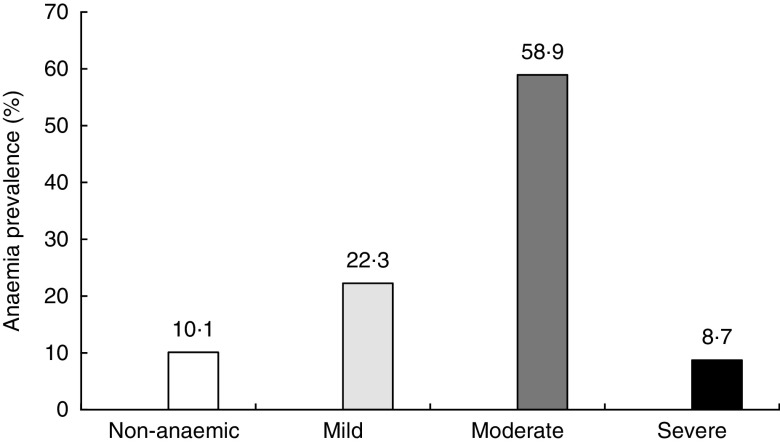
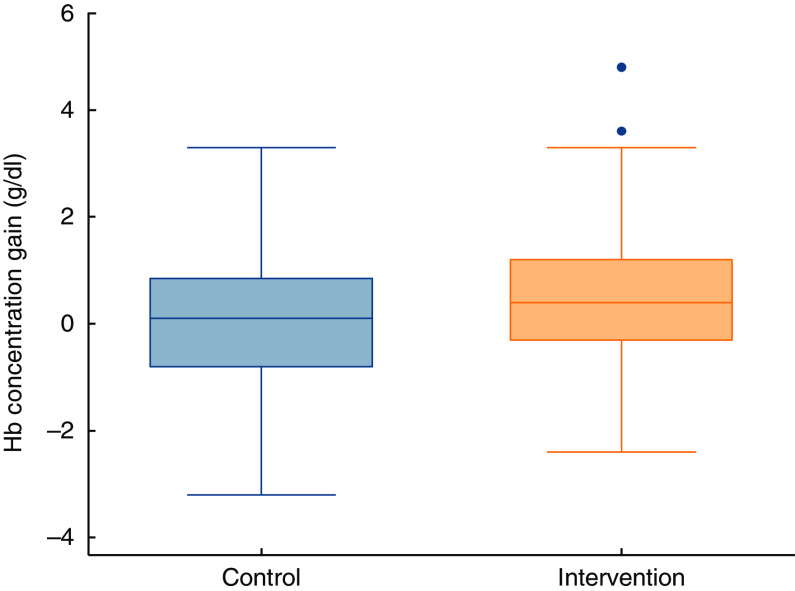
Results: Overall prevalence of anaemia in the sample was high: 90 %. HFF provided a modest but statistically significant Hb change v. no intervention (0·50 v. 0·09 g/dl, P=0·023). Prevalence of anaemia changed little: 91·3-85·8 % (P=0·04) in the intervention group v. 88·1-87·5 % % (P=0·86) in the control group. Proportion of severe anaemia was reduced by 84 % (from 9·8 to 1·6 %) in the intervention group, but increased in the control group (from 8·5 to 10·8 %). No effect was observed on weight.
Conclusions: The WHO HFF strategy to fight anaemia showed a modest change on Hb concentration and significantly reduced the rate of severe anaemia.
Keywords: Anaemia; Children; Growth; Hb; Multiple micronutrients.
Figures

References
-
- Bailey RL, West KP & Black RE (2015) The epidemiology of global micronutrient deficiencies. Ann Nutr Metab 66, Suppl. 2, 22–33. - PubMed
-
- Ahmed T, Hossain M & Sanin KI (2012) Global burden of maternal and child undernutrition and micronutrient deficiencies. Ann Nutr Metab 61, Suppl. 1, 8–17. - PubMed
-
- Bhutta ZA (2008) Micronutrient needs of malnourished children. Curr Opin Clin Nutr Metab Care 11, 309–314. - PubMed
-
- Balarajan Y, Ramakrishnan U, Ozaltin E et al. (2011) Anaemia in low-income and middle-income countries. Lancet 378, 2123–2135. - PubMed
Publication types
MeSH terms
Substances
LinkOut - more resources
Full Text Sources
Other Literature Sources
Medical
