


Outcome and prognostic factors in 110 consecutive patients with primary uterine leiomyosarcoma: A Rare Cancer Network study
- PMID: 29353974
- PMCID: PMC5775016
- DOI: 10.21147/j.issn.1000-9604.2017.06.06
Outcome and prognostic factors in 110 consecutive patients with primary uterine leiomyosarcoma: A Rare Cancer Network study
Abstract
Objective: Primary uterine leiomyosarcomas (ULMS) are rare, and the optimal treatment is controversial. We aimed to assess the outcome and prognostic factors in a multicenter population of women treated for primary ULMS.
Methods: We retrospectively collected data of 110 women treated in 19 institutions of the Rare Cancer Network (RCN). Inclusion criteria consisted of a pathology report confirming the diagnosis of ULMS, aged 18-80 years, complete International Federation of Gynecology and Obstetrics (FIGO) stage information, complete information on treatment, and a minimum follow-up of 6 months. Local control (LC) and locoregional control (LRC), overall survival (OS) and disease-free survival (DFS) rates were computed using the Kaplan-Meier method. Univariate analysis was implemented using the log rank test, and multivariate analysis using the Cox model.
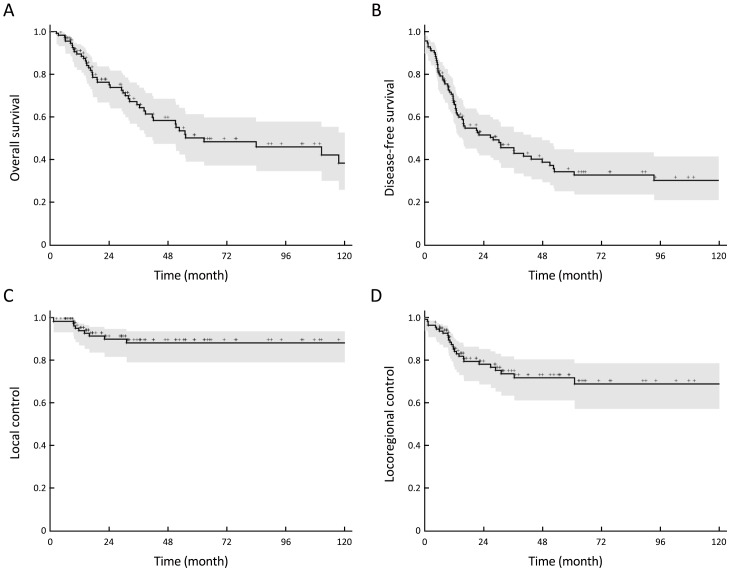
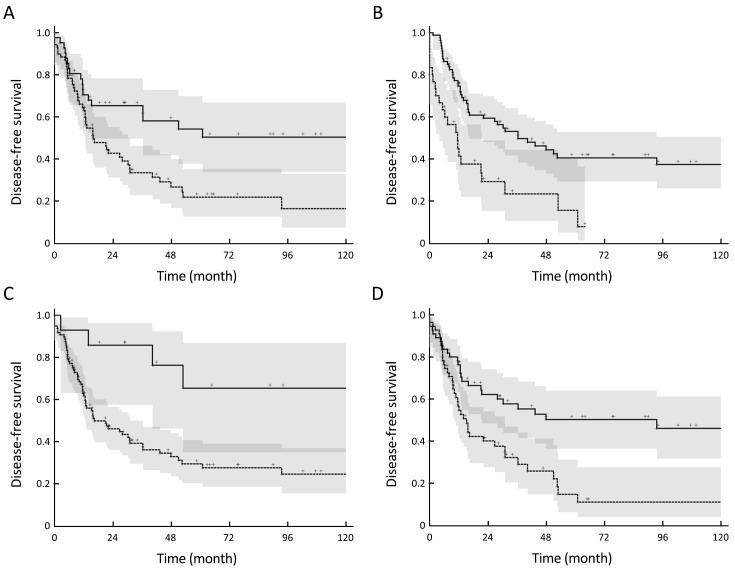
Results: All patients underwent surgery. Seventy-five patients (68%) received adjuvant radiotherapy (RT), including brachytherapy in 18 (16%). Seventeen patients (15%) received adjuvant chemotherapy. Median follow-up was 58 (range, 6-240) months. Five-year OS and DFS rates were 50% and 34%, and LC and LRC rates were 88% and 72%, respectively. On multivariate analysis, independent favorable prognostic factors were younger age, FIGO stage I, small tumor size, previous uterine disease, and no vascular invasion for OS and DFS. FIGO stage was the only favorable factor influencing LRC. Adjuvant local or systemic treatments did not improve the outcomes. Eight patients treated with RT presented a grade 3 acute toxicity, and only one patient with grade 3 late toxicity.
Conclusions: In this large population of primary ULMS patients, we found good results in terms of LC and LRC. Nevertheless, OS remains poor, mainly due to the occurrence of distant metastases. An early diagnosis seemed to improve the prognosis of the patients. Adjuvant local or systemic treatments, or more aggressive surgical procedures such as the Wertheim procedure, did not seem to impact the outcome.
Keywords: Uterine leiomyosarcoma; local control; overall survival; prognostic factors; radiotherapy.
Figures
References
-
-
PDQ<sup>®</sup> Adult Treatment Editorial Board. Uterine Sarcoma Treatment (PDQ<sup>®</sup>)-Health Professional Version. Bethesda: National Cancer Institute, 2015. Available online: http://www.cancer.gov/types/uterine/hp/uterine-sarcoma-treatment-pdq.
-
-
- Evans HL, Chawla SP, Simpson C, et al. Smooth muscle neoplasms of the uterus other than ordinary leiomyoma. A study of 46 cases, with emphasis on diagnostic criteria and prognostic factors. Cancer. 1988;62:2239–47. [Evans HL, Chawla SP, Simpson C, et al. Smooth muscle neoplasms of the uterus other than ordinary leiomyoma. A study of 46 cases, with emphasis on diagnostic criteria and prognostic factors. Cancer 1988;62:2239-47. <PMID: 3179938>] - PubMed
-
- Major FJ, Blessing JA, Silverberg SG, et al. Prognostic factors in early-stage uterine sarcoma. A Gynecologic Oncology Group study. Cancer. 1993;71:1702–9. [Major FJ, Blessing JA, Silverberg SG, et al. Prognostic factors in early-stage uterine sarcoma. A Gynecologic Oncology Group study. Cancer 1993;71:1702-9. <PMID: 8381710>] - PubMed
-
- Oláh KS, Dunn JA, Gee H. Leiomyosarcomas have a poorer prognosis than mixed mesodermal tumours when adjusting for known prognostic factors: the result of a retrospective study of 423 cases of uterine sarcoma. Br J Obstet Gynaecol. 1992;99:590–4. [Oláh KS, Dunn JA, Gee H. Leiomyosarcomas have a poorer prognosis than mixed mesodermal tumours when adjusting for known prognostic factors: the result of a retrospective study of 423 cases of uterine sarcoma. Br J Obstet Gynaecol 1992;99:590-4. <PMID: 1326319>] - PubMed
-
- Davidson B, Kjæreng ML, Førsund M, et al. Progesterone receptor expression is an independent prognosticator in FIGO stage I uterine leiomyo-sarcoma. Am J Clin Pathol. 2016;145:449–58. doi: 10.1093/ajcp/aqw030. [Davidson B, Kjæreng ML, Førsund M, et al. Progesterone receptor expression is an independent prognosticator in FIGO stage I uterine leiomyo-sarcoma. Am J Clin Pathol 2016;145:449-58. <DOI: 10.1093/ajcp/aqw030> <PMID: 27149024>] - DOI - PubMed
LinkOut - more resources
Full Text Sources
Other Literature Sources
Miscellaneous