Review
. 2018 Jan 4:8:985.
doi: 10.3389/fphys.2017.00985. eCollection 2017.

Interpreting Signal Amplitudes in Surface Electromyography Studies in Sport and Rehabilitation Sciences

Affiliations
Review

Interpreting Signal Amplitudes in Surface Electromyography Studies in Sport and Rehabilitation Sciences

Andrew D Vigotsky et al. Front Physiol. .

Abstract

Surface electromyography (sEMG) is a popular research tool in sport and rehabilitation sciences. Common study designs include the comparison of sEMG amplitudes collected from different muscles as participants perform various exercises and techniques under different loads. Based on such comparisons, researchers attempt to draw conclusions concerning the neuro- and electrophysiological underpinning of force production and hypothesize about possible longitudinal adaptations, such as strength and hypertrophy. However, such conclusions are frequently unsubstantiated and unwarranted. Hence, the goal of this review is to discuss what can and cannot be inferred from comparative research designs as it pertains to both the acute and longitudinal outcomes. General methodological recommendations are made, gaps in the literature are identified, and lines for future research to help improve the applicability of sEMG are suggested.

Keywords: activation; excitation; exercise; hypertrophy; motor unit recruitment; muscle force; rate coding; strength.


Figures

Figure 1
Figure 1
Production of muscle force from neural input. Excitation is the electrochemical input from the central nervous system into the muscle. This signal triggers excitation-contract coupling, which leads to an active muscle state (activation). Finally, muscle force is produced after cross-bridges are formed and force is transmitted through the muscle. Adapted from Zajac (1989).
Figure 2
Figure 2
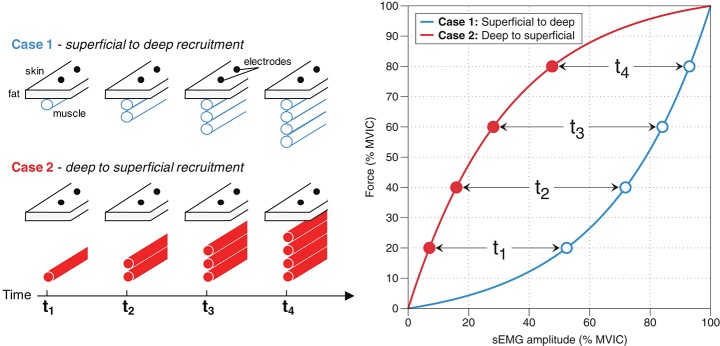
Recruitment methods and their effects on sEMG amplitude. Case 1: If a muscle recruits motor units from superficial to deep, then this will result in sEMG amplitude rising at a faster rate than force; that is, sEMG amplitude (% MVIC) ≥ Force (% MVIC). Case 2: If a muscle recruits motor units from deep to superficial, then this will result in force levels rising at a greater rate than sEMG amplitude; that is, Force (% MVIC) ≥ sEMG amplitude (% MVIC).
Figure 3
Figure 3
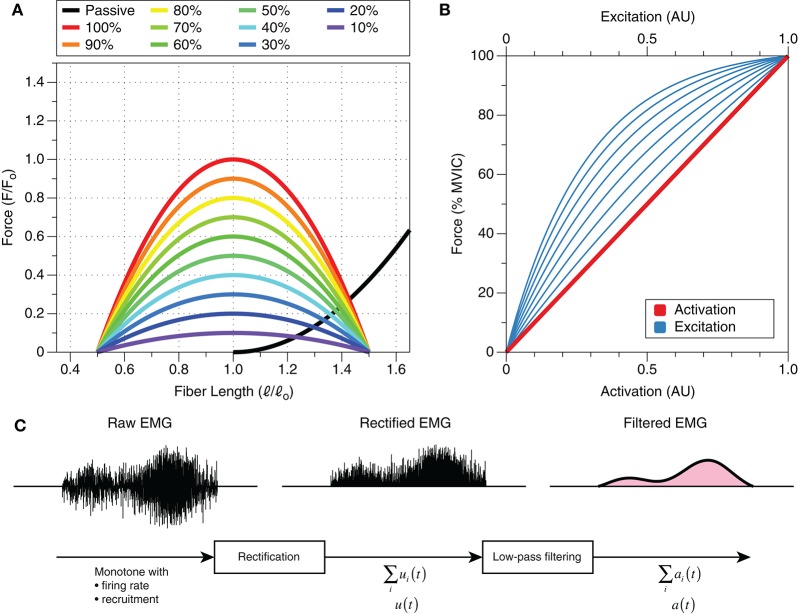
The isometric relationships between muscle force, activation, excitation, and fiber length. (A) Only the active curve is affected by activation, and any activation can occur regardless of the muscle's normalized force output. That is, activation is independent of fiber length; normalized force is a function of fiber length and activation, in addition to contraction velocity (not shown). The passive length-tension curve is unaffected by activation; this has important implications for force production and force sharing. Both force and length are represented relative to force and length, respectively, at optimal lengtha. (B) Excitation is curvilinearly related to activation and force, whereas force and activation are directly related to one another (one-to-one). Different muscles have different excitation-activation relationships, and thus, excitation for a given muscle can be one of the numerous lines that are plotted. Graph derived from Potvin et al. (1996) and Lloyd and Besier (2003). (C) Raw EMG is influenced primarily by motor unit recruitment and rate coding. The envelope of this signal, rectified EMG, may be considered the sum of neural drive to the area of muscle over which the electrode is placed, which, somehow [e.g., Σui(t)], is related to excitation, u(t). By filtering this signal, one can obtain data that are related to activation, a(t). Adapted from Zajac (1989). aThe optimal length shifts to the right with decreasing levels of activation (Lloyd and Besier, ; de Brito Fontana and Herzog, 2016), but a thorough description of these changes is outside the scope of this review.
Figure 4
Figure 4
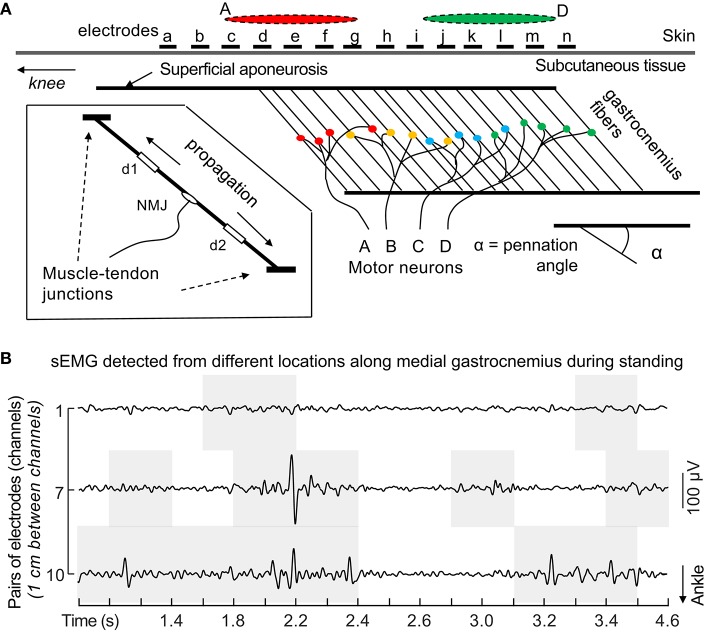
Under-representative sampling of motor units with sEMG. (A) Unlike observed for skin parallel-fibered muscles, the same action potentials propagating along the fibers of pennated muscles are not sampled by a single pair of surface electrodes positioned anywhere on the muscle. As exemplified above, action potentials of motor units A and D are detected mainly by proximal and distal electrodes (red and green ellipses), respectively. sEMG amplitudes detected locally likely provide an unrepresentative view of the actual degree of muscle excitation. Biased inferences may be drawn from unrepresentative sEMG. Consider, for example, the amplitude of sEMG detected by any pair of distal electrodes in the figure (from i to n). If, during a given submaximal contraction, only the distal muscle region is excited, normalized sEMG amplitude will likely indicate a nearly 100% degree of excitation. Conversely, normalized sEMG detected proximally would overly underestimate the degree of excitation. These considerations presume excitation of the whole muscle volume during the reference, normalization condition. Inferences on the degree and timing of excitation are not supported by EMGs detected locally from large, pennated muscles. Reproduced from Merletti et al. (2016), with permission. (B) Raw sEMG detected with pairs of electrodes from different locations along medial gastrocnemius. Gray, shaded areas indicate periods when the root mean square amplitude (30 ms epochs) was greater than the background, rest level during a standing task. Nota bene the false conclusions that can be drawn regarding the state of a muscle by looking at only one pair of electrodes (e.g., electrode pair #1). Reproduced from dos Anjos et al. (2017) (under CC-BY 4.0).

References

    1. Alkner B. A., Tesch P. A., Berg H. E. (2000). Quadriceps EMG/force relationship in knee extension and leg press. Med. Sci. Sports Exerc. 32, 459–463. 10.1097/00005768-200002000-00030 - DOI - PubMed
    1. Andersen L. L., Magnusson S. P., Nielsen M., Haleem J., Poulsen K., Aagaard P. (2006). Neuromuscular activation in conventional therapeutic exercises and heavy resistance exercises: implications for rehabilitation. Phys. Ther. 86, 683–697. 10.1093/ptj/86.5.683 - DOI - PubMed
    1. Arabadzhiev T. I., Dimitrov V. G., Dimitrova N. A., Dimitrov G. V. (2010a). Influence of motor unit synchronization on amplitude characteristics of surface and intramuscularly recorded EMG signals. Eur. J. Appl. Physiol. 108, 227–237. 10.1007/s00421-009-1206-3 - DOI - PubMed
    1. Arabadzhiev T. I., Dimitrov V. G., Dimitrova N. A., Dimitrov G. V. (2010b). Interpretation of EMG integral or RMS and estimates of “neuromuscular efficiency” can be misleading in fatiguing contraction. J. Electromyogr. Kinesiol. 20, 223–232. 10.1016/j.jelekin.2009.01.008 - DOI - PubMed
    1. Arabadzhiev T. I., Dimitrov V. G., Dimitrov G. V. (2014). The increase in surface EMG could be a misleading measure of neural adaptation during the early gains in strength. Eur. J. Appl. Physiol. 114, 1645–1655. 10.1007/s00421-014-2893-y - DOI - PubMed

LinkOut - more resources