


Molecular characterization of Plasmodium falciparum in Arunachal Pradesh from Northeast India based on merozoite surface protein 1 & glutamate-rich protein
- PMID: 29355145
- PMCID: PMC5793473
- DOI: 10.4103/ijmr.IJMR_291_16
Molecular characterization of Plasmodium falciparum in Arunachal Pradesh from Northeast India based on merozoite surface protein 1 & glutamate-rich protein
Abstract
Background & objectives: Northeast (NE) India is one of the high endemic regions for malaria with a preponderance of Plasmodium falciparum, resulting in high morbidity and mortality. The P. falciparum parasite of this region showed high polymorphism in drug-resistant molecular biomarkers. However, there is a paucity of information related to merozoite surface protein 1 (msp-1) and glutamate-rich protein (glurp) which have been extensively studied in various parts of the world. The present study was, therefore, aimed at investigating the genetic diversity of P. falciparum based on msp-1 and glurp in Arunachal Pradesh, a State in NE India.
Methods: Two hundred and forty nine patients with fever were screened for malaria, of whom 75 were positive for P. falciparum. Blood samples were collected from each microscopically confirmed patient. The DNA was extracted; nested polymerase chain reaction and sequencing were performed to study the genetic diversity of msp-1 (block 2) and glurp.
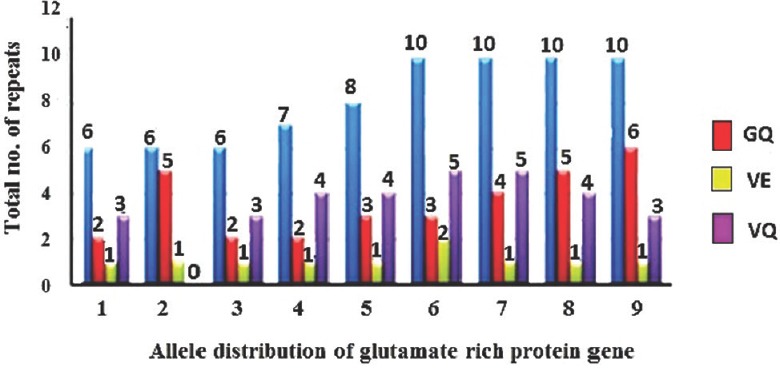
Results: The block 2 of msp-1 gene was found to be highly polymorphic, and overall allelic distribution showed that RO33 was the dominant allele (63%), followed by MAD20 (29%) and K1 (8%) alleles. However, an extensive diversity (9 alleles and 4 genotypes) and 6-10 repeat regions exclusively of R2 type were observed in glurp.
Interpretation & conclusions: The P. falciparum population of NE India was diverse which might be responsible for higher plasticity leading to the survival of the parasite and in turn to the higher endemicity of falciparum malaria of this region.
Conflict of interest statement
Figures
References
-
- World Malaria Report. 2016. [accessed on August 21, 2017]. Available from: http://apps.who.int/iris/bitstream/10665/252038/1/9789241511711-eng.pdf .
-
- Richards JS, Beeson JG. The future for blood-stage vaccines against malaria. Immunol Cell Biol. 2009;87:377–90. - PubMed
-
- Methods and techniques for clinical trials on antimalarial drug efficacy: Genotyping to identify parasite population. Informal consultation organized by the Medicines for Malaria Venture and cosponsored by the World Health Organization, May 29-31, 2007, Amsterdam, The Netherlands. 2007. [accessed on August 21, 2017]. Available from: https://apps.who.int/iris/bitstream/10665/43824/1/9789241596305_eng.pdf .
-
- Holder AA, Blackman MJ, Burghaus PA, Chappel JA, Ling IT, McCallum-Deighton N, et al. A malaria merozoite surface protein (MSP1)-structure, processing and function. Mem Inst Oswaldo Cruz. 1992;87(Suppl 3):37–42. - PubMed
MeSH terms
Substances
LinkOut - more resources
Full Text Sources
Research Materials