Delay discounting of losses and rewards in alcohol use disorder: The effect of working memory load
- PMID: 29355332
- PMCID: PMC5858963
- DOI: 10.1037/adb0000341
Delay discounting of losses and rewards in alcohol use disorder: The effect of working memory load
Abstract
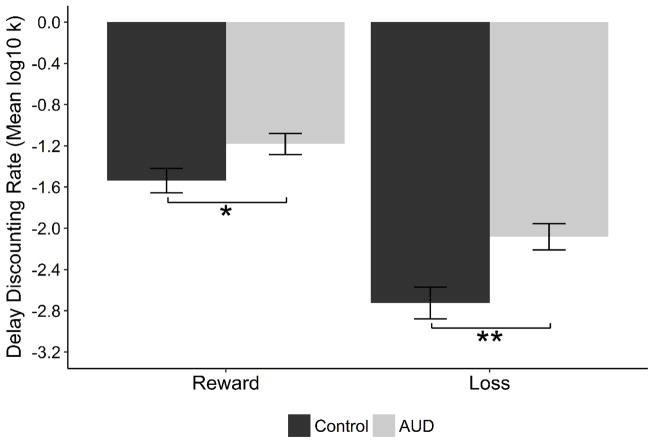
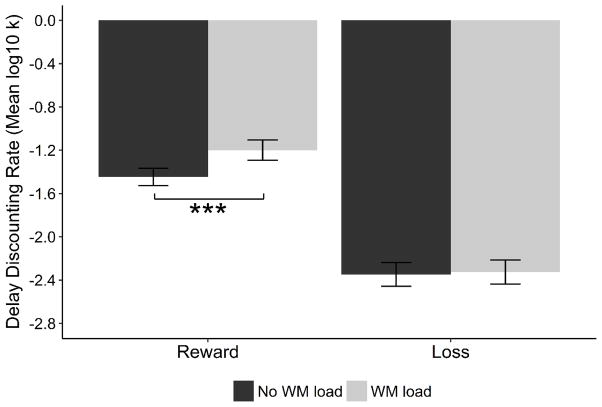
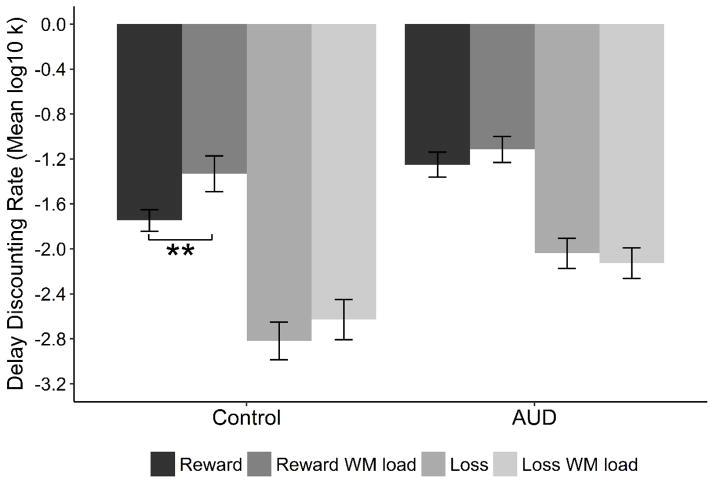
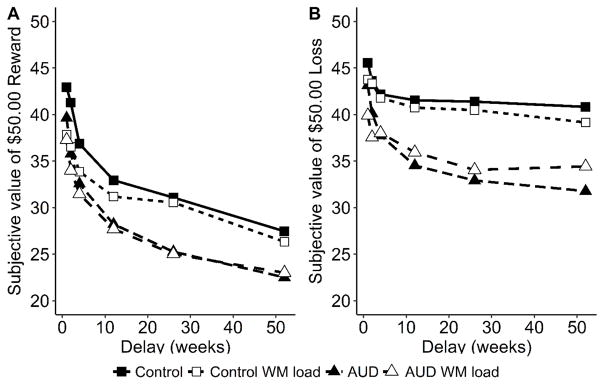
Alcohol use disorder (AUD) has been consistently associated with elevated discounting rates for delayed rewards. However, there are few studies of delay discounting of losses in those with AUD even though their drinking behavior suggests that they discount future negative consequences of excessive drinking. The current study extends this literature by examining delay discounting of rewards and losses in a sample of those with AUD (n = 78) and healthy controls (n = 51) in 2 conditions: working memory (WM) load and no WM load. The AUD group discounted both rewards and losses at higher rates than the control group. The WM load increased discounting rates in the reward task but not in the loss task. There was also a significant Group × WM load interaction; the WM load increased discounting in control participants but not in AUD participants. These findings suggest that AUD is associated with a general propensity to discount future incentivized events regardless of nature of the incentive. (PsycINFO Database Record
(c) 2018 APA, all rights reserved).
Conflict of interest statement
The authors have no conflicts of interest to report.
Figures
References
-
- American Psychiatric Association. Diagnostic and statistical manual of mental disorders: DSM-5. Washington, D.C: American Psychiatric Association; 2013.
-
- Baker F, Johnson MW, Bickel WK. Delay discounting in current and never-before cigarette smokers: similarities and differences across commodity, sign, and magnitude. Journal of abnormal psychology. 2003;112(3):382. - PubMed
-
- Bauer LO, Hesselbrock VM. EEG, Autonomic and Subjective Correlates of the Risk for Alcoholism* 1993. - PubMed
-
- Bickel WK, Marsch Lisa A. Toward a behavioral economic understanding of drug dependence: delay discounting processes. Addiction. 2001;96(1):73–86. - PubMed
Publication types
MeSH terms
Grants and funding
LinkOut - more resources
Full Text Sources
Other Literature Sources
Medical