


Parkinson disease with and without Dementia: A prevalence study and future projections
- PMID: 29356127
- PMCID: PMC5892791
- DOI: 10.1002/mds.27277
Parkinson disease with and without Dementia: A prevalence study and future projections
Abstract
Background: Limited population-based information is available on the co-occurrence of dementia and PD. However, projecting the prevalence of PD with and without dementia during the next 50 years is crucial for planning public-health and patient-care initiatives.
Objectives: The objective of this study was to project the prevalence of PD with and without dementia in the United States by 2060.
Methods: We used the Rochester Epidemiology Project medical records-linkage system to identify all persons with PD with or without dementia residing in Olmsted County, Minnesota, on January 1, 2006. A movement disorders specialist reviewed the complete medical records of each person to confirm the presence of PD. We calculated the age- and sex-specific prevalence of PD with and without dementia and projected U.S. prevalence through 2060.
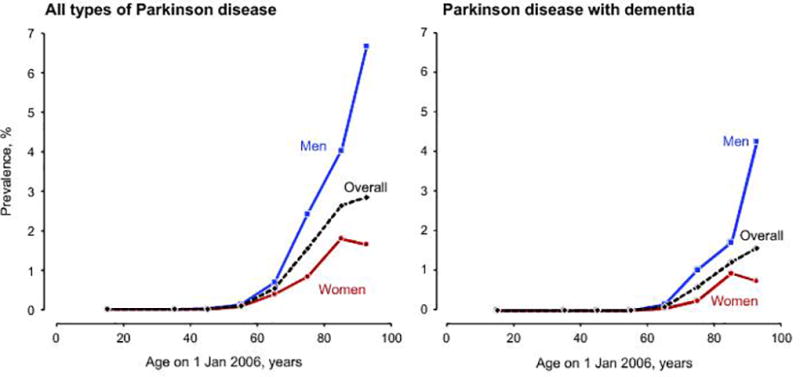
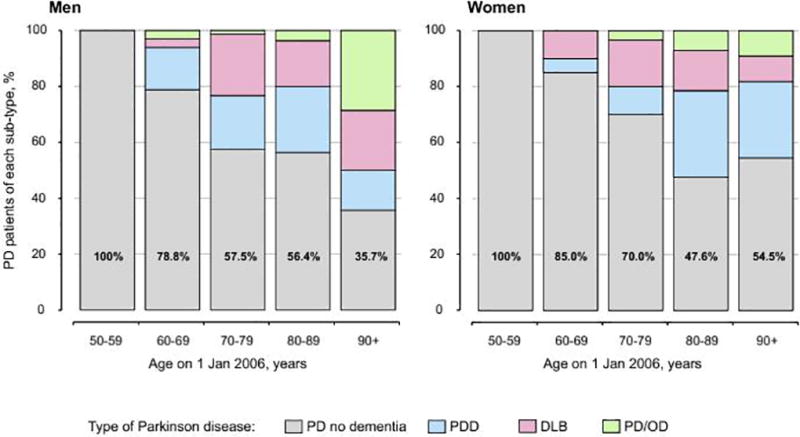
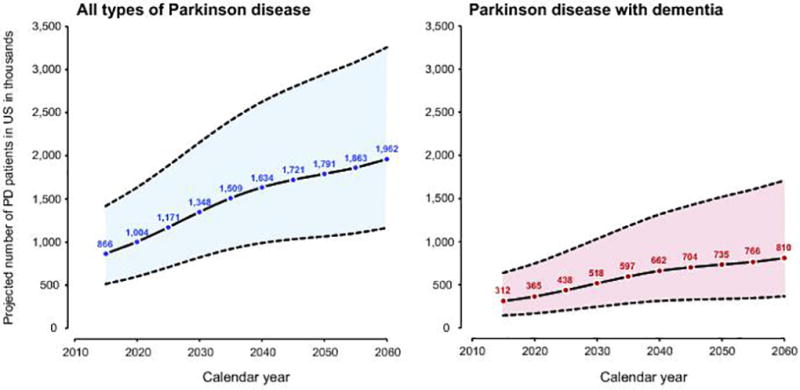
Results: We identified 296 persons with PD with and without dementia on the prevalence date (187 men, 109 women); the overall prevalence increased with age from 0.01% (30-39 years) to 2.83% (≥90 years). The prevalence of PD without dementia increased with age from 0.01% (30-39 years) to 1.25% (≥90 years). The prevalence of PD with dementia increased with age from 0.10% (60-69 years) to 1.59% (≥90 years). The prevalence was higher in men than in women for all subtypes and all age groups. We project by 2060 an approximate doubling of the number of persons with PD without dementia and a tripling of the number of persons with PD with dementia in the United States.
Conclusions: The prevalence of PD with and without dementia increases with age and is higher in men than women. We project that the number of persons with PD in the United States will increase substantially by 2060. © 2018 International Parkinson and Movement Disorder Society.
Keywords: Olmsted County; Parkinson's disease; Rochester Epidemiology Project (REP); dementia; prevalence; projections.
© 2018 International Parkinson and Movement Disorder Society.
Figures
References
-
- Pringsheim T, Jette N, Frolkis A, Steeves TD. The prevalence of Parkinson's disease: a systematic review and meta-analysis. Mov Disord. 2014;29:1583–1590. - PubMed
-
- Dorsey ER, Constantinescu R, Thompson JP, et al. Projected number of people with Parkinson disease in the most populous nations, 2005 through 2030. Neurology. 2007;68:384–386. - PubMed
-
- Bach JP, Ziegler U, Deuschl G, Dodel R, Doblhammer-Reiter G. Projected numbers of people with movement disorders in the years 2030 and 2050. Mov Disord. 2011;26:2286–2290. - PubMed
-
- Kowal SL, Dall TM, Chakrabarti R, Storm MV, Jain A. The current and projected economic burden of Parkinson's disease in the United States. Mov Disord. 2013;28:311–318. - PubMed
Publication types
MeSH terms
Grants and funding
LinkOut - more resources
Full Text Sources
Other Literature Sources
Medical
