


Bidirectional influences of caregiver utterances and supported joint engagement in children with and without autism spectrum disorder
- PMID: 29356414
- PMCID: PMC5991996
- DOI: 10.1002/aur.1928
Bidirectional influences of caregiver utterances and supported joint engagement in children with and without autism spectrum disorder
Abstract
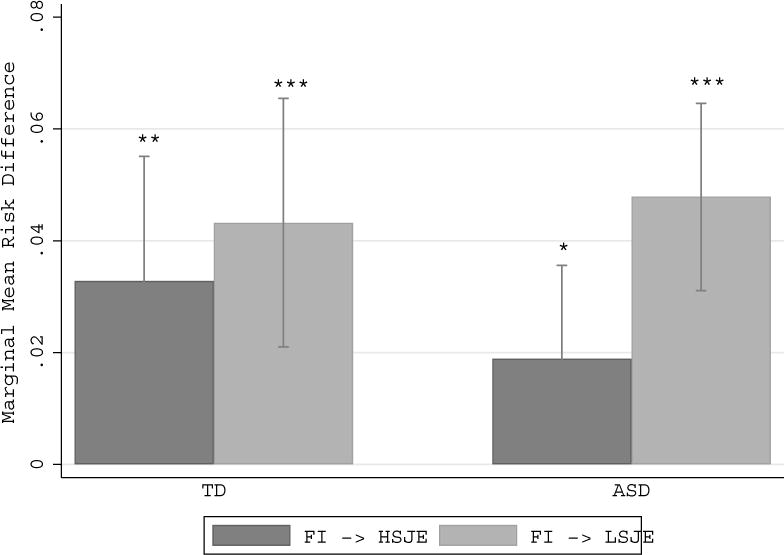
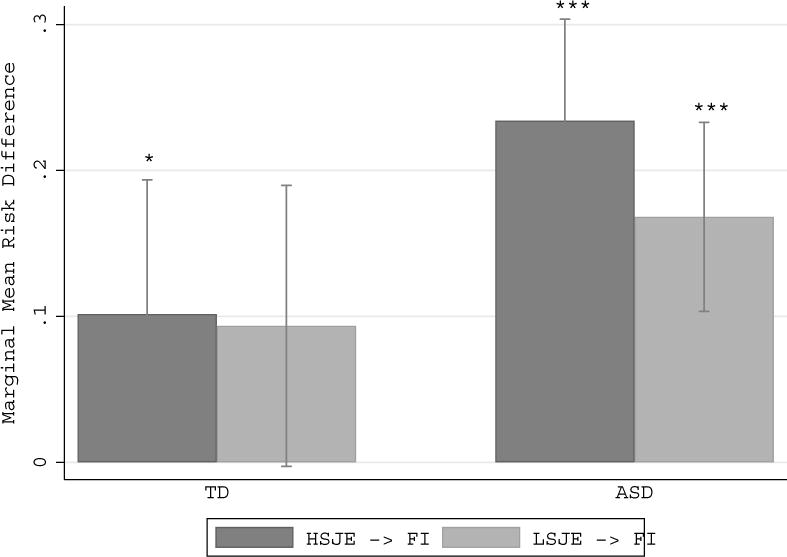
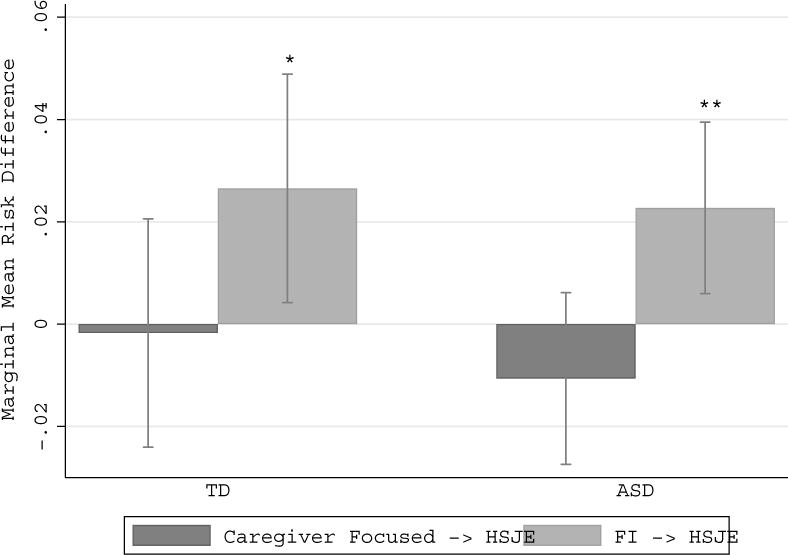
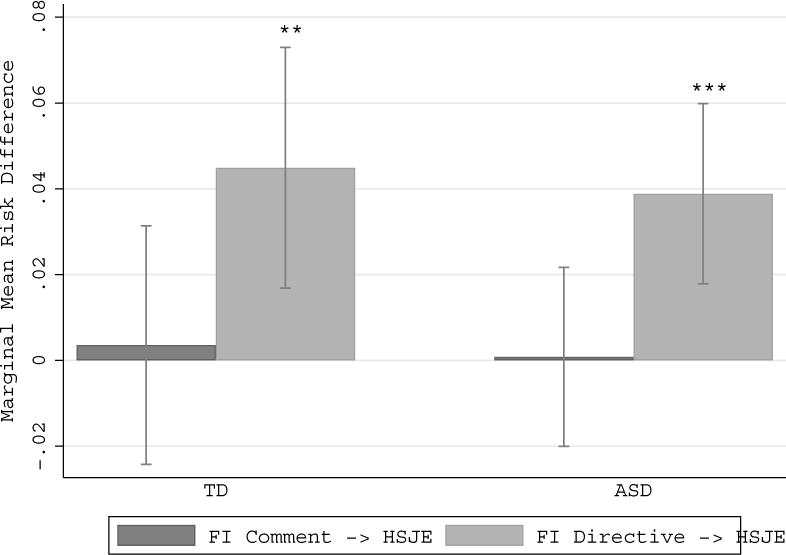
This study examined sequential associations between pairs of caregiver talk and caregiver-child joint engagement categories. Sequential associations quantify the extent to which one event (such as a particular type of caregiver talk) follows another event (such as a particular type of joint engagement) in a pre-specified time window, while controlling for the chance occurrence of the sequence. Although unable to support strong conclusions about causality, the requirement of sequential analysis that key events occur within a close temporal sequence rules out alternative explanation for associations that summary-level correlations cannot. We applied sequential analysis to observational data on 98 caregiver-child dyads, fifty of which included a child with autism spectrum disorder (ASD). Groups were matched on mental age, and all were just beginning to develop spoken vocabulary. Sequential associations between supported joint engagement and caregiver follow-in utterances were stronger in ASD dyads as compared to dyads with typically developing children. Further, sequential associations between utterances related to the child's focus of attention followed by higher order supported joint engagement (HSJE) were stronger than between utterances that related to the caregiver's focus of attention and HSJE, across both groups. Finally, sequential associations between follow-in directives followed by HSJE were stronger than between follow-in comments followed by HSJE, again across both groups of children. Autism Res 2018, 11: 755-765. © 2018 International Society for Autism Research, Wiley Periodicals, Inc.
Lay summary: Our findings suggest that caregivers of children with autism spectrum disorder (ASD) may be particularly adept at timing their talk to follow moments of high-level joint engagement, and that follow-in directives are particularly facilitative of high-level joint engagement. Future intervention work can capitalize on these findings to support high level caregiver-child engagement around toys, which may promote development in children with ASD.
Keywords: autism spectrum disorder; caregiver talk; responsivity; sequential analysis; supported joint engagement.
© 2018 International Society for Autism Research, Wiley Periodicals, Inc.
Conflict of interest statement
The authors report no conflicts of interest.
Figures
References
-
- Bloom L, Tinker E. The intentionality model and language acquisition: Engagement, effort, and the essential tension in development. Monographs for the Society for Research in Child Development. 2001;66:vii–91. - PubMed
-
- Bottema-Beutel K, Yoder PJ, Hochman JM, Watson LR. The role of supported joint engagement and parent utterances in language and social communication development in children with autism spectrum disorder. Journal of Autism and Developmental Disorders. 2014;44(9):2162–2174. doi: 10.1007/s10803-014-2092-z. - DOI - PMC - PubMed
Publication types
MeSH terms
Grants and funding
LinkOut - more resources
Full Text Sources
Other Literature Sources
Medical
