Association of Time to Treatment With Short-term Outcomes for Pediatric Patients With Refractory Convulsive Status Epilepticus
- PMID: 29356811
- PMCID: PMC5885266
- DOI: 10.1001/jamaneurol.2017.4382
Association of Time to Treatment With Short-term Outcomes for Pediatric Patients With Refractory Convulsive Status Epilepticus
Abstract
Importance: Treatment delay for seizures can lead to longer seizure duration. Whether treatment delay is associated with major adverse outcomes, such as death, remains unknown.
Objective: To evaluate whether untimely first-line benzodiazepine treatment is associated with unfavorable short-term outcomes.
Design, setting, and participants: This multicenter, observational, prospective cohort study included 218 pediatric patients admitted between June 1, 2011, and July 7, 2016, into the 11 tertiary hospitals in the United States within the Pediatric Status Epilepticus Research Group. Patients, ranging in age from 1 month to 21 years, with refractory convulsive status epilepticus (RCSE) that did not stop after the administration of at least 2 antiseizure medications were included. Patients were divided into 2 cohorts: those who received the first-line benzodiazepine treatment in less than 10 minutes and those who received it 10 or more minutes after seizure onset (untimely). Data were collected and analyzed from June 1, 2011, to July 7, 2016.
Main outcomes and measures: The primary outcome was death during the related hospital admission. The secondary outcome was the need for continuous infusion for seizure termination. Multivariate analysis of mortality controlled for structural cause, febrile RCSE, age, and previous neurological history (including previous RCSE events). Use of continuous infusions was additionally adjusted for generalized RCSE, continuous RCSE, and 5 or more administrations of antiseizure medication.
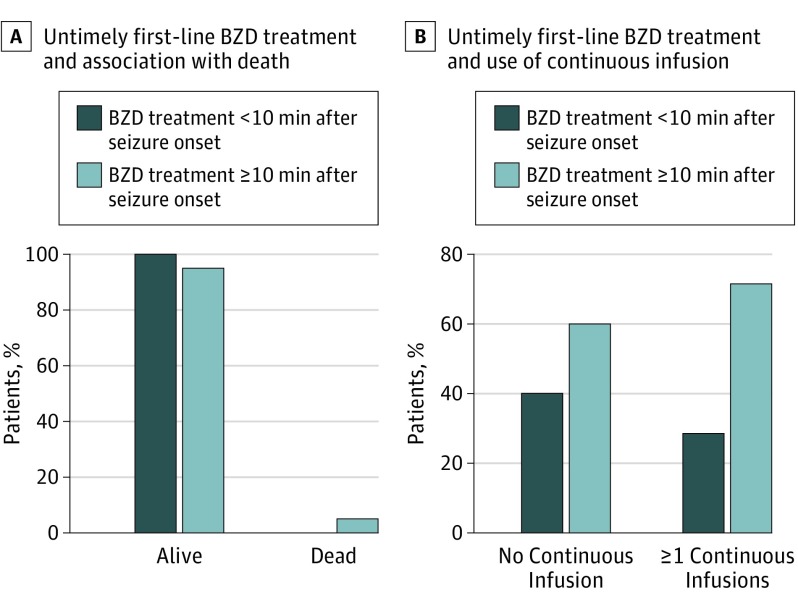
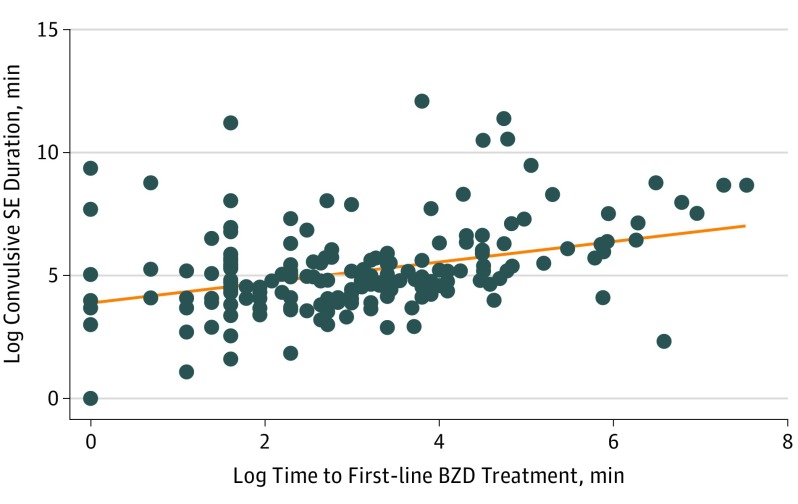
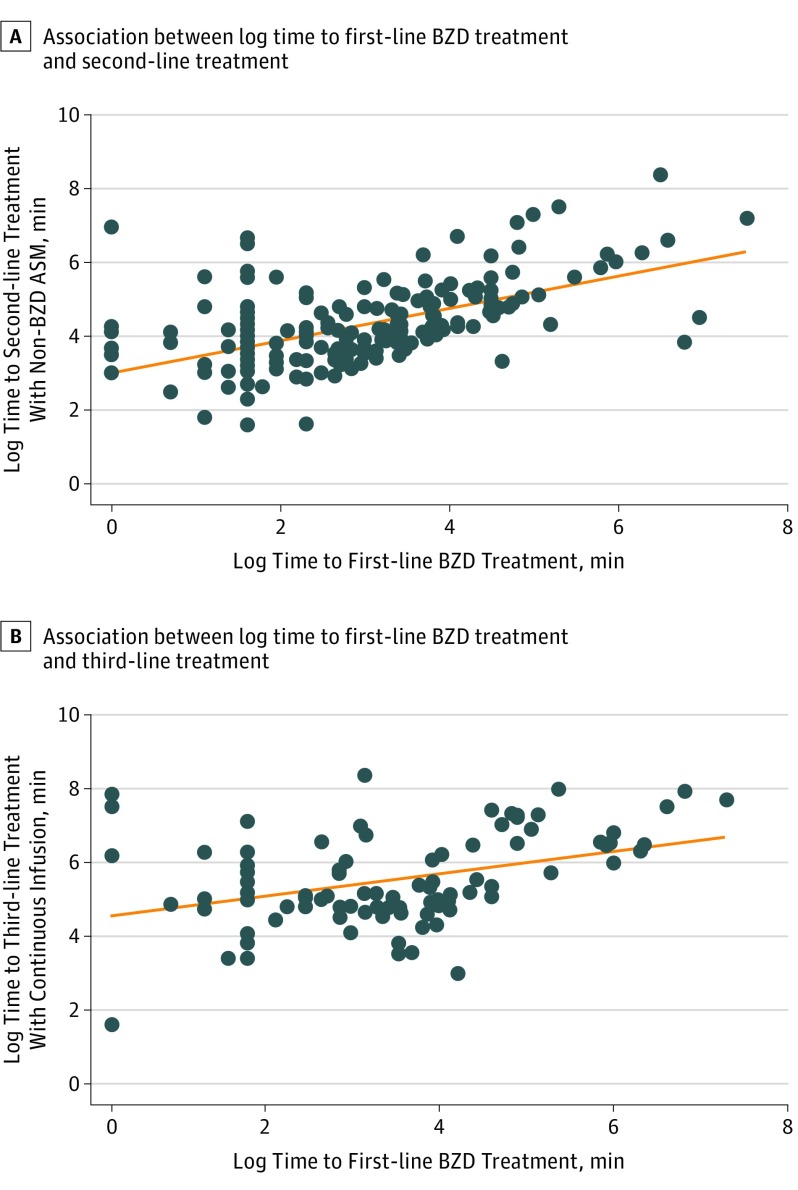
Results: A total of 218 patients were included, among whom 116 (53.2%) were male and the median (interquartile range) age was 4.0 (1.2-9.6) years. The RCSE started in the prehospital setting for 139 patients (63.8%). Seventy-four patients (33.9%) received their first-line benzodiazepine treatment in less than 10 minutes, and 144 (66.1%) received untimely first-line benzodiazepine treatment. Multivariate analysis showed that patients who received untimely first-line benzodiazepine treatment had higher odds of death (adjusted odds ratio [AOR], 11.0; 95% CI, 1.43 to ∞; P = .02), had greater odds of receiving continuous infusion (AOR, 1.8; 95% CI, 1.01-3.36; P = .047), had longer convulsive seizure duration (AOR, 2.6; 95% CI, 1.38-4.88; P = .003), and had more frequent hypotension (AOR 2.3; 95% CI, 1.16-4.63; P = .02). In addition, the timing of the first-line benzodiazepine treatment was correlated with the timing of the second-line (95% CI, 0.64-0.95; P < .001) and third-line antiseizure medications (95% CI, 0.25-0.78; P < .001).
Conclusions and relevance: Among pediatric patients with RCSE, an untimely first-line benzodiazepine treatment is independently associated with a higher frequency of death, use of continuous infusions, longer convulsion duration, and more frequent hypotension. Results of this study raise the question as to whether poor outcomes could, in part, be prevented by earlier administration of treatment.
Conflict of interest statement
Figures
Comment in
-
Time May Be of the Essence in the Treatment of Pediatric Patients With Refractory Convulsive Status Epilepticus.JAMA Neurol. 2018 Apr 1;75(4):402-403. doi: 10.1001/jamaneurol.2017.4028. JAMA Neurol. 2018. PMID: 29356824 No abstract available.
References
-
- Commission on Classification and Terminology of the International League Against Epilepsy Proposal for revised clinical and electroencephalographic classification of epileptic seizures. Epilepsia. 1981;22(4):489-501. - PubMed
-
- Chin RF, Neville BG, Peckham C, Bedford H, Wade A, Scott RC; NLSTEPSS Collaborative Group . Incidence, cause, and short-term outcome of convulsive status epilepticus in childhood: prospective population-based study. Lancet. 2006;368(9531):222-229. - PubMed
-
- DeLorenzo RJ, Hauser WA, Towne AR, et al. . A prospective, population-based epidemiologic study of status epilepticus in Richmond, Virginia. Neurology. 1996;46(4):1029-1035. - PubMed
-
- Hesdorffer DC, Logroscino G, Cascino G, Annegers JF, Hauser WA. Incidence of status epilepticus in Rochester, Minnesota, 1965-1984. Neurology. 1998;50(3):735-741. - PubMed
-
- Chin RF, Neville BG, Scott RC. A systematic review of the epidemiology of status epilepticus. Eur J Neurol. 2004;11(12):800-810. - PubMed
Publication types
MeSH terms
Substances
Grants and funding
LinkOut - more resources
Full Text Sources
Other Literature Sources
Medical