An official website of the United States government
The .gov means it’s official.
Federal government websites often end in .gov or .mil. Before
sharing sensitive information, make sure you’re on a federal
government site.
The site is secure.
The https:// ensures that you are connecting to the
official website and that any information you provide is encrypted
and transmitted securely.
1 Veterans Administration San Diego Healthcare System and Department of Anesthesiology, UCSD School of Medicine, San Diego, California.
2 Veterans Administration San Diego Healthcare System and Department of Anesthesiology, UCSD School of Medicine, San Diego, California hepatel@ucsd.edu.
1 Veterans Administration San Diego Healthcare System and Department of Anesthesiology, UCSD School of Medicine, San Diego, California.
2 Veterans Administration San Diego Healthcare System and Department of Anesthesiology, UCSD School of Medicine, San Diego, California hepatel@ucsd.edu.
Caveolins have been recognized over the past few decades as key regulators of cell physiology. They are ubiquitously expressed and regulate a number of processes that ultimately impact efficiency of cellular processes. Though not critical to life, they are central to stress adaptation in a number of organs. The following review will focus specifically on the role of caveolin in stress adaptation in the heart, brain, and eye, three organs that are susceptible to acute and chronic stress and that show as well declining function with age. In addition, we consider some novel molecular mechanisms that may account for this stress adaptation and also offer potential to drive the future of caveolin research.
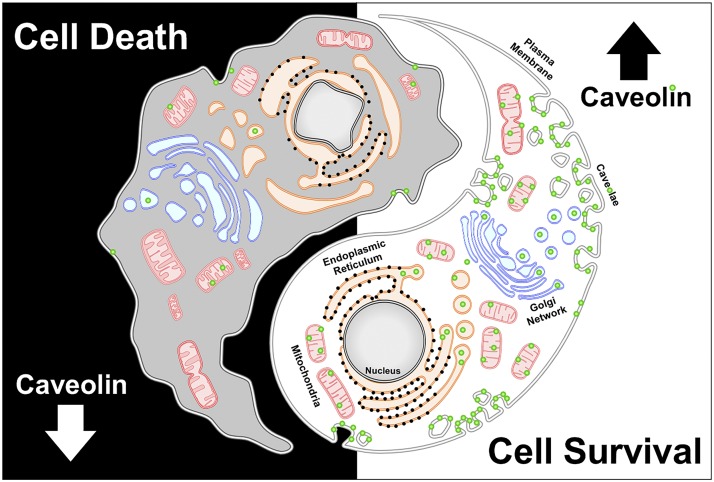
Caveolin has a critical role in maintaining cell survival via regulation of multiple…
Fig. 1.
Caveolin has a critical role in maintaining cell survival via regulation of multiple cellular sites, including the membrane and mitochondria, as well as negative aspects—loss of caveolin expression can lead to cell death.
Abbott NJ, Rönnbäck L, Hansson E. (2006) Astrocyte-endothelial interactions at the blood-brain barrier. Nat Rev Neurosci 7:41–53.
-
PubMed
Abrahams PH, Day A, Allt G. (1980) Schwann cell plasma membrane changes induced by nerve crush. A freeze-fracture study. Acta Neuropathol 50:85–90.
-
PubMed
Aga M, Bradley JM, Wanchu R, Yang YF, Acott TS, Keller KE. (2014) Differential effects of caveolin-1 and -2 knockdown on aqueous outflow and altered extracellular matrix turnover in caveolin-silenced trabecular meshwork cells. Invest Ophthalmol Vis Sci 55:5497–5509.
-
PMC
-
PubMed
Asterholm IW, Mundy DI, Weng J, Anderson RG, Scherer PE. (2012) Altered mitochondrial function and metabolic inflexibility associated with loss of caveolin-1. Cell Metab 15:171–185.
-
PMC
-
PubMed
Augustus AS, Buchanan J, Addya S, Rengo G, Pestell RG, Fortina P, Koch WJ, Bensadoun A, Abel ED, Lisanti MP. (2008a) Substrate uptake and metabolism are preserved in hypertrophic caveolin-3 knockout hearts. Am J Physiol Heart Circ Physiol 295:H657–H666.
-
PMC
-
PubMed