


Cost-effectiveness of an internet-based perioperative care programme to enhance postoperative recovery in gynaecological patients: economic evaluation alongside a stepped-wedge cluster-randomised trial
- PMID: 29358423
- PMCID: PMC5780709
- DOI: 10.1136/bmjopen-2017-017782
Cost-effectiveness of an internet-based perioperative care programme to enhance postoperative recovery in gynaecological patients: economic evaluation alongside a stepped-wedge cluster-randomised trial
Abstract
Objectives: To evaluate the cost-effectiveness and cost-utility of an internet-based perioperative care programme compared with usual care for gynaecological patients.
Design: Economic evaluation from a societal perspective alongside a stepped-wedge cluster-randomised controlled trial with 12 months of follow-up.
Setting: Secondary care, nine hospitals in the Netherlands, 2011-2014.
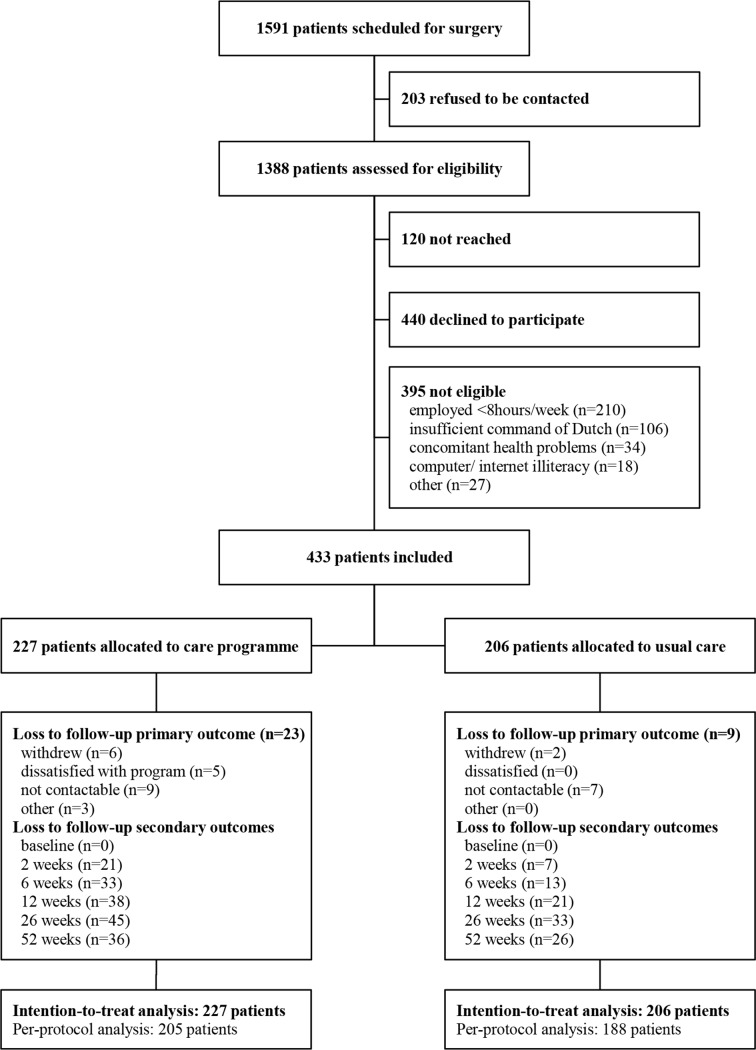
Participants: 433 employed women aged 18-65 years scheduled for a hysterectomy and/or laparoscopic adnexal surgery.
Intervention: The intervention comprised an internet-based care programme aimed at improving convalescence and preventing delayed return to work (RTW) following gynaecological surgery and was sequentially rolled out. Depending on the implementation phase of their hospital, patients were allocated to usual care (n=206) or to the intervention (n=227).
Main outcome measures: The primary outcome was duration until full sustainable RTW. Secondary outcomes were quality-adjusted life years (QALYs), health-related quality of life and recovery.
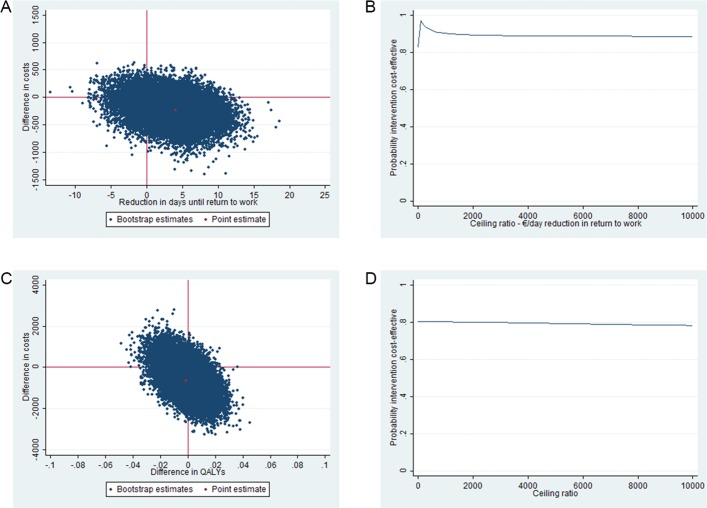
Results: At 12 months, there were no statistically significant differences in total societal costs (€-647; 95% CI €-2116 to €753) and duration until RTW (-4.1; 95% CI -10.8 to 2.6) between groups. The incremental cost-effectiveness ratio (ICER) for RTW was 56; each day earlier RTW in the intervention group was associated with cost savings of €56 compared with usual care. The probability of the intervention being cost-effective was 0.79 at a willingness-to-pay (WTP) of €0 per day earlier RTW, which increased to 0.97 at a WTP of €76 per day earlier RTW. The difference in QALYs gained over 12 months between the groups was clinically irrelevant resulting in a low probability of cost-effectiveness for QALYs.
Conclusions: Considering that on average the costs of a day of sickness absence are €230, the care programme is considered cost-effective in comparison with usual care for duration until sustainable RTW after gynaecological surgery for benign disease. Future research should indicate whether widespread implementation of this care programme has the potential to reduce societal costs associated with gynaecological surgery.
Trial registration number: NTR2933; Results.
Keywords: gynaecology; health economics; minimally invasive surgery; organisation of health services; telemedicine.
© Article author(s) (or their employer(s) unless otherwise stated in the text of the article) 2018. All rights reserved. No commercial use is permitted unless otherwise expressly granted.
Conflict of interest statement
Competing interests: JRA reports a chair in Insurance Medicine paid by the Dutch Social Security Agency, and he is a stockholder of Evalua. JAFH reports grants from Samsung, Gideon Richter and Celonova outside the submitted work. HAMB reports grants from Olympus and personal fees from Nordic Farma during the conduct of the study. JRA and JAFH are planning to set up a spin-off company concerning the implementation of a mobile application concerning the ikherstel intervention in the Netherlands.
Figures
References
-
- Cox H. Recovery from gynaecological day surgery: are we underestimating the process. Ambul Surg 2003;10:114–21. 10.1016/S0966-6532(03)00007-6 - DOI
Publication types
MeSH terms
LinkOut - more resources
Full Text Sources
Medical
